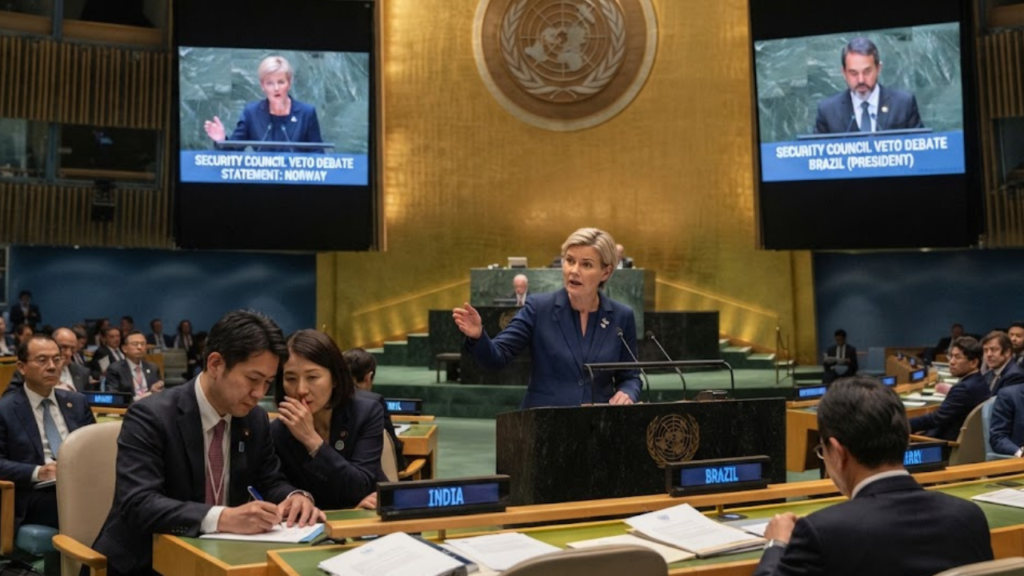
The General Assembly veto debate held on Thursday, October 1, put on the record why China and Russia blocked a US-drafted Security Council resolution that would have renewed a panel of experts monitoring sanctions on Iran. The vote took place on September 17, and the Assembly met within the 10 working days its own rules require. The debate cannot reverse the veto, but it exposes a deeper split over whether those sanctions are in force at all.
The draft would have extended the panel’s mandate for one year and drew 11 votes in favour, two against and two abstentions. Pakistan and Somalia abstained. The panel was authorised a year ago, but according to the Associated Press the members proposed by Secretary-General Antonio Guterres were never approved, so the vetoed text would have renewed a body that was never fully in place.
Why the General Assembly veto debate turned on a legal dispute
At the centre is the “snapback” clause of the 2015 nuclear deal with Iran, which lets sanctions return automatically if Iran is judged non-compliant. France, Germany and the United Kingdom triggered it, and the United States told the Assembly that the UN’s own sanctions website shows the measures were reapplied on September 27, 2025. That restored the Iran sanctions committee and authorised its expert panel.
Russia and China reject that reading. Russia’s representative said the Council finished its Iran nuclear file on October 18, 2025, the day resolution 2231 expired, so the draft “simply lacks the legal basis.” China’s deputy envoy, Sun Lei, said the impasse stems from the US withdrawal from the 2015 deal, its “maximum pressure” campaign and two rounds of strikes on Iran during negotiations. Iran called the vetoes principled and the sanctions committee illegitimate.
What speakers said for and against the panel
The Assembly’s president, Khalilur Rahman of Bangladesh, urged delegations to use the session to clarify positions and find a constructive way forward. Finland, speaking for the Nordic states, described the panel as the eyes and ears of the Council and wider membership on Iran’s nuclear programme. The Netherlands, for the Benelux countries, called abolishing the mandate reckless, while the European Union, South Korea and Bahrain also backed independent monitoring.
Israel’s representative cited International Atomic Energy Agency findings that more than nine tonnes of nuclear material, including 440 kilograms of highly enriched uranium, remain outside the agency’s safeguards. Iran rejects the claim that its programme has military aims. Those figures were presented by Israel in the debate and have not been independently tested in the reporting reviewed here.
Ukraine’s envoy tied the vote to Russia’s March 2024 veto, which ended 14 years of UN expert monitoring of North Korea sanctions. South Africa said the veto initiative reflects a principle in the UN Charter: the Council acts for all member states and is accountable to them. The US ambassador, Mike Waltz, said Washington would keep pressing for a panel of experts while advancing an independent multilateral body to monitor compliance.
What the veto changes and what it leaves in place
The vetoes did not cancel the sanctions, according to Britain’s ambassador, Sarah MacIntosh, and Western governments treat them as binding. Russia, China and Iran say they ended. What the veto did remove is a route to impartial, evidence-based reporting on violations, which Jennifer Locetta, speaking for the US at the Council vote, warned would leave a monitoring gap that benefits Iran and those who help it evade restrictions.
Russia’s ambassador, Vassily Nebenzia, rejected that framing and repeated that the snapback was illegal. France has said it will study how to keep enforcement going, and the AP reported that one option is a monitoring team of willing states, as happened after the North Korea panel was abolished. Nothing of that kind had been announced when this was written.
What the veto initiative can and cannot do
The veto initiative dates to 2022 and was designed to answer a long-standing complaint: the five permanent Council members can block action with no obligation to explain it. It does not override a veto. It guarantees a public debate in the 193-member Assembly, where no state holds a veto. The first such debate, in May 2022, also followed a China-Russia veto of a US draft on North Korea sanctions.
The debate produced no binding outcome and settled none of the main disputes. Whether UN sanctions on Iran are in force, who will monitor compliance, and whether any new monitoring body can work without Security Council backing all remain open. HCN will update this story as verified facts emerge.