
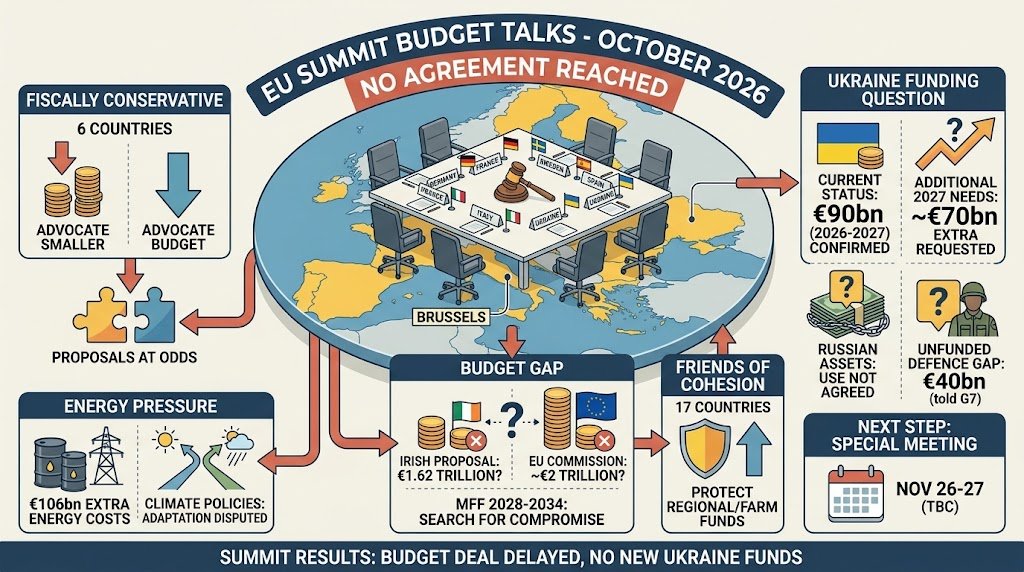
The EU summit budget deal that leaders hoped to reach in Brussels did not materialise. The two-day European Council ended on Friday, October 16 without agreement on the bloc’s 2028–2034 budget, and without new financial commitments for Ukraine. Leaders restated the aim of a deal before the end of 2026 and scheduled a special budget meeting for November 26.
The failure does not cancel money already promised. The EU has agreed a €90 billion loan for Ukraine covering 2026 and 2027, EUalive reported, while the new seven-year budget would only take effect in January 2028. Still, the summit showed how stretched European finances are, with security and energy costs competing against farm, regional and research spending.
Why the EU summit budget deal stalled
The Irish presidency’s revised proposal of €1.62 trillion was effectively set aside, EUalive reported. Fakti.bg said that figure was €141 billion below the European Commission’s initial proposal, while Xinhua described the Commission’s plan as nearly €2 trillion. The reports do not explain the gap between those numbers, so HCN treats them as proposals that may rest on different bases.
Net contributors pushed back hard. Swedish Prime Minister Ulf Kristersson said the proposal was “too big and too expensive,” Fakti.bg reported, and German Chancellor Friedrich Merz called for a significant reduction. Merz warned of “very, very difficult negotiations,” according to bne IntelliNews.
The think tank Bruegel, cited by Xinhua, describes two camps. Six fiscally conservative countries led by Germany favour a smaller budget, while 17 “Friends of Cohesion”, including Italy and Spain, want to protect agricultural subsidies and regional development funds. New EU revenue sources, including ideas for pan-European taxes, also remain contested, Fakti.bg reported.
European Council President António Costa now has to steer a compromise. Leaders want an agreement by the end of 2026 so programmes can start without interruption in January 2028. Several capitals signalled little urgency, EUalive reported, so the year-end target is not guaranteed.
What the EU summit budget deal means for Ukraine
President Volodymyr Zelenskyy attended and asked for an additional €70 billion for 2027, EUalive reported. He said the war would cost around €155 billion that year and that the existing €90 billion loan would not cover the gap. Leaders reaffirmed support and asked the Commission to prepare a proposal on Ukraine’s extra 2027 needs, but made no funding decision.
The summit also left unresolved how to use immobilised Russian assets and how to share the burden among member states. bne IntelliNews reported that most EU leaders remain opposed to confiscating the assets, citing legal risks and concerns about trust in the euro. These are reported positions, and the Council has not published a decision on the matter.
A separate figure comes from bne IntelliNews, which reported that Kyiv told the G7 that €40 billion of its 2027 defence needs is unfunded. The same report said Ukraine has so far received about a third of the budget aid it expected this year. That figure measures an unfunded defence gap, not total extra financing, so it should not be compared directly with the €70 billion request.
The budget impasse and Ukraine’s 2027 shortfall are separate files, but they draw on the same political will. Any 2027 support beyond the loan will need its own decision. If talks drag on, Ukrainian energy and defence planning could face more uncertainty, though that is a possible effect, not a confirmed one.
Energy bills and other pressures behind the EU summit budget deal
Energy costs added to the strain. European Commission President Ursula von der Leyen said the Middle East conflict has added €106 billion to the EU’s fossil fuel import bill, Xinhua reported. Leaders discussed temporary measures on high energy prices, but talks on the first day ended without conclusions, according to Fakti.bg and bne IntelliNews.
Leaders also disagreed over how far to adjust climate policies to ease immediate costs, Xinhua reported. Their conclusions expressed regret at the United States’ temporary easing of certain sanctions on Russian diesel, EUalive reported. Ordinary households and farmers are the groups most exposed to these debates, though the summit set no concrete relief.
What happens next after the EU summit budget deal failure
The next confirmed step is the special budget meeting on November 26. The EU leaders’ agenda lists it as a special European Council on November 26–27, with the date marked as to be confirmed. Another regular European Council is listed for December 17–18, where the budget is again on the agenda.
The Commission is also expected to prepare a proposal on Ukraine’s additional 2027 financing. It remains unclear whether any such money would come from the common budget, joint borrowing or national contributions. Follow developing coverage at Human Crisis News.