
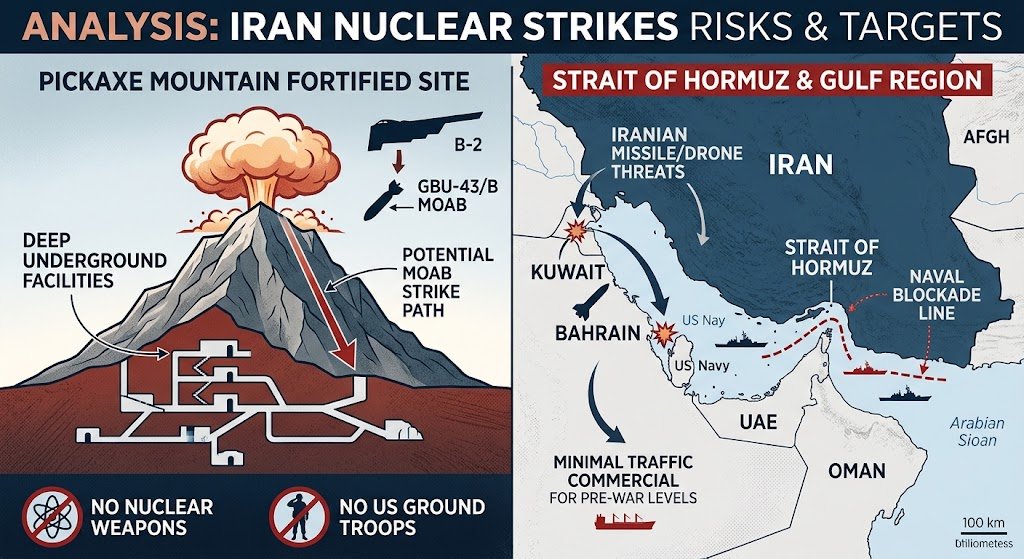
Possible Iran nuclear strikes returned to the centre of US policy this week after President Donald Trump said Washington may have to target Pickaxe Mountain, a fortified underground site linked to Iran’s nuclear programme. He made the remarks in an interview with Newsmax on Thursday, October 15. He ruled out using nuclear weapons and said he did not foresee deploying US ground troops.
His comments outlined a possible attack, not a new military operation. No strike has been announced, and Trump did not say whether any specific weapon had been authorised. The remarks come while talks with Tehran remain stalled and a US blockade of Iranian ports stays in place, nearly eight months after the war began on February 28.
What Trump said about possible Iran nuclear strikes
“Now we’re looking at Pickaxe Mountain. We may have to go there,” Trump said, according to Reuters reporting carried by Eurasia Review. He added that the United States wants to stop Iran from obtaining a nuclear weapon. Reuters described the site as lying deep underground near one of Iran’s main nuclear facilities.
His public position on what Iran has hidden there has been less settled. In July, Axios reported, Trump said the US thinks Iran may have stored centrifuges at the site but that officials did not have that on record. He also argued the question matters little unless Iran has the nuclear material, which he said it does not.
The CNN report and what remains unverified
The wider debate over Iran nuclear strikes rests partly on a CNN report published on Thursday. Citing US officials, CNN said the military has drawn up options using the GBU-43/B Massive Ordnance Air Blast bomb, the largest non-nuclear bomb in the US arsenal. Reuters said it could not independently verify the report.
The options reportedly cover Iranian energy infrastructure and nuclear sites, including Pickaxe Mountain, and would apply if Trump orders combat to resume. Officials also questioned whether the weapon could penetrate deeply buried facilities, CNN reported. Trump said earlier this month the US would not attack before the November 3 midterm elections, while the CNN sources described plans that could proceed before or after them.
How the standoff reached this point
The war began on February 28 with US and Israeli strikes on Iran, and Iran effectively closed the Strait of Hormuz, a route that carried about one fifth of global crude oil, according to Jordan News. A Pakistan-brokered ceasefire followed in April. On June 17, Trump signed a memorandum of understanding that opened a 60-day window for talks, as described by the US Institute of Peace.
Under that memorandum, Iran committed to safe passage through Hormuz and reaffirmed it would not develop nuclear weapons, while the US agreed to lift its naval blockade. The deal then unravelled amid renewed strikes and disputes over the strait. The 60-day window expired in August without a final agreement, and the US restored its blockade.
Military action has largely halted in recent weeks, CBS News reported earlier this month. Iran has proposed a seven-day plan to restart nuclear talks and reopen Hormuz in phases. Foreign Minister Abbas Araghchi said this week that Tehran was reviewing the US response and expected to reply within days.
What is known about Iran’s nuclear material
The International Atomic Energy Agency (IAEA) has not been able to verify Iran’s stockpile since the 2025 war. Earlier this year, IAEA chief Rafael Grossi cited an estimated 440.9 kilograms of uranium enriched up to 60%, which the agency says would be enough for about 10 bombs if enriched further. Iran denies seeking a nuclear weapon and says its programme is peaceful.
In June, the Associated Press reported that both Iran and the IAEA said enrichment had stopped. Nonproliferation experts, however, worried that material might have been moved to undeclared locations. HCN could not confirm the current state of inspections after the memorandum collapsed, so the location and condition of the stockpile remain open questions.
Who is affected by the escalating risk
Any new Iran nuclear strikes would also carry risks beyond the battlefield. Commercial shipping and energy markets are the most direct documented exposure. Traffic through Hormuz has fallen to a small fraction of pre-war levels, Fast Company reported, and the Washington Examiner described it as still reduced.
Higher risks to tankers raise costs for fuel importers far from the region. Gulf states have already been targets: the US military said in June that it intercepted Iranian missiles and drones aimed at Kuwait and Bahrain. Further strikes could prompt retaliation against US forces and neighbouring countries, though that is a possibility, not a certainty. The humanitarian cost of any new strike has not been assessed publicly.
Reports of missile and drone incidents also need caution. Gulf News reported in August that claims of a tanker hit near Oman circulated on social media but had not been confirmed by official maritime authorities. HCN has not independently verified any recent missile or drone incident.
What to watch next
The key question is whether Iran nuclear strikes move from planning to orders. The next confirmed step is Iran’s formal reply to the US response on resuming talks, which Araghchi said could come within days. After that, attention turns to whether IAEA inspectors regain access to the struck sites and whether the November 3 midterms change the timing. Follow developing coverage at Human Crisis News.