
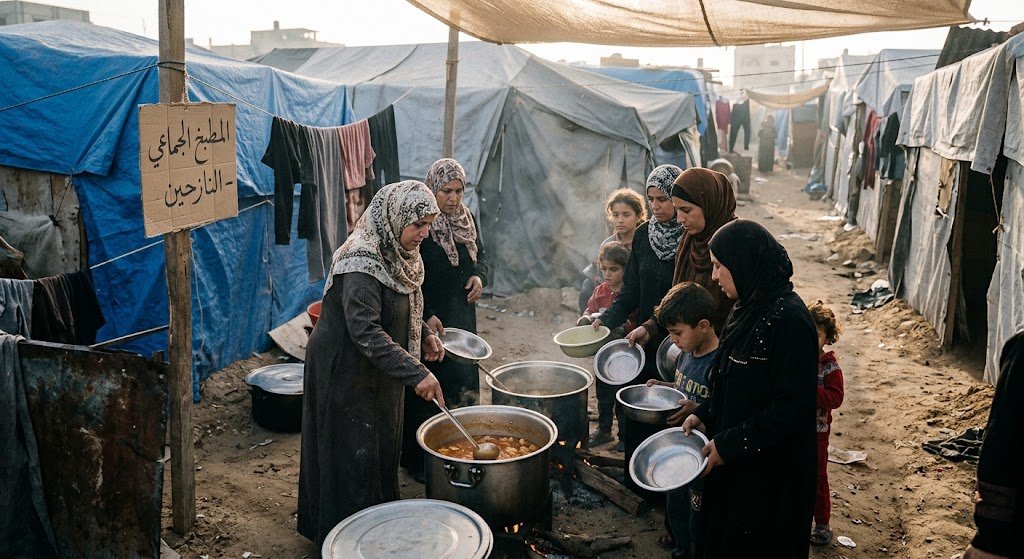
The Gaza commercial goods halt, announced by Israel on Wednesday, October 14, had left the territory without private-sector shipments for two days as of Thursday. The suspension cuts off fresh food, fruit and winter clothing for a population of roughly 2 million people who already depend heavily on aid. Humanitarian deliveries are still entering Gaza, but the dispute over who actually stopped the commercial channel has not been settled.
Israeli authorities blame a tax dispute involving Hamas. Gaza’s traders say Israel imposed the restriction. UNICEF warns that recent progress against child malnutrition could be lost.
Two accounts of why the shipments stopped
COGAT, the Israeli military body that oversees civilian and humanitarian affairs in Gaza, says the merchants made the decision themselves. In its account, importers stopped coordinating with Israel after the Hamas-run authorities imposed a fee of 10,000 shekels, about $3,200, on every truck entering Gaza and demanded that 30 percent of all sales be made in cash. Al Jazeera’s report on the announcement sets out those claims in detail. COGAT adds that no private importers have tried to bring in goods since the merchants told Israel of their decision on Tuesday.
Palestinian traders reject that version. Nahed Sheheiber, head of Gaza’s private truckers’ union, told reporters the merchants did not halt anything and that Israel imposed the restriction. He said his union met Gaza’s Ministry of Economy after the announcement and told officials it believed Israel was using the ministry’s fees as a pretext.
The fee itself is not in dispute, because Sheheiber also said the ministry had been asking merchants for 10,000 shekels a truck. What is contested is the cause: did the fee prompt a voluntary boycott, or did it hand Israel a reason to block the trucks? HCN has not been able to verify either account independently.
Why the Gaza commercial goods halt matters for food supply
Aid agencies and private merchants bring in different things. According to COGAT data released earlier this year, aid groups mostly deliver staples such as flour, while merchants import perishable foods like fruit and meat. Without the commercial route, families lose much of the variety in what they can buy, along with seasonal items such as warm clothing.
The size of the loss is hard to pin down because the truck numbers conflict. COGAT says the halt will cut total daily truck entries, aid and commercial combined, to about 300, or half the usual level. Sheheiber says entries were already close to 300 a day, with roughly two-thirds carrying commercial goods. COGAT also says Gaza needs around 250 truckloads a day, well under the 600-truck daily minimum in the US-brokered ceasefire. Israel says that minimum applies to humanitarian aid and that commercial goods are meant to add to it. These figures measure different things over different periods, so they cannot be compared directly.
What it means for families
For ordinary households, the risk is a thinner, more expensive food supply just as the weather turns cold. Aid workers told reporters that humanitarian deliveries alone cannot keep people adequately fed or keep prices stable. That is a warning, not a measured result, and HCN found no verified price data covering the days since the halt began.
The warning lands on a fragile situation. The world’s leading food-security monitor reported earlier this year that conditions had improved since famine was declared in Gaza in August 2025, but were still at crisis levels. It cautioned that even small disruptions to access could quickly reverse those gains. A separate hunger assessment in July warned that more than two-thirds of Gaza’s people could face acute hunger by the end of the year.
On Friday, UNICEF said progress against malnutrition remains fragile. Its spokesperson, Ricardo Pires, told reporters in Geneva that both commercial and humanitarian supplies need to flow predictably and without interruption, and the agency urged that all crossings stay open. Gaza’s merchants and transport workers also face lost income, whichever side’s account proves correct.
What to watch next
Several questions are still open: whether Gaza’s authorities will change the fee, whether Israel will resume coordination with merchants, and how long the suspension will last. Daily truck counts from UN agencies and COGAT will show whether aid volumes can make up for the missing commercial supply. The next UN food-security update should indicate whether prices and access are shifting on the ground.