
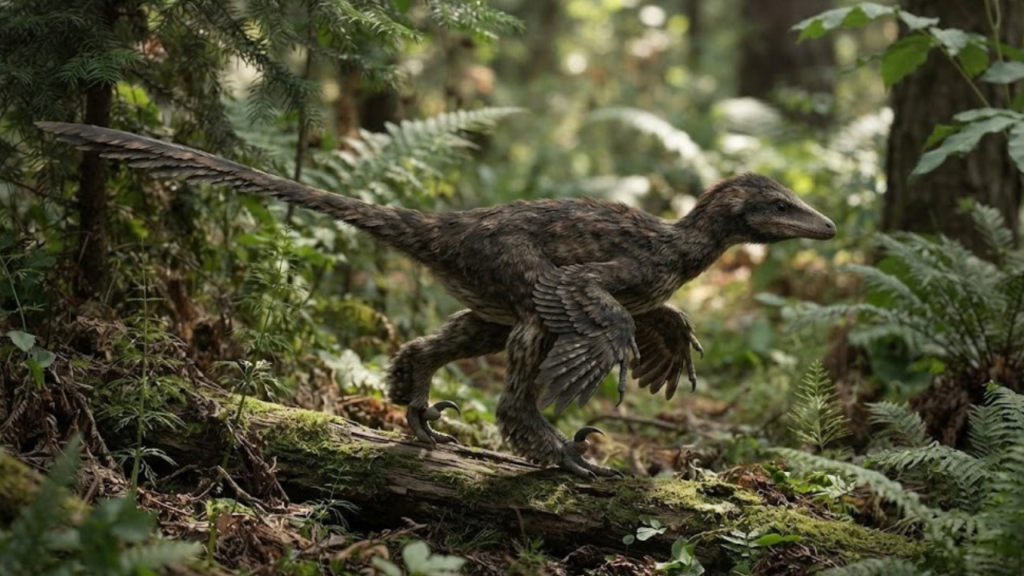
A fossil picked up by a farmer in western Liaoning has been named Norellraptor barsboldi, a new feathered dinosaur described in a study published in Nature Communications on 29 September 2026. The 57-centimetre skeleton belongs to the microraptorines, small bird-like dinosaurs whose feathered limbs have long fuelled a debate over whether flight evolved once or several times.
The authors say Norellraptor barsboldi supports the second answer, though their case rests on a single specimen and a preliminary bone analysis. The skeleton is complete, and it adds a new name to a group that Discover Wildlife notes may contain more than a dozen genera.
How a Farmer’s Find Became Norellraptor barsboldi
The specimen was found near Lamadong Town in Jianchang County and donated in 2023 to the museum of Hebei GEO University, the paper says. The donor asked to remain anonymous. The researchers state that they checked the fossil’s origin and integrity, and that its almost undisturbed skeleton shows microraptorine traits in every region of the body.
The rock unit is the Jiufotang Formation, part of the Lower Cretaceous record in Liaoning. Traces of feathers survive beside the right upper arm, along the tail and around the right lower leg. The authors caution that the exact length and shape of the plumage are hard to establish because the preservation is poor.
The name honours two paleontologists who both died in 2025: Mark Norell of the United States and Rinchen Barsbold of Mongolia, each known for work on bird-like dinosaurs. The genus name pairs Norell’s surname with the Latin word for robber, a common ending among dromaeosaurids, the family of raptor-like dinosaurs to which this animal belongs.
What the Forearm Bone Says About the Animal’s Age
A thin slice cut from the left forearm bone gave the team a growth record, much as tree rings do for a tree. Two pauses in bone growth, plus the start of a third layer, point to at least two years of life; the authors’ more cautious reading is that the animal was at least three years old when it died.
They place it at a late-juvenile or post-juvenile stage, and note an unusual mix of fast and slow growth that might reflect an unknown health problem. The authors themselves describe the bone evidence as preliminary, so it is best read as a first look rather than a firm growth model for the whole group.
Why a Small Dinosaur Matters for the Origin of Flight
Microraptorines belong to Paraves, the wider group that includes birds. Several of them show traits linked to life in the air, such as shortened finger bones and fused wrist bones. Researchers have long argued over whether those traits came from an ancestor shared with birds or arose separately. Norellraptor barsboldi is not the first so-called four-winged dinosaur; a 2003 Nature paper used that label for Microraptor.
The flight question is not limited to dinosaurs. A separate Nature study, published on 23 September, placed the origin of bats in Europe about 65 million years ago; bats are the only mammals capable of powered flight, and that work also found flight arose near the start of their lineage.
To test which explanation fits, the team mapped 194 anatomical changes along the microraptorine family tree. About 30 percent of them, 57 in all, also appeared independently in the bird lineage. But the order differs: in microraptorines the finger bones shortened first, at the base of the group, while a fused wrist, an opening in the upper-arm crest and a longer breastbone came later.
Birds followed the reverse sequence, acquiring those wrist and breastbone changes before the finger shortening. A statistical comparison found no significant correlation between the two orders. The authors conclude that the two lineages did not follow one shared developmental pattern and point instead to separate selective pressures on each.
What the Norellraptor barsboldi Study Cannot Yet Settle
Some coverage has leaned on the four-wing label, but the fossil itself is more modest: feather traces survive on the arm, tail and lower leg, yet their detail is limited. Findings also come from the describing team alone; no independent response had appeared in published coverage when this report was written.
The team’s own family tree also puts two groups of bird-like dinosaurs, the halszkaraptorines and unenlagiines, closer to birds than dromaeosaurids and troodontids. That result cuts against several earlier studies. The authors argue it also calls into question how directly microraptorine flight traits explain the origin of bird flight.
The Norellraptor barsboldi fossil is housed at the Hebei GEO University museum and can be accessed by contacting Qiang Ji, and the phylogenetic data are public, so other researchers can test the claims. What remains unresolved is whether other microraptorines, especially ones with better-preserved feathers and bone samples from more limbs, will show the same sequence. HCN will update this report as expert responses emerge.