
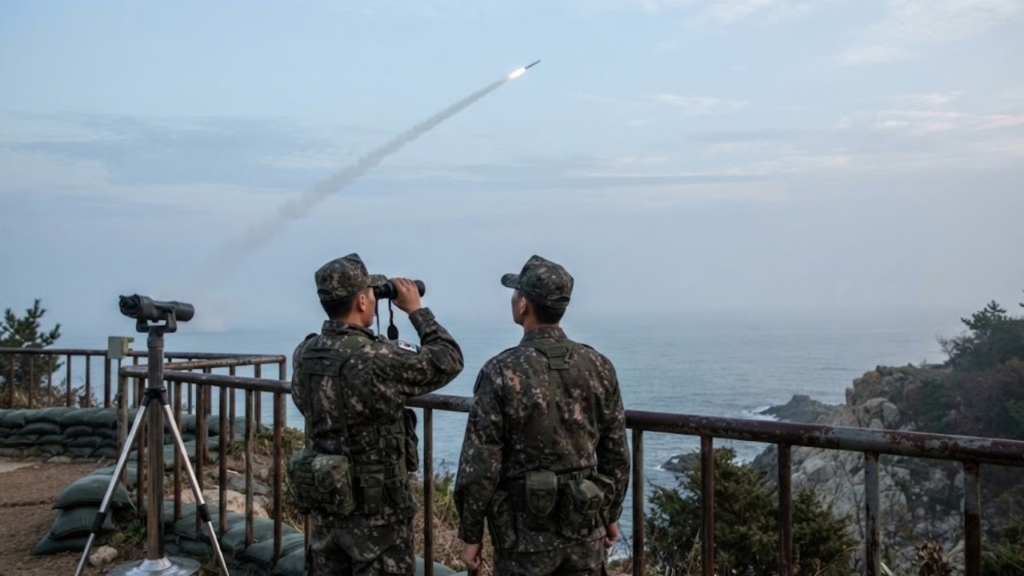
South Korea’s military said a North Korea ballistic missile launched from the Wonsan area early Saturday flew more than 700 kilometres (435 miles) before landing at sea. The Joint Chiefs of Staff detected the launch at about 6:30 a.m. local time on October 3 and has since tightened surveillance in case further launches follow.
Seoul has not said what kind of North Korea ballistic missile it was. The Joint Chiefs said they were analysing its specifications with US authorities, and Yonhap news agency reported that the military was weighing a medium-range or intermediate-range type. One South Korean government source told Yonhap it may have been an intermediate-range missile fired at reduced range, a reading that has not been officially confirmed.
What South Korea and Japan have said about the launch
In its notice, the Joint Chiefs said South Korean and US intelligence agencies tracked the missile from the early stage of flight and passed details to Japan. The military said it was keeping a robust combined defence posture with Washington and the readiness to respond decisively to any provocation. HCN had found no separate US government statement when this was written.
Japan’s Defense Ministry gave a slightly different account: a launch at around 6:36 a.m., a flight of about 680 kilometres, and a landing outside Japan’s exclusive economic zone, the sea area reaching 200 nautical miles from its coast. No damage to aircraft or vessels had been confirmed. Tokyo lodged a stern protest, saying the launch breaches UN Security Council resolutions. Neither government has explained the gap between 680 and 700 kilometres.
Prime Minister Takaichi Sanae told officials to gather and analyse information, release updates quickly and protect the safety of aircraft and ships. She gave the instructions immediately after the launch, Japanese officials said. An emergency response team drawn from several ministries met at the crisis management centre in the prime minister’s office.
In Seoul, the national security office at the presidential compound, known as Cheong Wa Dae, held an emergency meeting with defence ministry and military officials. Its statement said repeated launches violate UN Security Council resolutions and urged Pyongyang to stop. It also called for a fresh look at South Korea’s readiness after both the launch and the recent land-mine explosion in the Demilitarized Zone.
How a border mine blast and earlier launches set the scene
The launch came 13 days after North Korea fired two short-range ballistic missiles from the same Wonsan area within hours of each other on September 20. The next day, a land-mine blast inside the Demilitarized Zone injured three South Korean soldiers, two of them seriously. South Korea’s military blames North Korea, calls it a violation of the Korean War armistice, and has demanded an apology and an end to border fortification work.
Pyongyang denies involvement. Kim Yo-jong, the sister of leader Kim Jong Un, said in a statement on Wednesday that Seoul had fabricated its findings, and she warned of “merciless” retaliation if the South takes corresponding action. On Friday she repeated the denial, mocked President Lee Jae Myung’s pledge to reduce military tensions, and dismissed Unification Minister Chung Dong-young’s offer of talks on clarifying the Military Demarcation Line, which Chung had tied to the line’s fading visibility.
A government source in Seoul said the missile appears similar to one North Korea fired from Wonsan on August 12, in what Yonhap described as an apparent protest against the annual Ulchi Freedom Shield, a joint US–South Korean military exercise. Seoul never disclosed that missile’s specifications, and the idea that it was a reduced-range medium- or intermediate-range test remains speculation.
Why the type of North Korea ballistic missile matters
UN Security Council resolutions bar North Korea from ballistic missile launches of any range, a restriction Pyongyang has long rejected, and both Seoul and Tokyo cited those resolutions in their reactions. Missile class also shapes how Seoul, Tokyo and Washington read a test.
Yonhap gives the usual ranges as 1,000 to 3,000 kilometres for medium-range missiles and 3,000 to 5,500 kilometres for intermediate-range ones. A flight of roughly 700 kilometres therefore says little about the maximum range of a North Korea ballistic missile on its own, because a missile can be flown on a shorter path than it is built for. That is why the specifications review matters.
What is still unresolved
Several basic points are open. The missile’s type and designed range are unconfirmed, and no North Korean statement on the launch had been reported when this was written. State media released images of the September 20 test two days after it took place, so Pyongyang’s own account may not arrive quickly.
What Seoul does next is also unclear, since the mine-blast dispute has produced no dialogue and Pyongyang has rejected the proposal for talks. HCN will update this North Korea ballistic missile report as the specifications, any North Korean statement and further official responses are confirmed. HCN has also covered a separate flashpoint, the Kaliningrad nuclear warning involving Russia and NATO.