
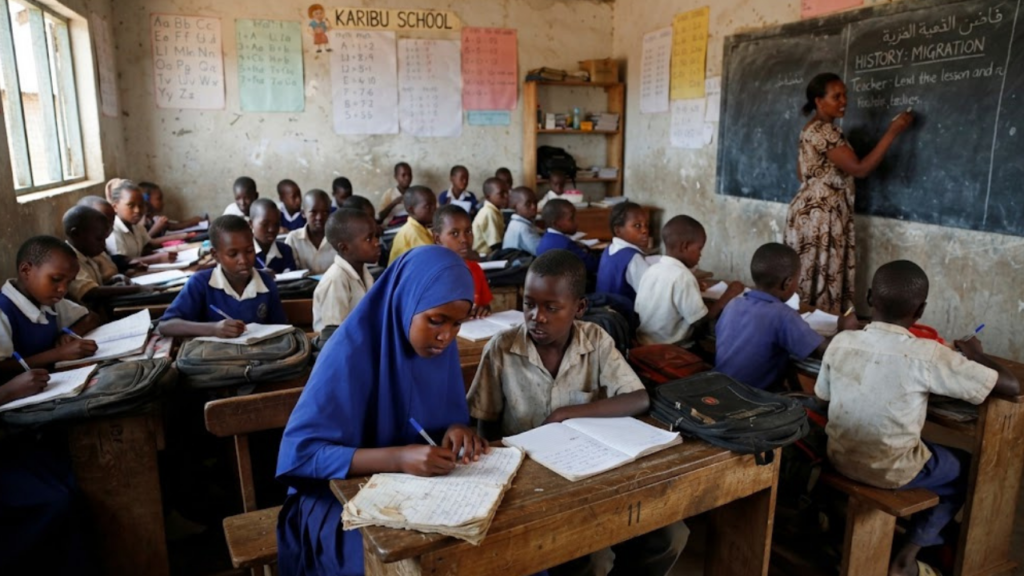
The number of refugee children out of school worldwide stood at 5.8 million in 2025, according to a new UNHCR report that warns shrinking aid budgets could shut millions more out of classrooms. The UN refugee agency says that is 44 per cent of the 13.1 million refugee children of school age.
What the new UNHCR report says
The annual report, titled Pathways to the Future: Education, Opportunity and Self-Reliance, was published on Friday 2 October. UN High Commissioner for Refugees Barham Salih, who spent years as a refugee himself, said education gave him opportunities that displacement might have denied, and summed it up as “Education is protection.”
UNHCR is asking international partners and development agencies to safeguard education funding and to invest in the national school systems of countries that host refugees. The request matters because host countries often face their own resource limits, which UNHCR said last year makes including refugee children in national schools difficult.
Last year’s edition offers a point of comparison. In September 2025, UNHCR estimated 12.4 million school-aged refugees, with 46 per cent, or about 5.7 million, out of school. On those headline figures the share has fallen two points while the count has edged up by roughly 100,000, because the school-aged population grew. UNHCR may have revised earlier estimates, so the comparison is indicative.
Refugee children out of school: where the drop-off begins
Enrolment falls sharply as children grow older. UNHCR says 65 per cent of primary-age refugee children were in primary education in 2025, but only 32 per cent were enrolled in secondary education. Coverage of the report describes that transition as a critical hurdle for refugee learners.
Girls and boys attend primary school at broadly similar rates, the agency says, but the gap widens in secondary school as poverty, protection risks, early marriage and other pressures push more adolescent girls out of class. Those are UNHCR’s own explanations for the divide.
Higher education: wide gaps between refugees and nationals
UNHCR reports that in more than 80 per cent of reporting countries, refugee enrolment in higher education was below the national average last year. In low-income and conflict-affected countries, just 2 per cent of refugees were enrolled, against 13 per cent of nationals.
A year earlier, the agency put global refugee enrolment in higher education at 9 per cent, up from 7 per cent, against a 2030 target of 15 per cent. UNHCR says higher education can be especially transformative for refugee women and girls, opening access to skills, qualifications and work.
Funding falls while the school-age refugee population grows
The education report does not stand alone. In a separate report, Protection Eroded, released days earlier, UNHCR said available funding fell from $5.178 billion to $3.932 billion between 2024 and 2025. Dominique Hyde, the agency’s Director of External Relations, warned that when registration, safe houses or child protection services stop, the violence, exploitation and abuse people fled can return.
The distinction matters: the 5.8 million figure describes 2025, while the warning about cuts looks forward. UNHCR presents reduced funding as a threat to continued progress, not as the cause of last year’s numbers. Whether 2026 budgets push enrolment into reverse will only show in later data.
In Egypt, aid shortfalls already force families to choose
The pressure is already visible in host countries. In May, UN News reported that Sudanese refugees in Egypt faced the possible loss of critical services, with UNHCR cash assistance of about 1,530 Egyptian pounds, or roughly $29, a month already described as not enough. That reporting predates and is separate from the new education report.
One widowed mother described in the account had enrolled only three of her six children in school, and her eldest son had left class to look after his siblings while she worked. According to the account, most families receiving the cash support are headed by women with school-aged children, so when aid stops a mother may have to choose between feeding her children and sending them to school.
What is still unresolved
Several questions remain open. UNHCR’s data covers the 2025 school year, so the effect of this year’s budget reductions on enrolment has not yet been measured, and HCN found no announced donor commitments tied to the report at the time of writing.
It also remains unclear how far host governments, many of which face their own resource limits, can absorb more refugee pupils without added support. HCN will update this story as UNHCR releases further country-level data and as donors respond.