
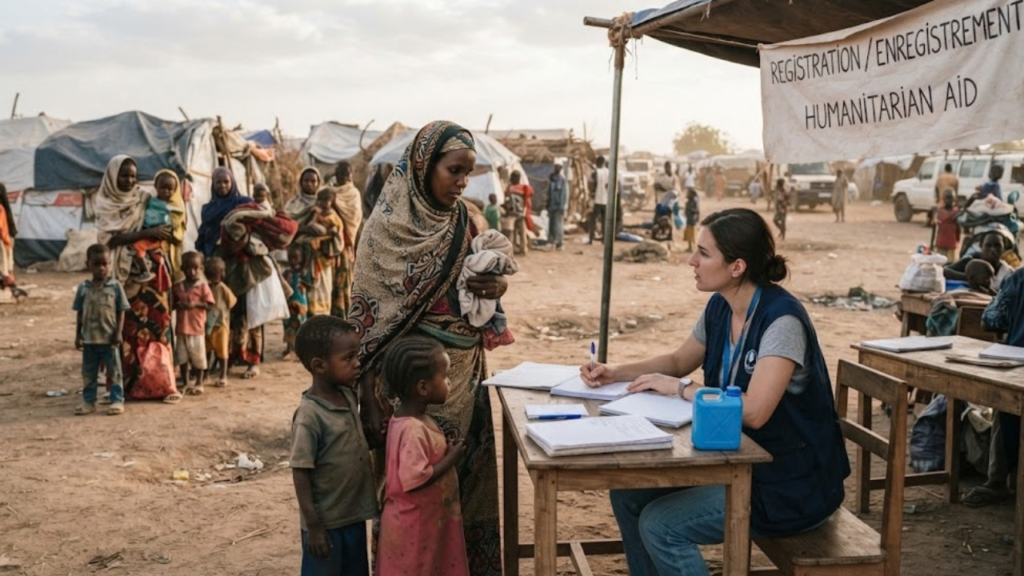
The UNHCR funding shortfall has left nearly 8.3 million refugees and other forcibly displaced or stateless people at risk of losing access to assistance this year, the United Nations refugee agency said on 29 September. UNHCR faces a gap of $5.789 billion against a 2026 requirement of $8.505 billion, and by the end of July it had received only 32% of that sum, roughly $2.7 billion. The warning comes in a 26-page report, “Protection Eroded: The Human Cost of Underfunding,” published in Geneva. The 8.3 million figure is UNHCR’s own estimate of people exposed to losing help, not a count of those who have already lost it.
How the UNHCR funding shortfall grew
Money available to the agency fell from $5.2 billion in 2024 to $3.9 billion in 2025, a drop of 24%. Reuters reported that the decline followed aid cuts by the United States and other donors, and it described the agency as facing one of its worst funding crises. The need has not eased in the meantime. UNHCR expects the population under its mandate to reach 131.2 million by the end of 2026, up from 129.4 million a year earlier.
Staffing has shrunk along with the budget. AFP reported that UNHCR shed nearly 5,000 jobs in 2025, more than a quarter of its workforce. The agency says it has carried out reforms and set priorities to protect its most critical work, but that even its highest-priority protection and solutions activities are now affected.
Registration, safe houses and child protection lose capacity
The report’s examples show the UNHCR funding shortfall reaching protection work, the services meant to keep people documented, safe and free from exploitation. UNHCR’s published summary does not rank services by the order in which they were cut, so the material available does not show which went first. It does show a pattern: registration, safe spaces for women and girls, child protection and support for survivors of gender-based violence appear again and again across countries.
In Chad, 319,000 refugees face registration delays that leave them without documents to reach services and exposed to detention. Up to 200,000 women and girls there risk losing safe spaces and prevention programmes, and around 233,000 children could lose child protection services. In Ethiopia, capacity at safe houses for survivors of gender-based violence has more than halved in a year, while child protection coverage in some areas has fallen by as much as 85%.
In Sudan, which the UN considers the world’s worst displacement crisis, about 140,000 refugees and asylum-seekers were still unregistered by mid-year after registration was suspended for the first five months of 2026. The civil war there entered its fourth year in April. UNHCR says tens of thousands of survivors of sexual violence and children at serious risk could lose access to protection services.
Dominique Hyde, UNHCR’s director of external relations, argued that the damage compounds. When registration stops or safe houses close, she said, the violence, exploitation and abuse people fled can reappear in displacement, and some families are pushed to move again or into the hands of traffickers. Those are UNHCR’s own assessments of the risk, and HCN has not independently verified the country figures.
Where the cuts are landing hardest
Beyond Chad, Ethiopia and Sudan, UNHCR points to cuts that reach into efforts to help people rebuild. In Iraq, up to 350,000 refugees and asylum-seekers risk losing access to economic inclusion opportunities. In Chad, livelihoods and business development support is at risk for about 395,000 refugees and members of host communities.
Returns are affected too. In Syria, 162,500 vulnerable displaced people and returnees will receive no financial assistance in the early stages of their return unless more money arrives quickly. In Afghanistan, reintegration grants have reached just 175 households so far in 2026, compared with 5,300 in 2024.
The list is UNHCR’s chosen illustrations, not a ranking of every exposed host country. The countries it names sit in Africa, the Middle East and Asia, so the pattern is not confined to one emergency. Chad is a useful example of how the pressure builds, since it hosts refugees who fled the conflict in neighbouring Sudan and now faces cuts across registration, protection and livelihoods at once.
The strain reaches beyond the countries named in the report. HCN’s coverage of the displacement crisis in Yemen shows the same pressure at work: UNHCR said on 22 September that more than 130,000 people had fled fighting there since the start of the month. A Jurist report on that briefing put the agency’s Yemen operation at only 18% funded for 2026, and its Djibouti response, where Yemeni refugees are arriving across the Gulf of Aden, at 15%. Those Yemen figures come from separate UNHCR statements, not from the Protection Eroded report.
Why earmarked money limits the response
The share of UNHCR funding tied to specific activities or projects has risen from 19% in 2022 to 51% in 2026, according to the agency. That reduces its ability to redirect money to the places where needs are greatest. Hyde said flexible funding lets UNHCR move expertise and resources quickly as needs change, keep essential services running and respond to new emergencies without abandoning crises that have fallen out of the headlines.
UNHCR is asking donors and partners to act now and to widen flexible funding. The material HCN reviewed does not identify a specific pledge that would close the UNHCR funding shortfall. How much of the 8.3 million figure becomes real service loss will depend on what donors provide in the months left in 2026.
What remains unresolved
Much depends on how, or whether, the UNHCR funding shortfall is closed. The 8.3 million figure is a projection of who is at risk, and the report warns that protection systems can break down rather than merely thin out. “Below a certain threshold, the system doesn’t shrink, it fails,” it says. Where that threshold lies in each country is not something the published summary states.
HCN did not find responses from the United States or other major donors to the report in the coverage reviewed on 29 September. The country-level numbers come from UNHCR and were not independently verified. HCN will update this story as donors respond and as UNHCR releases further figures.
[…] education report does not stand alone. In a separate report, Protection Eroded, released days earlier, UNHCR said available funding fell from $5.178 billion to $3.932 billion […]