
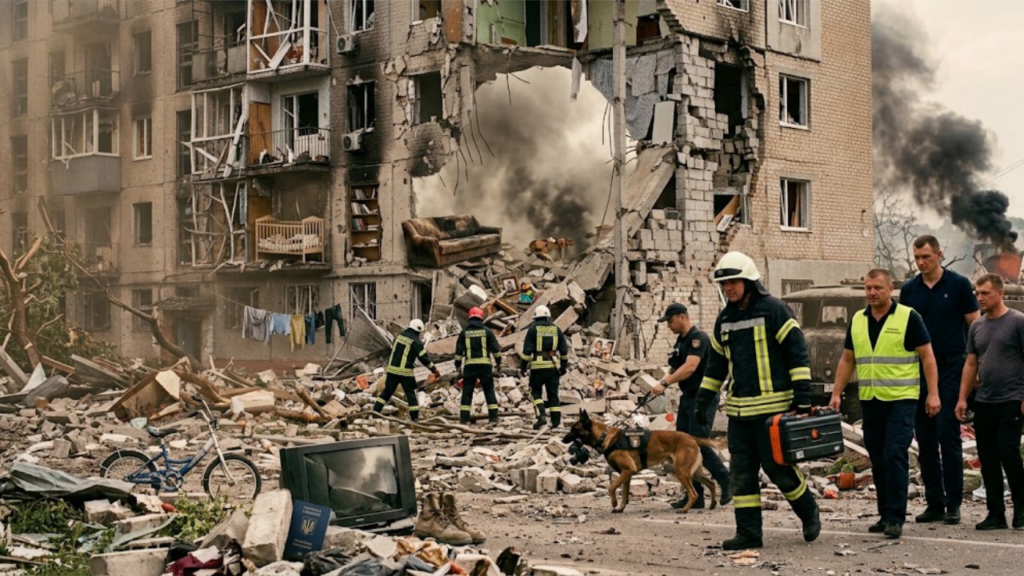
The Pechenihy missile strike has left a small town in Ukraine’s Kharkiv region mourning its dead, after Russian forces hit the settlement’s center on Tuesday morning, killing at least 10 people as they went about the ordinary business of starting their week.
Pechenihy, a settlement of a few thousand residents roughly 48 kilometers southeast of the city of Kharkiv, was struck at around 8:40 a.m. local time on August 18, when two Banderol-type missiles hit the intersection at the heart of the town. It is the kind of place that rarely appears on a map of the war: no strategic value, no front-line significance, just a post office, a café, a small shop, and the homes clustered around them. On Tuesday, that ordinariness is precisely what made the strike so devastating – the missiles landed as residents were heading to work and local businesses were opening for the day.
Pechenihy’s mayor, Oleksandr Husarov, announced the toll and the town’s response in a post on Telegram. “August 18 and 19, 2026, are hereby declared days of mourning in the Pechenihy community,” he wrote, confirming that as of midday, 10 people had been confirmed dead and roughly 20 injured, though he cautioned that the figures were still being finalized. Oleh Syniehubov, head of the Kharkiv regional military administration, gave a similar account, describing a “crowded intersection” surrounded by residential buildings, a post office, and shops.
According to regional officials, the Pechenihy missile strike also damaged ten private homes, the café, the post office, a shop, and at least seven vehicles. Emergency crews extinguished fires at the scene and continued working through the day, while officials said the full circumstances of the attack were still being established.
The Pechenihy Missile Strike, Beyond the Front Line
Pechenihy’s story is not one that typically makes it past a single line in a daily casualty count. Unlike Kharkiv city, or the contested towns along the eastern front that anchor most maps of the war, Pechenihy has no tactical role in the conflict. It is simply a place where people live, work, and run small businesses – the kind of quiet, unremarkable town that rarely draws international attention until a tragedy like this one forces it into the news.
That is part of what makes the Pechenihy missile strike so telling. The war’s daily toll is rarely limited to contested territory or military targets. For residents of towns like Pechenihy, the war arrives without warning on an otherwise unremarkable Tuesday morning, at a post office or a corner shop, among neighbors running errands rather than soldiers on a front line.
Ukrainian President Volodymyr Zelensky addressed the strike directly, saying Russian forces had hit a busy intersection lined with a post office, stores, and residential buildings. He extended condolences to the families of those killed and said Ukraine “will definitely respond to this Russian strike,” calling for international partners to pair their support with continued pressure on Moscow.
The Pechenihy Missile Strike Fits a Wider Pattern
The Pechenihy missile strike did not happen in isolation. It came the same morning that Ukraine launched one of its largest drone operations of the war, sending an estimated 620 unmanned aerial vehicles toward Moscow and the surrounding region overnight – described by Russian state media as the most expansive strike on the capital in roughly two years. Russian forces, meanwhile, launched around 147 drones at targets across Ukraine overnight, hitting civilian infrastructure near Kyiv and killing two more people in Zaporizhzhia.
The days leading up to the strike had already been costly for Ukrainian civilians. A woman was killed and six others wounded in an attack on Kryvyi Rih, Zelensky’s hometown. A separate strike on a book market in Kyiv killed one person and wounded at least seven. A weekend missile barrage on a steel plant operated by ArcelorMittal in Kryvyi Rih injured 13 employees and killed one. Ukrainian officials have also pointed to a persistent shortage of air-defense interceptors, saying a ballistic missile fired at Kyiv days earlier went entirely unintercepted.
Taken together, these incidents point to a pattern that has defined recent weeks of the war: strikes reaching well beyond the contested front line, into towns, markets, and industrial sites with no direct role in the fighting. It’s a pattern this outlet has traced elsewhere too – communities far from any obvious front line still absorbing the worst of a disaster, as seen recently in the Flores earthquake death toll in Indonesia, where isolated villages waited days for aid to reach them.
What Happens Next After the Pechenihy Missile Strike
For now, Pechenihy is focused on recovery. Local authorities say identification and support efforts for victims’ families are ongoing, alongside repairs to the homes and businesses damaged in the strike. The declared days of mourning, August 18 and 19, give the community formal space to grieve before the practical work of rebuilding resumes.
Casualty figures from the strike have shifted slightly across official statements over the course of the day, reflecting the early and evolving nature of the reporting; Ukrainian authorities have said the numbers may still be updated as emergency response and identification work continues. No independent international body had issued its own casualty assessment as of Tuesday afternoon.
Reporting on the wider drone exchange and the pattern of recent strikes suggests that both sides are likely to continue trading long-range attacks in the near term, with Ukrainian officials signaling that a response to the Pechenihy strike is expected. Whether that response brings any near-term change to the frequency of attacks on non-military targets like Pechenihy remains to be seen.
Sources: Reporting based on statements from Pechenihy Mayor Oleksandr Husarov and Kharkiv regional military administration head Oleh Syniehubov, as carried by Ukrinform, Meduza, Kyiv Post, and UPI, and remarks from Ukrainian President Volodymyr Zelensky, as of August 18, 2026. Casualty figures were described by officials as preliminary and subject to revision.