
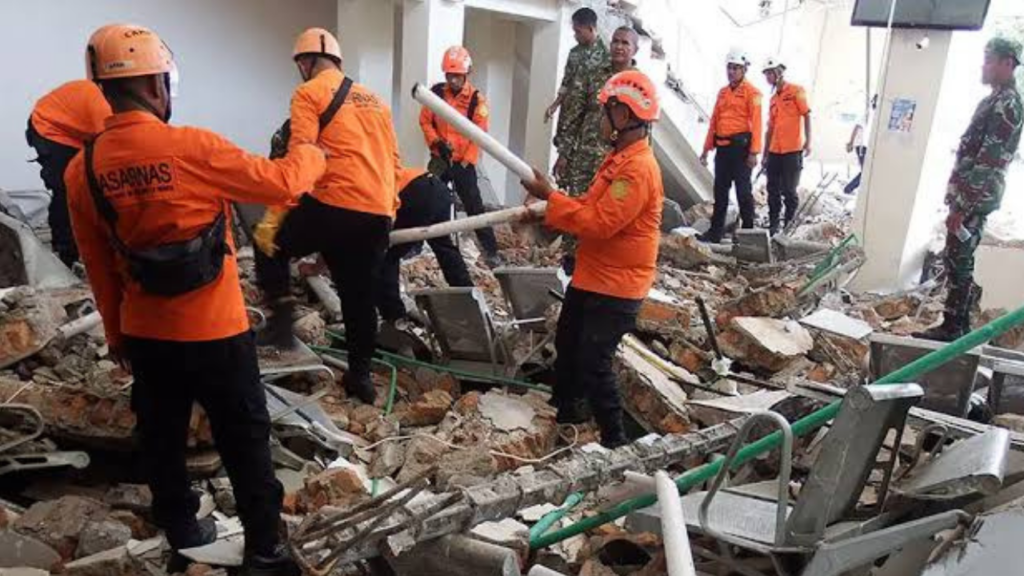
Five days after a magnitude-7.7 earthquake tore through Indonesia’s Flores Sea, the Flores earthquake death toll stood at 70 as of Wednesday, August 19, with disaster officials warning the number could still climb.
Crews are cutting their way into the last isolated communities of East Nusa Tenggara province. More than 40,000 people remain in tents and evacuation shelters, and relief convoys are only now reaching villages that landslides sealed off for days.
What Happened on August 15
The quake struck at 5:58 a.m. local time on Saturday, its rupture centered roughly 68 kilometers north-northwest of the coastal city of Ende, at a depth of about 10 kilometers. That shallow depth, according to the U.S. Geological Survey, is what allowed the shaking to hit the surface with far more force than a deeper quake of the same magnitude would produce. The source was later identified as the Flores Back-Arc Thrust, a fault system stitched into the island’s history. The same structure ruptured in 1992, killing an estimated 2,500 people and sending a tsunami as high as 26 meters onto the coast near Maumere.
This time, the sea rose only modestly by comparison. Tide gauges recorded waves peaking around 1.6 meters, and a tsunami warning issued within minutes of the shaking was lifted roughly three hours later once no destructive surge materialized. Geophysicists studying the rupture say the outcome likely came down to geometry: most of Saturday’s slip occurred beneath the island itself rather than out at sea, sparing Flores the kind of wave that devastated Babi Island and the Hading Bay coastline three decades ago.
What the earthquake lacked in tsunami force, it made up for on land. According to Indonesia’s National Disaster Management Agency (BNPB), damage or destruction has been tallied across roughly 12,000 to 19,000 homes – figures still being reconciled between national and provincial agencies – along with 653 schools, 182 health facilities, 173 houses of worship, and 184 government buildings. Landslides triggered by the shaking severed stretches of the roughly 700-kilometer Trans-Flores Highway, the island’s main artery, cutting off entire regencies from road access for days.
Why the Flores Earthquake Death Toll Keeps Climbing
The Flores earthquake death toll has climbed gradually rather than all at once. That pattern reflects less about the quake’s initial force than about how hard it has been to reach the people it hurt.
Nagekeo regency, the area closest to the epicenter, lost telecommunications entirely when landslides tore through its infrastructure, leaving rescue teams to physically travel in before anyone could confirm what they would find. According to BNPB deputy chief Abdul Muhari, nearly 1,500 military and police personnel and ten aircraft have been mobilized to move roughly 275 tons of supplies into the disaster zone. Steep, narrow mountain roads and blocked routes have slowed even that effort to a crawl in places, a challenge documented in detail by NPR’s on-the-ground reporting from Jakarta.
Palue Island, a small volcanic outcrop close to the epicenter, went without outside contact until aid workers finally reached it late Sunday after what one police official described as a punishing combination of sea and overland travel through landslide debris.
“The roads are steep and many were blocked by landslides. It was a near-death journey,” said Marselus Yugo Amboro, deputy police chief of Sikka regency, describing the push to get emergency supplies onto the island. In Reo, the hardest-hit village in Manggarai regency, residents have spent days sifting through collapsed homes for whatever can be salvaged. “My house is just rubble now,” said Rasyid Jafar, a local clothing trader. “We need food, medicine and clean water urgently.”
With hospitals in Ruteng damaged beyond immediate use, authorities set up two emergency field hospitals there to keep treating the injured, of whom BNPB has now counted nearly 1,200.
A Disaster the World Barely Noticed
Saturday’s earthquake landed on Indonesia’s Independence Day weekend and arrived alongside major quakes elsewhere — in Colombia, Mexico and Venezuela – that have crowded it out of much international coverage even as the death toll from the Flores earthquake has kept rising.
For families in Reo, Nagekeo and on Palue Island, that competition for global attention has had a direct cost. The same isolation that made this earthquake so damaging has also made it easy for the outside world to look away. Flores has no international airport hub, no major industry, and few of the markers that typically pull a disaster into sustained global headlines – only mountain villages, subsistence farmers, and a coastline that has already buried thousands of its own people to this same fault line once before.
It is a pattern this outlet has traced elsewhere too, from flattened villages in Ukraine’s Kharkiv region to the mountain communities of East Nusa Tenggara: the places least equipped to survive a disaster are often the last to be seen by the world watching it.
That history is not abstract to the people living through it now. Older residents across East Nusa Tenggara have spoken of the 1992 disaster in the days since Saturday’s quake, a memory that shapes how communities are responding even as the current toll, while severe, has so far stayed far below that earlier catastrophe. Aid workers have begun setting up psychological support activities for children in some shelters, including in Maumere, as displaced families settle in for what officials acknowledge could be a long recovery.
Government Response and What Comes Next
Indonesia’s government has pledged Rp15 million – roughly $900 – to the families of each confirmed victim, and Rp5 million, about $300, to each of the 199 people BNPB has recorded as injured. President Prabowo Subianto’s office has said a visit to the earthquake zone is being arranged as the government continues assessing conditions on the ground, though no date has been confirmed.
For now, the priority remains reaching what few pockets of the island are still cut off. Officials have not ruled out further fatalities as search teams work through remaining debris, particularly in regencies where communication was knocked out longest. Aftershocks – BNPB has recorded more than 1,600 since Saturday, though only a small fraction have been strong enough for residents to feel – continue to complicate both search operations and the psychological toll on residents too afraid to sleep indoors. With the rainy season still months away, authorities are racing to move displaced families from tents into more durable shelter before conditions in the camps deteriorate further.
Casualty and damage figures in this report are preliminary and subject to revision as BNPB continues verifying reports from remote areas. Sources: Reporting based on confirmed statements and data from Indonesia’s National Disaster Management Agency (BNPB), the Associated Press, NPR, CBS News, Al Jazeera, France 24, and Tempo, as of August 19, 2026. Casualty and damage figures were described by officials as preliminary and subject to revision as assessments continue.