
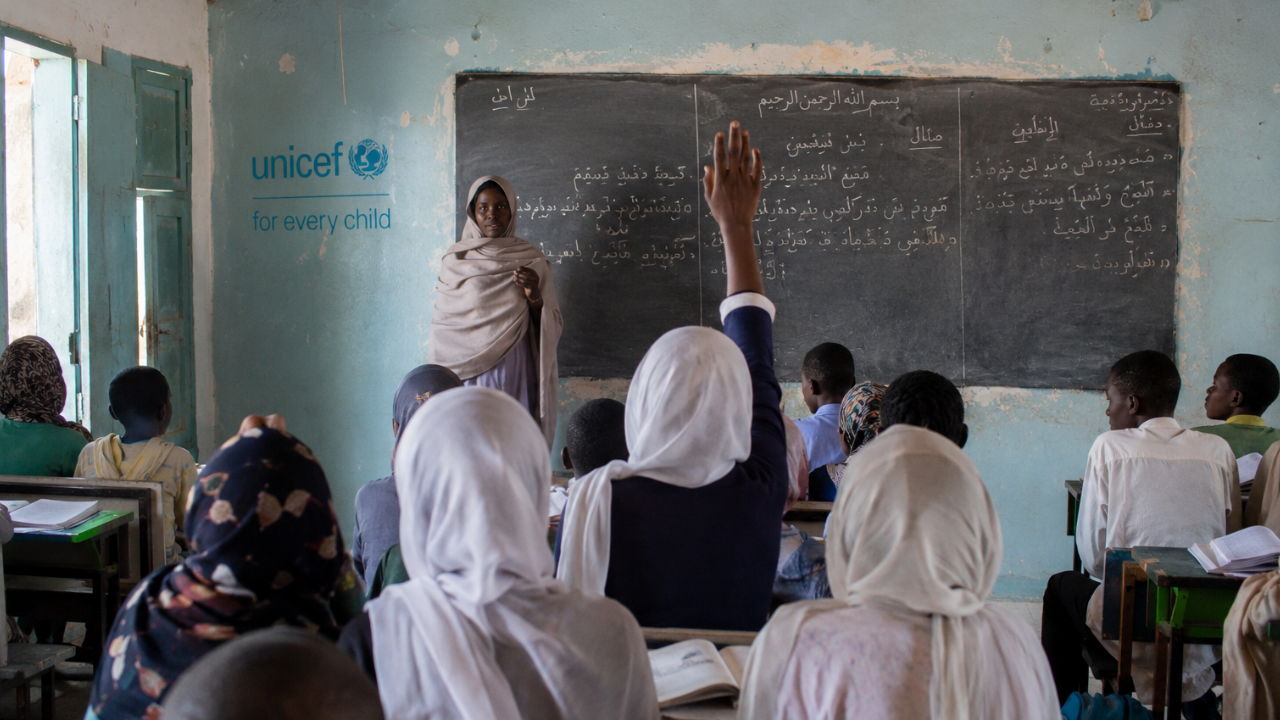
More than three years into Sudan’s civil war, roughly eight million school-age children remain outside a classroom. In Darfur alone, nearly three-quarters of school buildings have been damaged, destroyed, or put to other uses, the United Nations said this month.
The figures mark one of the largest and least-covered education emergencies now unfolding anywhere in the world. Children out of school in Sudan are facing a fight for their future that most of the international press has largely stopped covering – echoing other overlooked emergencies this outlet has followed, from the missile strike that leveled a small Ukrainian village few outside it had ever heard of to the earthquake that quietly pushed Indonesia’s death toll past 70.
UN Deputy Secretary-General Amina Mohammed delivered the warning on August 7 at an informal Security Council session – held under the so-called Arria formula – devoted specifically to safeguarding education in the country. The conflict had by then passed its 1,210th day. “Among everything this war is taking, one of the most significant is the future of Sudan – depriving the education of its children,” Mohammed told council members, according to UN News.
Children Out of School in Sudan: The National Picture
The war began in April 2023, when fighting broke out between Sudan’s army and the paramilitary Rapid Support Forces, and it has not stopped since. UNICEF now estimates that more than a third of the country’s schools stand closed outright.
Another roughly one in nine buildings has been converted into a shelter or is occupied by an armed party. Together, that pushes the share of school buildings no longer functioning as classrooms toward half of the national total. Roughly 33 million Sudanese, more than half the population, now depend on some form of humanitarian assistance, Mohammed said.
Save the Children’s own analysis, released in January to coincide with the International Day of Education, put a number on the accumulated damage. The roughly eight million children shut out of class had by then gone without a single day of instruction for approximately 484 days combined.
That stretch runs about ten percent longer than the school closures endured in the Philippines during COVID-19, the last country to fully resume in-person classes after the pandemic, the organization said. Few wars in recent memory have kept classrooms dark this long.
The toll extends beyond buildings. Mohammed told the Security Council that the UN has verified more than 67 direct attacks on schools since 2024, alongside upward of 154 documented cases in which armed actors occupied school premises for military purposes. She cautioned that these numbers almost certainly undercount the true scale, given how much of the country remains inaccessible to monitors. More than half of Sudan’s teachers, meanwhile, have gone unpaid for extended periods. Many continue showing up regardless.
Darfur’s Crisis of Children Out of School in Sudan
Nowhere has the collapse been sharper than Darfur, the western region that drew global attention during an earlier wave of atrocities two decades ago. It is now, by UNICEF’s account, facing a crisis of comparable scale with far less of the world watching.
Of an estimated 3.9 million school-age children living across Darfur’s five states, roughly 3.3 million – more than four in five – are currently out of school, according to UNICEF USA’s Sudan Child Alert. “Twenty years ago, the world united in outrage at the suffering of children in Darfur. Today, a new generation of children is living through horrific violence, hunger and terror,” UNICEF Executive Director Catherine Russell said in the report. “We cannot allow history to repeat itself.”
Mohammed’s own account to the Security Council put the human calculation starkly. Across Sudan, she said, five children in every six are currently missing school, and parents increasingly choose to keep their children home rather than risk sending them to a building that may not be safe. “Home for them is the only place left where they can keep them safe,” she said.
The stakes go beyond lost lesson time. UNICEF has separately warned that acute malnutrition is expected to affect 4.2 million Sudanese children this year, more than 825,000 of them severely. Drone strikes now account for nearly four out of every five child deaths and injuries recorded in the conflict so far in 2026. A generation is being asked to survive war and hunger with no school day to anchor it.
A Generation’s Lost Earnings, and a Fragile Recovery
The economic dimension of the crisis has drawn less attention than the humanitarian one, but it is not small. UNICEF has calculated that if the disruption to schooling is not addressed, the war-affected cohort of Sudanese children stands to lose a combined US$26 billion in lifetime earnings. That figure reframes the crisis of children out of school in Sudan as more than a present-day emergency. It is a debt the country will carry for decades.
Some recovery efforts are underway, unevenly and against difficult odds. In May, UNICEF and Save the Children, backed by the Global Partnership for Education, launched a three-year initiative known by the acronym BRIDGES. It is intended to return roughly 328,000 conflict-affected children to learning.
The program aims to reopen about 850 schools across seven of the states hit hardest by the fighting. It will also retrain more than 9,000 teachers to deliver catch-up lessons, and establish nearly 1,800 informal “safe learning spaces” for children who cannot yet reach a functioning school. “For millions of children across Sudan, education has been disrupted for far too long,” Sheldon Yett, UNICEF’s representative in Sudan, said of the effort.
In White Nile State, one of the relatively calmer corners of the country, that kind of intervention has already produced a visible result. A secondary school in the village of Al Jabalain reopened this year after standing empty for more than two and a half years, according to UNHCR.
Enrollment has since surged to include more than 700 girls – a mix of local children, internally displaced Sudanese, and refugees from South Sudan sharing the same freshly painted classrooms. The state now hosts an estimated 400,000 refugees and 460,000 internally displaced people, making the reopened school one of the few stable fixtures in an otherwise transient community. “Reopening the schools was like a gift for us teachers and for the children,” the school’s headteacher, Susan Zein Faisal Allah Al-Kamali, said.
Individual stories from elsewhere in the country point to the same resilience. In Port Sudan, 13-year-old Afrah, who wants to become a surgeon, kept studying largely on her own while displaced by the fighting. She repeated her lessons “again and again,” she told the Japan Times, until she was able to resume formal classes through a UNICEF-backed program with the local group SCEFA.
These pockets of recovery remain the exception rather than the rule. Humanitarian officials are blunt about the funding gap standing in the way of scaling them up. UNICEF says it needs $962.9 million this year to reach 7.9 million Sudanese children with lifesaving assistance across health, nutrition, water, and education. Those appeals have struggled to compete for global attention against other crises, much like the coverage of Sudan’s war itself.
What Comes Next
No ceasefire or negotiated settlement to Sudan’s war appeared imminent as of this month. UN officials have offered no timeline for when the bulk of the country’s shuttered schools might reopen.
Mohammed used her Security Council briefing to call for immediate, concrete steps: protecting schools and teachers from attack, ending the military use of educational buildings, and securing sustained funding for programs like BRIDGES. Absent that, aid officials warn, the crisis of children out of school in Sudan will keep compounding. Nearly 500 lost school days for millions of children, and counting, is a cost that will not be fully visible until the children affected today are adults.
One thought on “8 Million Children Out of School in Sudan’s Forgotten War”