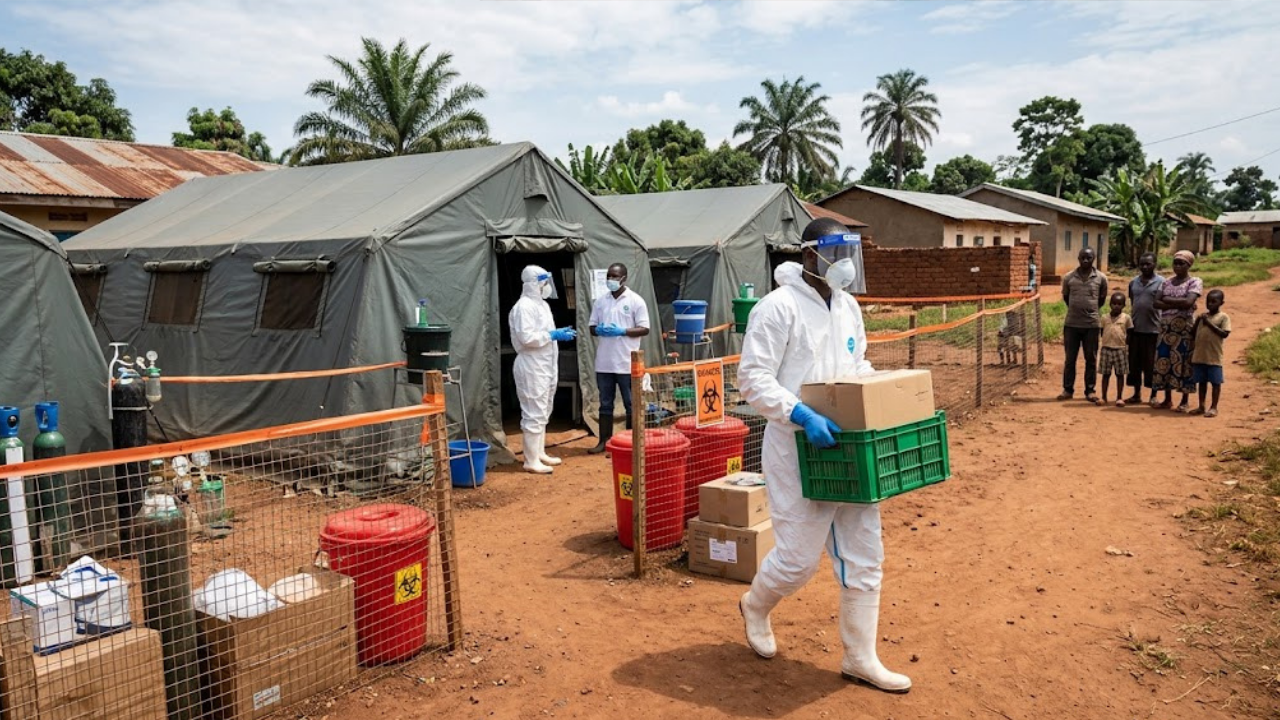
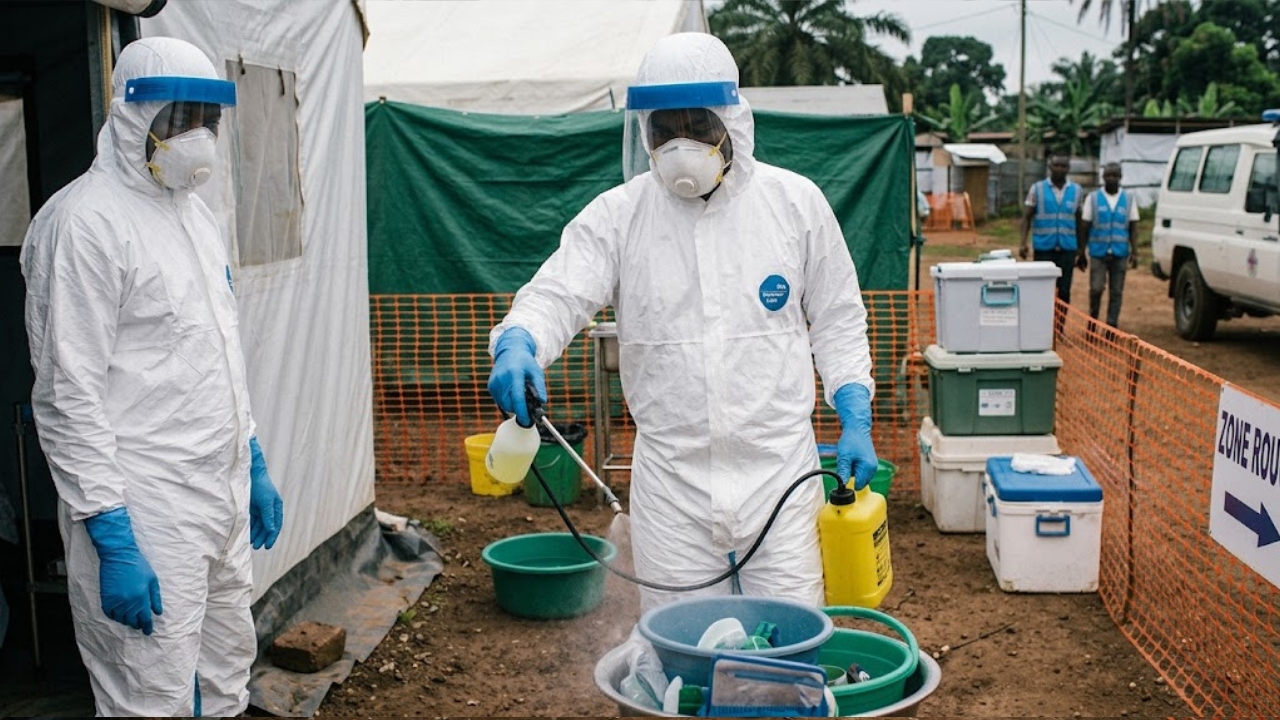
Three months after it began in a single health zone in eastern Congo, the DRC Ebola outbreak has overtaken every epidemic of the disease except one. As of 20 August 2026, the Democratic Republic of the Congo had recorded 5,290 confirmed cases and 2,516 deaths, according to the European Centre for Disease Prevention and Control, citing national health authorities. Those figures make this the largest Ebola outbreak the country has ever reported, and the second-largest anywhere since the virus was first identified in 1976.
Only the 2014–2016 West Africa epidemic, which killed more than 11,000 people, remains larger. WHO Director-General Tedros Adhanom Ghebreyesus told the organization’s Emergency Committee on 18 August that the DRC Ebola outbreak was still gaining speed rather than slowing down. “It is already the second-biggest Ebola epidemic on record, and it is moving faster than any previous Ebola outbreak,” he said.
Why This DRC Ebola Outbreak Is Different
The epidemic traces back to the town of Mongbwalu in Ituri Province, where genomic sequencing suggests the virus was quietly circulating as early as January or February before its formal detection on 14 May. It is the Democratic Republic of the Congo’s seventeenth recorded Ebola outbreak, arriving barely five months after the last one was declared over. It is also only the country’s second outbreak caused by the Bundibugyo strain of the virus rather than the more familiar Zaire strain.
That distinction matters enormously for treatment. Every Ebola vaccine and therapeutic currently licensed for use was developed against Zaire ebolavirus. That leaves frontline clinicians in Ituri, North Kivu and four other provinces with no approved tool against the pathogen actually driving this DRC Ebola outbreak.
In early August, WHO’s technical advisory group recommended fast-tracking Ervebo — the licensed Zaire-strain vaccine — into a Phase 3 trial. The recommendation rested on animal data showing three of four vaccinated primates survived a Bundibugyo challenge, compared with one of four unvaccinated controls. A vaccine built specifically for the Bundibugyo strain only entered Phase 1 human testing in the United Kingdom on 24 July, with a second trial beginning in Canada. Results, if they come, will likely arrive too late to change the course of this particular epidemic.
Roughly 55,000 health workers in Ituri and North Kivu had already received Ervebo during earlier campaigns against the Zaire strain. Gavi has also pre-positioned doses from its 500,000-dose global stockpile inside the country. But without confirmed efficacy against Bundibugyo, none of that constitutes real protection yet – a gap the WHO’s Disease Outbreak News bulletin describes as a central challenge of the response.
The Human Cost Behind the Case Count
Behind the statistics is a health system that was already under strain before the first case was confirmed. Northeastern DRC is a region shaped by years of armed conflict, mass displacement and food insecurity.
Tedros pointed directly to that context when explaining why containment has failed to keep pace with transmission. Insecurity, displacement and constant population movement along roads, rivers and mining routes, he told the Emergency Committee, have fed the epidemic’s spread rather than slowed it.
That mobility is precisely what worries responders now. This week, health officials in Kinshasa launched an initiative dubbed “Congo River Without Ebola,” aimed at keeping the country’s principal transport waterway — a lifeline for trade and travel between provinces — from becoming a new corridor for the virus. Meanwhile, the Africa Centres for Disease Control and Prevention has warned that joint modelling with the DRC’s National Institute of Biomedical Research points to a true infection burden considerably higher than what has been formally confirmed. That gap reflects how thinly surveillance is stretched across the affected health zones, rather than any single failure of reporting.
Ituri Province, where the outbreak began, still carries the overwhelming weight of it: 4,447 cases and 1,984 deaths across 28 of its 36 health zones. North Kivu, the second-hardest-hit province, has recorded 663 cases and 452 deaths in a dozen health zones. Four other provinces — South Kivu, Haut-Uélé, Tshopo and, as of mid-August, Bas-Uélé — have each logged smaller but growing clusters, bringing the total geographic footprint of this DRC Ebola outbreak to six provinces and more than fifty health zones. Speaking to Reuters as the outbreak passed its earlier milestones, Carl Skau, then acting head of the UN World Food Programme, called it “the fastest spreading Ebola epidemic that we have ever seen.”
Those are the numbers mainstream coverage tends to lead with. What often goes unsaid is what a 47 percent case-fatality rate means inside an isolation ward with limited staff: roughly one in two confirmed patients will not walk out, in provinces where reaching a treatment centre at all can mean a journey of hours along roads shared with armed groups. It is the kind of arithmetic that rarely survives translation into a headline – much like the quieter emergencies HumanCrisisNews has tracked elsewhere, from children shut out of classrooms across Sudan to families still searching the rubble after the Flores earthquake to a missile strike on the small Ukrainian village of Pechenihy that barely registered abroad.
DRC Ebola Outbreak: Current Status and What’s Next
The picture is not entirely bleak. Of the 5,290 people confirmed infected as of 20 August, 1,152 have recovered. Contact-tracing teams say they have kept roughly 83 percent of identified contacts under active follow-up despite the security constraints — a figure responders consider a meaningful achievement given the terrain.
Uganda, which recorded 20 cases linked to cross-border spread earlier in the epidemic, declared its own outbreak over on 28 July after 18 recoveries and no new transmission for more than five weeks. WHO has kept enhanced surveillance in place there as a precaution. Isolated imported cases have also been managed successfully outside the region, including patients evacuated for treatment to France and Germany.
Whether the DRC Ebola outbreak follows a similar trajectory toward containment remains genuinely uncertain. The Emergency Committee’s decision to keep the Public Health Emergency of International Concern designation in force reflects that uncertainty directly: WHO assesses the risk as very high within DRC itself, high for neighbouring countries that share a land border, and low — for now — at the regional and global level. The coming weeks, as the Bundibugyo-specific vaccine trials progress and the Ervebo trial gets underway inside the outbreak zone, will determine whether this becomes the outbreak that closes the gap in Ebola’s vaccine coverage, or the one that shows how badly that gap was already costing lives.
Some case and death figures in this report are described by health authorities as provisional and subject to revision as surveillance data is reconciled.