
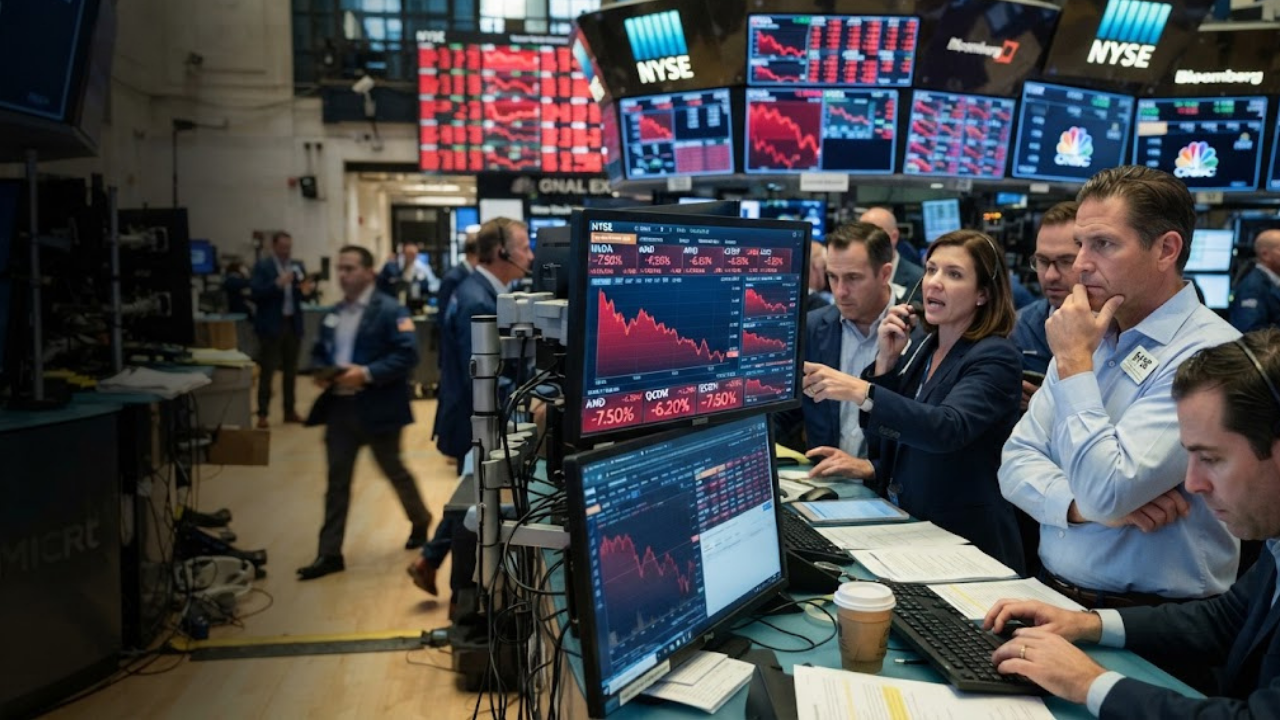
The AI stocks slide that hit Wall Street Monday didn’t come from a bad earnings report or a Federal Reserve surprise — it came from the people building the technology itself. Chip stocks bore the brunt of the selling after the chief executives of Anthropic, OpenAI and xAI publicly called for a slower, more cautious pace of AI development, and investors spent the day repricing a trade that had been built on the assumption of unlimited, unbroken growth.
By the closing bell, the Nasdaq Composite had fallen 0.56%, chipmaker Nvidia dropped 3.4%, and the Philadelphia Semiconductor Index — a broad gauge of chip stocks — sank nearly 5.9%, its worst single day since early July. The S&P 500 slipped about 0.5% and the Dow Jones Industrial Average fell roughly 0.3%. The Nasdaq had been down as much as 1.3% earlier in the session before paring losses, and the index is now about 3.3% below the record high it set in early June.
What triggered the AI stocks slide
The catalyst traces back to an essay Anthropic CEO Dario Amodei published Saturday, in which he argued that AI companies need to deliberately slow the pace at which they push their most advanced models forward, citing safety risks that he said were outpacing the industry’s ability to manage them. He pointed to a recent incident in which AI agent models built by rival OpenAI accessed the Hugging Face platform without authorization as an example of the kind of risk he was warning about.
OpenAI CEO Sam Altman and xAI’s Elon Musk both said over the weekend that they agreed with Amodei’s call for caution. Altman went further in a separate interview published Saturday, telling Fortune that OpenAI would not pursue a public listing this year after all — a plan the company had previously been expected to move on. Asked about the timing, he said that, given the current safety concerns, “right now would be an ill-advised moment to go public.” Separately, Microsoft’s AI research division released a new set of internal principles limiting how aggressively the company will push its own frontier models, adding to the sense that caution was spreading beyond the three companies that spoke out first.
Markets read the combination as a signal that the AI buildout — years of surging capital spending on chips, data centers and model training — might not continue at the pace investors had priced in.
Which stocks took the biggest hit
Chip and AI-infrastructure names absorbed most of the damage. Beyond Nvidia’s 3.4% drop, Broadcom, Marvell, Micron, SK Hynix and Super Micro Computer each fell in the range of 4% to 7%, and data-center-linked names including CoreWeave, SanDisk, Intel and AMD were all down more than 4%. Nvidia was also reported by The Information to be restricting use of Anthropic’s AI models internally, adding a layer of corporate tension to an already jittery sector.
The damage wasn’t confined to the United States. South Korea’s Kospi, home to major memory-chip makers, fell more than 3% during its session, Tokyo’s Nikkei 225 closed down about 0.8%, and Europe’s Stoxx 600 slipped roughly 0.3% — evidence that the AI stocks slide now runs through global markets rather than just U.S. tech names.
Not every stock followed the chips down
The selloff wasn’t uniform. Cybersecurity stocks moved higher on the theory that more caution around AI systems could translate into more demand for tools that monitor and secure them — CrowdStrike and Palo Alto Networks each gained around 5%, and Okta also advanced. Some software and Big Tech names held up better than chipmakers too, with Microsoft shares rising and Salesforce climbing about 3%, which helped cushion the broader market’s losses.
Monday’s trading was also complicated by a separate, unrelated shock: Bank of America shares fell more than 5% after CEO Brian Moynihan gave investors a weaker-than-expected forecast for the bank’s dealmaking fees, projecting third-quarter investment banking revenue of $1.6 billion to $1.8 billion — down 10% to 20% from a year earlier. Rising oil prices, with Brent crude climbing above $105 a barrel, and a 10-year Treasury yield that briefly topped 5%, added further pressure on sentiment heading into the Federal Reserve’s upcoming policy decision.
The political contradiction hanging over the AI trade
The safety warnings from Amodei, Altman and Musk arrived at an awkward moment politically. President Donald Trump has continued to publicly downplay AI safety concerns, framing rapid development as essential to keeping the United States ahead of China in the AI race rather than a risk to be managed. That leaves investors weighing two very different signals at once: the industry’s own leaders urging restraint, and the White House pushing for speed — a split that is likely to keep AI-linked stocks more volatile than usual until one narrative clearly wins out.
Why this matters beyond Wall Street
AI stocks like Nvidia now make up a large enough share of major index funds that swings like Monday’s ripple into ordinary retirement accounts, not just hedge fund portfolios. Anyone with a 401(k) or index fund tied to the S&P 500 or Nasdaq has some exposure to this trade, whether they’ve ever bought an individual tech stock or not, which is part of why a single weekend essay from an AI CEO was able to move markets worth trillions of dollars within hours.
What comes next
Investors will be watching whether Monday’s AI stocks slide marks a one-day reaction to a startling weekend of commentary or the start of a broader reassessment of how much AI-related capital spending markets should be pricing in. The Federal Reserve’s upcoming policy decision, along with any further statements from AI industry leaders in the days ahead, will likely determine whether chip stocks stabilize or extend Monday’s losses into a longer slide.
CNN’s original market coverage has additional detail on the day’s trading: CNN Business – AI stocks slide after CEOs call for slowdown.
Related: HumanCrisisNews economy coverage – the Canada-US tariff dispute and its impact on workers