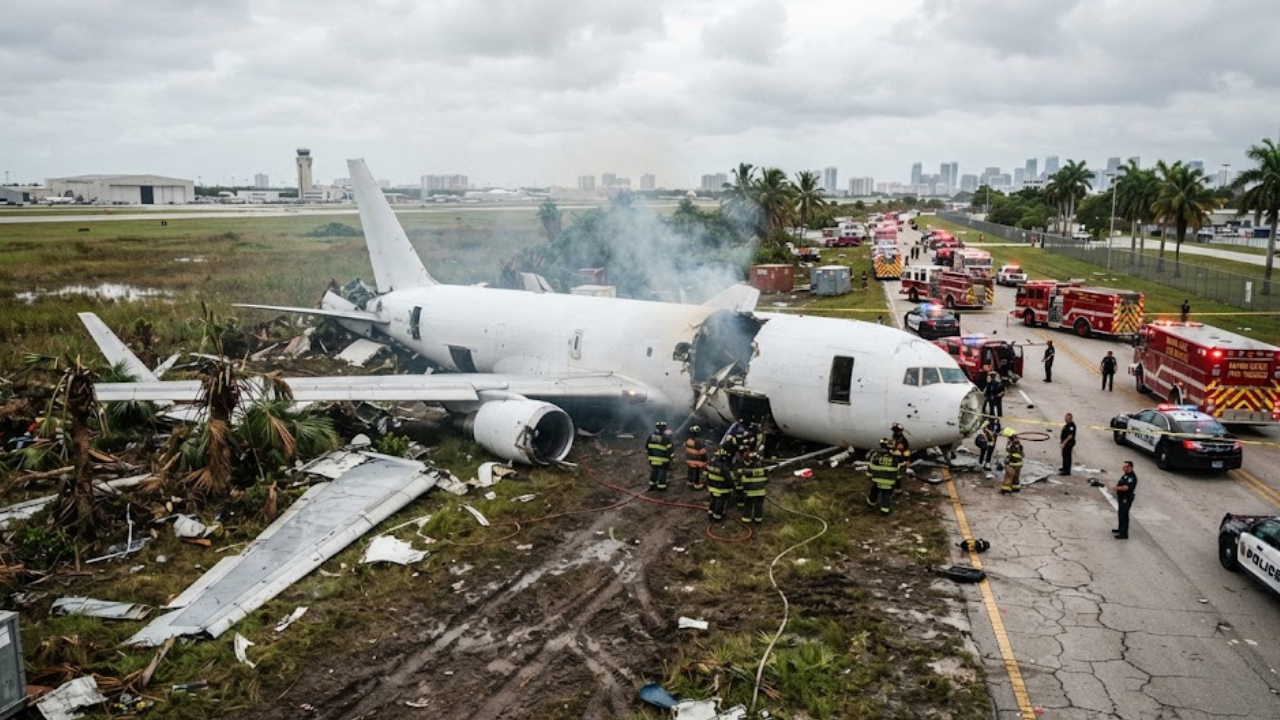
The Amazon cargo plane crash in Miami happened Sunday afternoon, when a Boeing 767 flying under the Prime Air brand overran a runway at Miami International Airport, tore through airport equipment and struck two vehicles before coming to rest near a parking lot in flames. Five people died. All five were on the ground – inside a company van and a passenger SUV – not aboard the aircraft, whose two pilots survived and had to be pulled from the cockpit by rescue crews.
The jet, operating as Flight 7598, was not flown by Amazon. It was flown by 21 Air LLC, one of several outside cargo airlines that Amazon contracts with to move packages across its delivery network. That distinction – a household e-commerce brand painted on the fuselage of a plane it does not operate, staffed by pilots it does not employ – sits at the center of what investigators, labor unions and aviation regulators are now examining.
The National Transportation Safety Board said the aircraft struck a 2012 Ford Econoline van carrying seven aircraft-cleaning workers, then continued roughly 1,300 feet past the paved runway before hitting a Toyota SUV on a road outside the airport perimeter. NTSB Chair Jennifer Homendy described the wreckage as “utter devastation,” and said the van, owned by contract cleaning firm Professional Ocean Service Corporation, was torn apart. Five people were injured, three of them critically. The company’s vice president said from Chile that some of his employees were among the dead, though he had not yet received a full accounting.
Inside the Amazon Cargo Plane Crash in Miami: What Investigators Are Looking At
According to the Federal Aviation Administration and NTSB, the 767-300 freighter touched down on runway 30 around 1:53 p.m. Sunday after arriving from San Juan, Puerto Rico – the third leg of a route that had already taken the plane from Cincinnati to Miami and back out to Puerto Rico earlier that day.
Every detail investigators confirm about the Amazon cargo plane crash in Miami this week will shape how the NTSB frames its eventual findings. It overran the runway, struck navigational equipment, then hit the cleaning company’s van before crashing through a perimeter fence and colliding with the SUV. Miami-Dade Fire Rescue sent more than 60 units and 200 personnel to the scene.
A 32-person NTSB team has begun documenting what Homendy called “perishable evidence,” including tire marks that carve through pavement and grass at the runway’s edge. Investigators have recovered the plane’s flight data and cockpit voice recorders and plan to examine the aircraft’s maintenance history, its braking and thrust-reverser systems, and the flight crew’s training and workload during the approach – standard steps in any runway-overrun investigation, and ones that will take months to complete. No cause has yet been determined, and officials have repeatedly cautioned against speculation.
One detail already under review is infrastructure. Miami’s runway 30 has the FAA-mandated 1,000-foot safety buffer at its end but, unlike some U.S. runways, does not have an Engineered Materials Arresting System – a bed of crushable material designed to stop an overrunning aircraft.
The FAA credits that technology with saving hundreds of lives at other airports, but Miami was never required to install it because of its existing buffer zone, according to a former FAA airport-safety official. Whether that gap mattered in Sunday’s crash is one of the questions the investigation will have to answer.
Who Operates Amazon’s Planes – and Why That Matters
Amazon does not own or fly most of the aircraft carrying its logo. Its air network runs on a patchwork of contracted carriers – among them 21 Air, Air Transport International, Atlas Air and Southern Air – that lease crews and aircraft to Amazon under arrangements known in the industry as ACMI, short for aircraft, crew, maintenance and insurance. The retailer sets delivery schedules and branding; the contractors supply the planes, the pilots and, ultimately, the operating decisions made in the cockpit.
21 Air is a comparatively new and fast-growing player in that system. Headquartered in Greensboro, North Carolina, with a 24-hour operations hub in Miami, the airline began flying for Amazon only in late 2024.
Majority owned since 2021 by Houston Astros owner Jim Crane through Avia Acquisitions, the carrier’s Amazon-dedicated fleet had grown to roughly seven or eight converted 767 freighters by this year, aviation-data firm Cirium reported. The airline also changed leadership in 2026, installing former Crane Worldwide Logistics executive Keith Winters as chief executive to oversee what the company has described internally as an accelerated growth plan.
That rapid expansion is now under a different kind of scrutiny. Contract cargo carriers operate under the same federal safety rules as passenger airlines, but they answer to fewer public eyes: no ticketed passengers, no consumer-facing brand of their own, and comparatively little outside reporting on their labor conditions until something goes wrong.
A Labor Force Under Strain
The pilots who fly Amazon’s contracted network have spent years warning that the system is stretched thin – part of a broader pattern HumanCrisisNews has tracked of workers absorbing the strain of corporate and economic pressures. Cargo pilots are excluded from a 2014 federal rule that guarantees passenger pilots at least 10 hours of rest between flights, leaving rest requirements for freight crews governed by older, less protective standards.
Unions representing pilots at Atlas Air and Air Transport International have staged strikes, no-confidence votes and shareholder-meeting protests in recent years over understaffing, fatigue and pay, with one union survey finding a majority of pilots flying for Amazon’s carriers were looking for other jobs. An internal Atlas Air report this year found that 92 of its pilots had quit, roughly double the prior year’s total, largely for better pay elsewhere.
Those tensions are not new to Amazon’s air operation, and they are part of why the Amazon cargo plane crash in Miami is drawing attention beyond the runway itself. In February 2019, an Atlas Air-operated 767 flying cargo for Amazon crashed into a Texas bay, killing all three people aboard; some aviation observers at the time pointed to crew fatigue and inexperience as contributing concerns, though investigators ultimately attributed that accident to pilot error during a mishandled recovery from turbulence.
Sunday’s Miami crash is a different kind of event – no one aboard the aircraft died – but it lands the same underlying question back in front of regulators: what oversight exists for the growing web of contractors that keep Amazon’s next-day promise running, and how well are the people working inside that system, in the air and on the ground, being protected.
The Support Gap on the Ground
Sunday’s deaths also point to a less-examined vulnerability: the workers who service aircraft on the ramp, often employed by small contracting firms with little public visibility, moving through active runway environments as a routine part of their jobs. The seven cleaning workers in the Econoline van were doing exactly that kind of work when the overrunning jet struck them. Investigators say the crash is drawing attention not only to what happened in the cockpit but to how ground personnel are positioned and protected near runways at one of the country’s busiest cargo airports.
What Comes Next
The NTSB investigation is expected to take up to a year before a final report identifies a probable cause, though preliminary findings on facts such as weather, aircraft weight and crew statements could emerge sooner. Homendy said Monday that recovering victims remained the priority before investigators move deeper into the wreckage.
Two of Miami International Airport’s four runways had reopened by Monday. The identities of those killed had not been released as of Monday evening, and Professional Ocean Service Corporation had not confirmed how many of its employees were among the dead or injured.
For Amazon, the crash arrives as its contracted carrier network continues to expand to meet delivery demand, and as pilot unions continue pressing the company’s leadership over staffing and working conditions across that network. Whatever the NTSB ultimately finds caused Sunday’s runway overrun, the crash has already put a spotlight on a part of the delivery system most customers never see: the outside airlines, contract crews and ground workers who keep it running.