The UK flower growers heatwave of 2026 has done what no single bad season usually does: it has pushed working farms out of business in real time. Britain just recorded its hottest summer since national weather records began in 1884, and for a small, largely invisible corner of the country’s agricultural economy, that record has translated directly into lost income. Independent flower growers say the heat destroyed entire crops this year, leaving some with nothing to bring to the London markets that make up their livelihood. The story has circulated in the UK mostly as a seasonal weather curiosity. It is, more precisely, a story about small businesses absorbing a climate cost with no safety net to catch them.
Met Office provisional figures confirm summer 2026 as the UK’s warmest on record, with a mean temperature of 16.5°C, edging past the previous record of 16.10°C set just last year. England and Wales had their driest July on record, and by mid-August more than 71% of England was officially in drought, with over 27 million people living under water restrictions, according to the National Drought Group. For flower farmers who depend on predictable rainfall and stable spring temperatures, the season arrived broken from the start.
What makes this development worth HumanCrisisNews’s attention isn’t the temperature record itself – Britain has been setting and breaking heat records for several years now. It’s that the damage is landing on people with almost no institutional cushion: small growers selling directly at farmers’ markets, without the crop insurance, subsidy structures or compensation schemes available to larger arable operations.
Why This Summer Broke Britain’s Heat Records
The 2026 heat did not arrive as a single event. A record-breaking heatwave in late May pushed temperatures at Kew Gardens to 35.1°C, shattering a 1922 record by two full degrees, and was followed by a second heatwave in June that produced the UK’s hottest June day on record. Researchers have linked the spring heat spike to an estimated 550 heat-related deaths during that period alone. By the time the Met Office’s summer-long assessment came in, the country’s mean temperature for June through August – 16.5°C – had beaten every summer in a 142-year dataset.
For growers, the more damaging figure may be rainfall, not temperature. Prolonged dryness left soil too depleted for seeds to germinate in some regions even after growers irrigated through the summer. The Energy and Climate Intelligence Unit, a climate-policy research group, estimates the combined heat and drought could cost UK arable farmers as much as £390 million in lost revenue, putting 2026 on track to be one of the worst harvests since detailed record-keeping began in 1984.
That figure covers the broader arable sector; no comparable financial estimate specific to cut-flower growers has yet been published, and HumanCrisisNews was unable to confirm sector-specific loss figures with the National Farmers’ Union or an equivalent trade body – a gap that itself illustrates how little economic attention this particular slice of agriculture receives.
Inside the UK Flower Growers Heatwave: How the Season Fell Apart
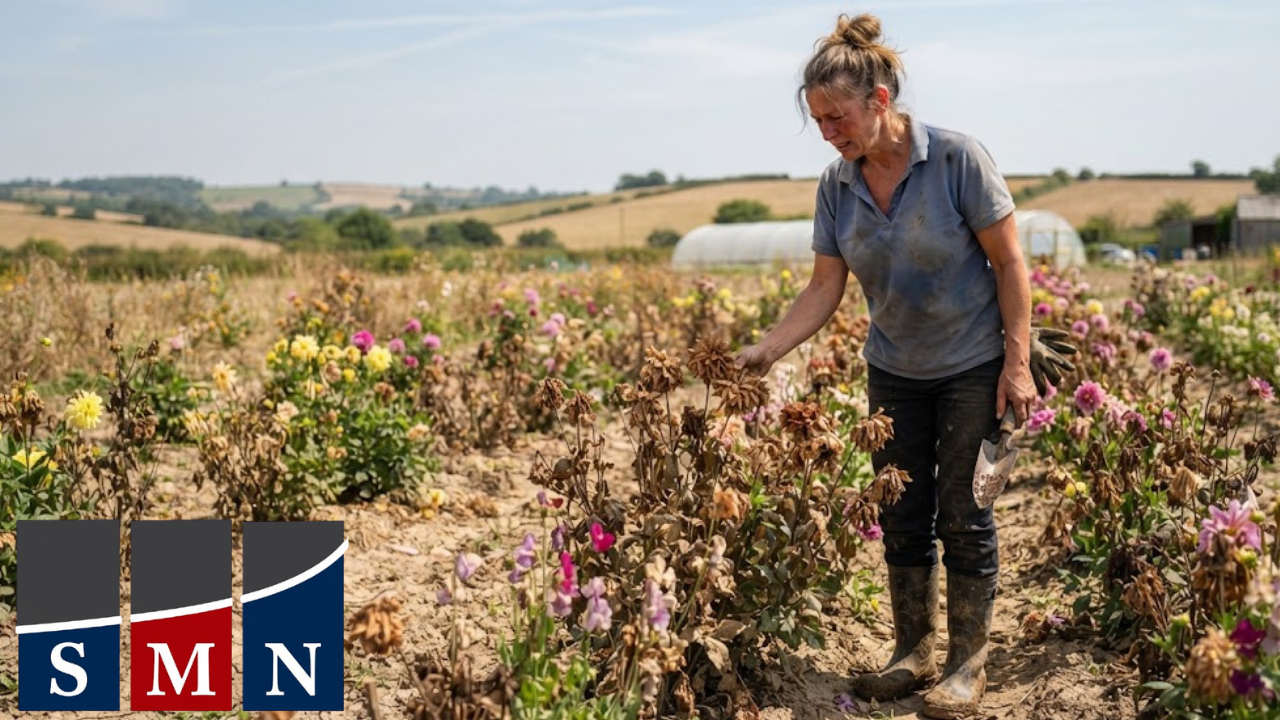
George Stevens, a fourth-generation grower at Stevens of Sibsey in Lincolnshire, lost most of his peony season in May, when temperatures jumped from 14°C to 30°C within days – a swing too abrupt for the flowers to survive. He has spent the months since irrigating ground too dry for new seed to take hold. “It’s by far the driest year we’ve ever had,” he told the BBC at Chiswick Flower Market earlier this month.
The toll extends beyond any single farm. Organizers of Chiswick Flower Market, one of several UK markets that let growers sell flowers directly to the public rather than through wholesalers, said several regular sellers dropped out entirely this summer because they had nothing left to bring. For growers who rely on these direct-sale markets – often driving flowers into London after harvesting and packing through the night – a missed market date is not a delay. It is income that does not come back.
That precariousness is compounded by the shape of the UK flower trade itself. The growers’ association Flowers from the Farm, which now counts more than 1,000 members, estimates that roughly 90% of flowers sold through British florists, supermarkets and wholesalers are imported – chiefly from the Netherlands, with additional volume from Kenya, Ecuador, Colombia and Ethiopia. British-grown cut flowers already occupy a thin sliver of the market. A single destructive season can push a small domestic grower out of it altogether, even as demand for seasonal, locally grown blooms has been rising.
A Climate-Damage Story Without a Humanitarian Label
Extreme heat is usually covered in wealthy countries as a matter of comfort and inconvenience – hosepipe bans, transport delays, warnings to stay hydrated. It is rarely covered as a livelihood-loss event, the kind of framing routinely applied when drought damages subsistence farming in lower-income regions – a pattern HumanCrisisNews has examined in how differently comparable crises get covered depending on where they happen. That asymmetry is part of what makes this story worth telling on its own terms: Britain’s small growers are experiencing a version of the same climate-driven economic harm long documented elsewhere, without the same recognition, research attention or support structures.
Other UK sectors are beginning to quantify what repeated heat is costing the broader economy. Independent economic analysis attributed roughly £2.4 billion in lost output to June’s heatwave alone, with cumulative estimates for the summer reaching into the billions. Food-price researchers have separately tracked accelerating inflation in heat-vulnerable categories such as butter, beef, milk, coffee and chocolate. Against that backdrop, the losses facing flower growers are small in national economic terms – but for the individual farms absorbing them, they are close to total.
The Support Gap Facing Small Growers
Unlike larger arable farms, most small flower growers operate outside the insurance and subsidy frameworks built around staple crops, and outside any emergency drought-relief scheme aimed specifically at ornamental horticulture. The UK flower growers heatwave has exposed that gap clearly: when a season fails, there is currently no compensation mechanism to offset it.
Growers interviewed by the BBC described the response as falling to them alone: investing in soil health during the off-season, adjusting planting schedules, and absorbing the financial hit in the meantime. Stevens said the real work now happens after the season ends, in rebuilding the ground itself rather than relying on emergency irrigation during the next heat spell.
Industry bodies beyond flower growing are sounding similar warnings about the broader pressure behind the UK flower growers heatwave. The Turfgrass Growers Association has told its own members to expect rising costs and mounting climate risk going forward, a sign that the pressure facing ornamental and specialty growers is not isolated to one crop.
What Comes Next
The Met Office has cautioned against assuming this summer’s records mean an automatic continuation into a hot autumn – a warm season and a heatwave are meteorologically distinct, and forecasters say confidence in any near-term heat event remains too low to predict reliably. But the underlying pattern is not in dispute: 2025 and 2026 have now each set consecutive UK summer heat records, and researchers at the Climate Change Committee have separately warned the government that the country remains unprepared for the growing frequency of extreme heat.
For growers like Stevens, the immediate question is less about next week’s forecast than next year’s ground conditions – whether a wetter winter can restore soil that this summer left too dry to plant in. Whether any formal support follows this season’s losses remains, for now, an open question that neither Whitehall nor the flower industry’s own trade bodies have yet answered.