
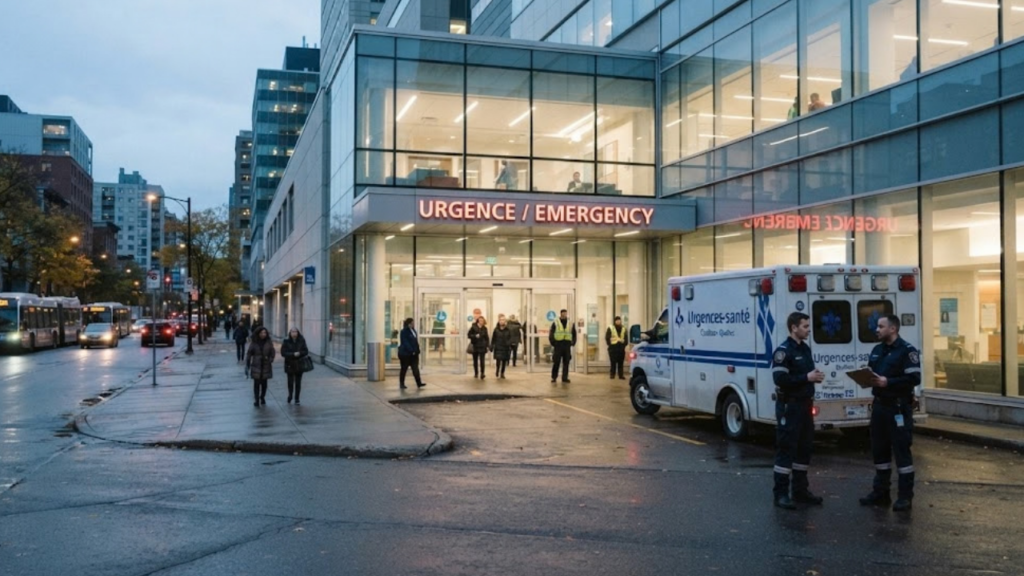
A suspected Ebola case at a Montreal hospital was ruled out on Thursday evening, hours after the Centre hospitalier de l’Université de Montréal (CHUM) isolated a female patient who arrived showing signs officials described as consistent with the disease. The hospital said the isolation was lifted at about 8pm and that its Ebola protocols would not be activated, according to CTV News.
CBC News reported the suspected Ebola case was a false alarm. The CHUM did not say how it reached that conclusion, and it declined further comment, citing patient confidentiality. A hospital spokesperson, Irène Marcheterre, told CBC she did not know the woman’s travel history.
What happened at the CHUM
The hospital first told CTV News by email at about 4:30pm that a patient was being evaluated for a potential Ebola case. It said standard protocols were in place, including temporarily rerouting ambulances so staff could safely move the patient from the ambulance to a dedicated isolation room in the emergency department.
Within roughly three and a half hours the hospital confirmed the patient was no longer considered a potential case. The patient’s name, age, symptoms and condition have not been released, and HCN found no statement from Quebec health authorities on the case in the reporting reviewed.
Why a suspected Ebola case triggers isolation
The scare comes during the largest Ebola outbreak on record in the Democratic Republic of Congo, caused by the Bundibugyo strain of the virus and declared in May. CTV News reports that confirmed cases there have passed 8,000 and that the outbreak remains out of control. CBC has reported that thousands have died.
Canada has barred entry to people from Congo, Uganda and South Sudan since May. The restrictions were due to expire on 28 September and were extended by 60 days, to 27 November, CTV reported. Foreign nationals from other countries who entered Congo in the previous 21 days cannot board a flight to Canada, and arrivals from the other two countries must quarantine for 21 days.
Early Ebola symptoms are easy to confuse with other illnesses. The Public Health Agency of Canada lists fever, fatigue, muscle pain, headache, sore throat, vomiting, diarrhea and rash among them, which is why it says diagnosis relies on laboratory testing together with clinical and travel-history investigation. A hospital that sees a possible match is expected to isolate first and rule the disease out afterwards.
What guidance says for staff and residents after a suspected Ebola case
The agency says the overall risk to the general population in Canada remains low. It says the virus requires direct contact with the body fluids or tissues of an infected person, that it does not spread through the air between people, and that people are not thought to be infectious before symptoms begin. Its guidance page, last updated on 11 September, says no cases had been reported in Canada.
For hospital staff, the agency advises routine hygiene and protective equipment plus additional contact and droplet precautions when treating a person under investigation, until Ebola is definitively ruled out. Stricter protection applies if the patient is clinically unstable. The CHUM has not announced any measures for people living or working near the hospital, and the ambulance rerouting was described as temporary.
There is no Health Canada-approved treatment for Ebola disease, and the licensed vaccine is not approved for Bundibugyo virus, according to the agency. That is why people with suspected cases are supposed to be cared for in specialised centres rather than moved on public transit.
Earlier scares in Montreal
This is not the first time a Montreal hospital has isolated a patient and then cleared them. During the 2014 West African outbreak, a patient quarantined at Maisonneuve-Rosemont Hospital after returning from Guinea tested negative, CBC reported. A man who fell ill on a flight from Guinea and was isolated at Notre-Dame Hospital also tested negative, according to Global News.
In that 2014 case, results from the National Microbiology Laboratory in Winnipeg took 12 to 24 hours, Global News reported. The CHUM has not said whether it sent samples to a laboratory this time or cleared the patient on clinical grounds.
What remains unclear
In this suspected Ebola case, still unknown are how the patient was assessed, what illness she had, whether she had any link to an outbreak area and whether Quebec public-health officials were involved. The hospital’s confidentiality position means some of those details may not be released. HCN will update this story as facts emerge.