
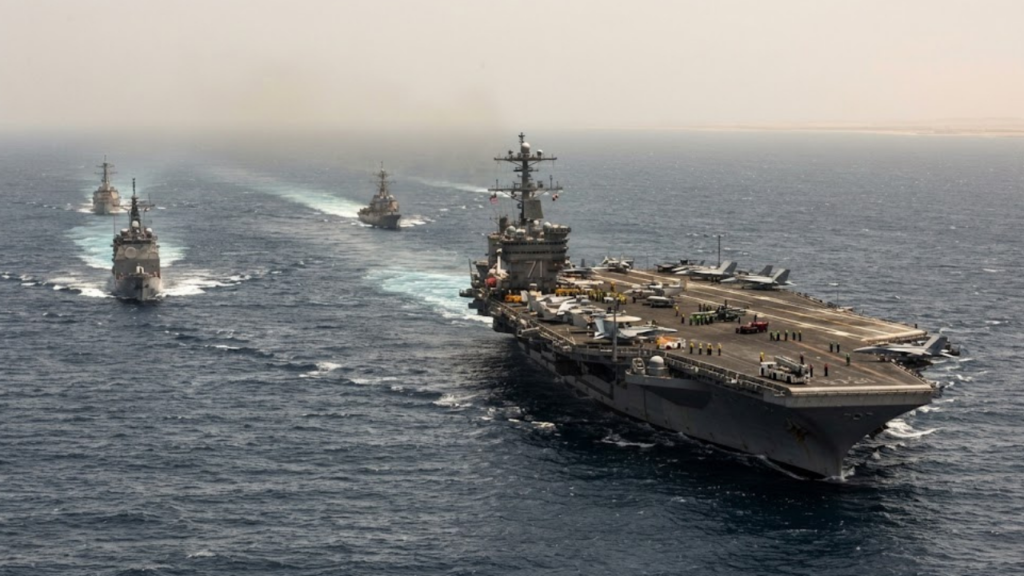
The US troop deployment announced on Thursday will send roughly 9,000 more sailors and Marines to the Middle East aboard a group of ships that includes a third aircraft carrier, a US official told the Associated Press. It arrives as President Donald Trump says new strikes on Iran remain possible, in a war that began in late February and has swung between ceasefires, talks and renewed attacks.
The official spoke on condition of anonymity to discuss sensitive military movements, and the reporting reviewed by HCN does not include an on-the-record Pentagon announcement. The group carries more than 7,000 sailors and 2,000 Marines. Other US media reports, summarised by CNBC and Anadolu Agency, put the figure at 9,000 to 10,000.
What the US troop deployment includes
The ships include the USS Theodore Roosevelt carrier strike group, which sailed recently with the cruiser USS Chosin, and the USS Makin Island amphibious readiness group. That group includes the amphibious landing ships USS John P. Murtha and USS Anchorage. An amphibious readiness group is a Navy task force built to carry Marines and land them from the sea.
The AP’s source said the move could put three carriers in the region as early as the end of October. The USS George H.W. Bush and USS George Washington are already there, along with the USS Boxer amphibious group. With the new ships, the US naval presence would pass 20,000 sailors and Marines and hundreds of aircraft, the AP reported.
Trump’s position on new Iran strikes
In a Time magazine interview conducted on Monday and published Thursday, Trump said it was “possible” he would step up bombing of Iran after the 3 November US midterm elections. He declined to say what he would target. He also said he rejected Iran’s latest ceasefire proposal, which Anadolu reported would have reopened the Strait of Hormuz and restarted nuclear talks in exchange for lifting a US blockade of Iranian ports.
The Strait of Hormuz is the narrow waterway at the mouth of the Persian Gulf, through which about one-fifth of the world’s oil normally passes. Trump said Iran offered to open the strait but called the overall proposal not good enough. HCN has not seen Iran’s proposal in full, so its terms are as described by those outlets, not confirmed by Tehran or Washington. For earlier coverage of the diplomatic track, see HCN’s report on the Iran talks at the UN and Trump’s warning.
What the US troop deployment means for shipping and oil
Oil markets reacted on Thursday. Brent crude, the international benchmark, rose 4.4 percent to close at $102.31 a barrel, while US benchmark West Texas Intermediate settled at $92.87, CNBC reported. Crude flows from the Middle East have largely recovered to pre-war levels, CNBC said, but the recovery is fragile, with at least three tankers attacked this week as they tried to cross the strait.
The US Navy has been enforcing the blockade of Iranian oil exports, and the AP reported that Washington has had more success loosening Iran’s grip on Hormuz and getting Gulf allies’ oil to market. A separate report cited by Anadolu said about 20 Navy ships are in the region enforcing the blockade and escorting commercial vessels. For ordinary consumers, the link is higher fuel costs rather than any direct effect from the troop movement. None of the reporting reviewed described new restrictions on civilians or commercial travel tied to the US troop deployment itself.
Security concerns beyond the Gulf
Trump told reporters on Thursday that early indications suggest Iran may be linked to the Flydubai co-pilot who, according to the AP, stabbed his captain and tried to crash an Israel-bound flight on Wednesday. Trump said the US would retaliate if a link is established, and that his information was still being worked on. He offered no evidence, and Israeli Prime Minister Benjamin Netanyahu separately said investigators believe the suspect was radicalised. Neither claim has been independently verified.
British authorities also announced on Thursday the arrest of a 27-year-old dual UK-Iranian national on suspicion of plotting a terror attack, after a security incident at RAF Fairford, a US-run air base in England. The AP said British authorities have linked the earlier incident to Tehran. Five men arrested near the base on Sunday have been released on bail.
What remains unclear
It is not yet known whether the forces in this US troop deployment are meant for defence, enforcing the blockade, or preparing for strikes or a ground operation, because officials have not said. The timing also needs confirming: the AP’s source pointed to the end of October for the third carrier, while other reports have given different arrival windows. The strain on the fleet is also visible, as the carrier USS Abraham Lincoln was at sea for more than 260 days straight before the George Washington relieved it.
For now, the confirmed facts about the US troop deployment are the ships, the numbers cited by an anonymous official, and Trump’s own statements that more strikes are possible. HCN will update this story as facts emerge.