
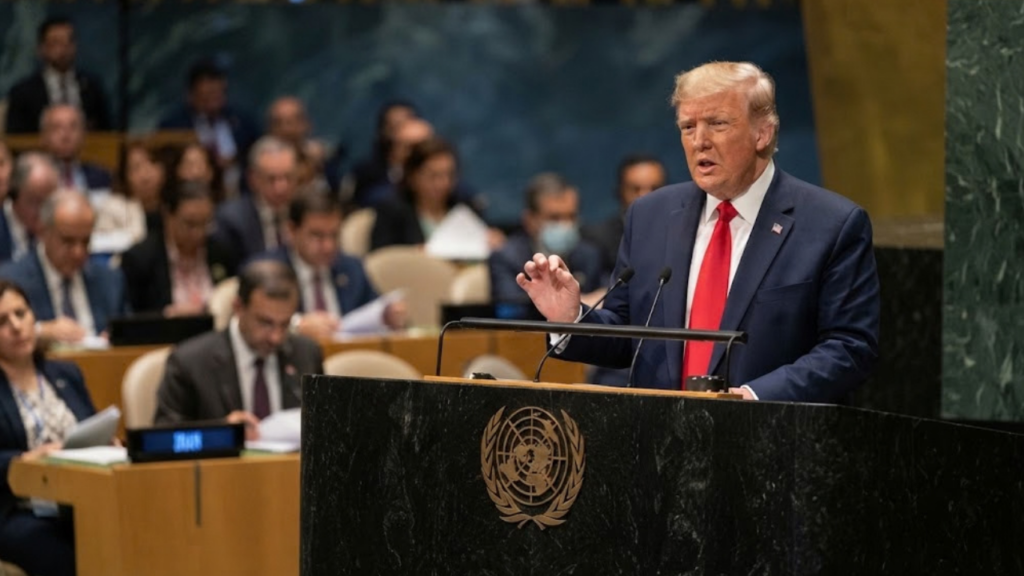
The Iran talks at the UN wrapped after three hours on Tuesday, Donald Trump told reporters, a strikingly calm coda to a speech in which he’d spent the morning threatening to erase the country entirely.
Addressing the UN General Assembly in New York, the American president framed the nearly seven-month war with Iran as a binary choice. Iran could accept a deal and rebuild into, in his words, one of the greatest countries in the Middle East, or he could “annihilate the Islamic Republic” and give it no chance of recovery. He lingered on the second option rhetorically, then turned hours later to describe the day’s actual diplomacy in far cooler terms.
What the Iran Talks at the UN Actually Produced
The substance behind the podium theatrics was a closed-door meeting between US and Iranian officials, conducted through mediators on the sidelines of the General Assembly’s high-level week. Special envoy Steve Witkoff and White House adviser Jared Kushner, who have led the American side of the negotiations since the war began, took part.
Trump told reporters afterward the session ran three hours and called it “very good” and productive, adding that a follow-up meeting was already being scheduled. Witkoff echoed the assessment but, like Trump, gave no specifics on what was discussed or how close either side is to a written agreement.
The gap between the speech and the meeting room says something about where this conflict actually stands. Since Israeli and American strikes opened the war in late February, the fighting has cycled through at least two ceasefires that didn’t hold: a Pakistan-brokered pause in April and a more detailed 14-point framework, the Islamabad Memorandum, signed in June.
Both briefly reopened the Strait of Hormuz to shipping before new attacks shut it again. As of this week, US Central Command has redirected 110 ships around the strait as part of an ongoing naval blockade, and Tehran has again attached conditions to letting commercial traffic back through, a standoff that has already spilled into aviation, where new sanctions on Iranian carriers took effect this week.
Iran’s public posture on Tuesday was defiance, not concession. Parliamentary speaker Mohammad Bagher Ghalibaf told state media Tasnim that the country would “never surrender” and would keep responding with force. Issued the same day Iranian officials sat across the table from American negotiators, that isn’t necessarily a contradiction, Iranian leaders have paired battlefield rhetoric with active talks before, including during the two earlier ceasefires that eventually collapsed. Domestically, the line serves a purpose too: it lets Tehran negotiate without appearing to negotiate from weakness, a balance it has struck through nearly every prior round of this war.
UN Secretary-General António Guterres used his own remarks to push both sides, and the wider region, toward something more durable than another pause. “So-called ceasefires have amounted to little more than lesser fires, with civilians continuing to pay the price,” he said, urging leaders gathered in New York to use the week for genuine de-escalation rather than another temporary fix. His comment reflected a pattern the last seven months have made familiar: agreements that ease the immediate danger without resolving what caused it.
Trump, for his part, suggested a resolution is closer than the war’s history would predict, saying he expects a deal to come together soon, though he offered no timeline. That optimism is exactly what made these Iran talks at the UN worth watching in the first place, not because the two sides met, but because every previous meeting like it has ended the same way, with a pause instead of a resolution.
Whether Tuesday’s meeting becomes the third pause in a conflict that has already outlived two of them is the question neither government answered on the record. For a region that has watched two previous frameworks unravel within weeks of being signed, that uncertainty is not a footnote, it is the story, and it is one the next round of talks, whenever it happens, will still have to answer.
[…] administration also pointed to a 2025 appeals court decision that let it temporarily keep the Associated Press out of the Oval Office and Air Force One. […]
[…] may not actually be seeking. The caution echoes a broader pattern this week, as leaders navigated rising tensions at the UN over Iran alongside the warnings about […]
[…] The Strait of Hormuz is the narrow waterway at the mouth of the Persian Gulf, through which about one-fifth of the world’s oil normally passes. Trump said Iran offered to open the strait but called the overall proposal not good enough. HCN has not seen Iran’s proposal in full, so its terms are as described by those outlets, not confirmed by Tehran or Washington. For earlier coverage of the diplomatic track, see HCN’s report on the Iran talks at the UN and Trump’s warning. […]
[…] agreement signed in June was meant to end the war, but attacks continued afterward. In September, Iran talks at the UN ran for three hours, and Trump called the meeting very good. No settlement has followed, and the […]