
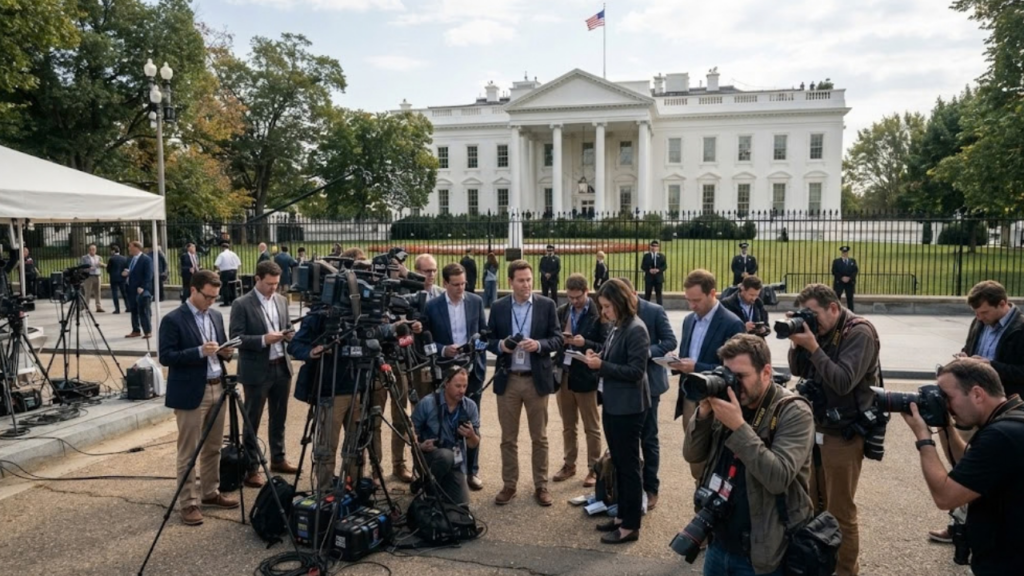
A federal judge in Washington has temporarily blocked the White House press ban on CNN, MS NOW and Politico, ordering the administration to restore the reporters’ credentials after finding that President Donald Trump’s ban was likely unconstitutional. The restraining order, issued early Thursday by U.S. District Judge Timothy Kelly, reinstates the journalists’ access to the White House complex for 14 days while he considers longer-lasting relief. Trump said before the ruling that he expected to lose and would appeal. The order is preliminary and does not decide the case. But it is the first judicial answer to a ban that took effect within a day of its announcement and reached the courts within a week.
How the White House press ban unfolded
Trump announced the ban on Friday, Sept. 18, in a social media post that accused the three outlets of reporting fake news and said other organizations could follow. On Saturday, Secret Service officers turned away reporters from the outlets and took their “hard passes,” the credentials needed for access. The outlets sued on Monday, arguing that the ban violated both their First Amendment rights and their right to due process. They said in a joint statement that they were acting to defend the principle that the government does not decide what the press publishes. The named journalist plaintiffs are CNN’s Betsy Klein, MS NOW’s Akayla Gardner and Politico’s Cheyenne Haslett.
What the judge found
In an eight-page order, Kelly said the outlets were likely to succeed in showing that their journalists lost their passes without prior notice or a chance to challenge the decision. He also noted that some of the coverage the White House cited as justification was routine and, in some cases, months old. The government argued that national security concerns drove the decision, but Kelly said he was skeptical. He wrote that nothing in the record before the lawsuit suggested national security motivated the revocations. Trump’s own announcement, he noted, focused on what Trump described as untruthful and negative coverage.
The judge also refused a Justice Department request to delay the order for at least two days. Doing so, he wrote, would defeat the purpose of an emergency order, which is to preserve the last uncontested status quo while the case continues. Kelly was nominated to the bench by Trump in 2017. A fuller ruling on longer-lasting relief has not yet been issued.
The precedent behind the ruling
Much of the reasoning rests on a 1977 decision by the U.S. Court of Appeals for the D.C. Circuit, known as Sherrill, which held that the White House cannot arbitrarily deny a journalist a hard pass without due process. At Wednesday’s hearing, Kelly said he had been surprised to find how clearly earlier courts had recognized that interest. Government lawyers argue those cases were wrongly decided, but Kelly said he still has a duty to apply them. Only a higher court could overturn the precedent. That leaves the administration with an appeal as its main route to change the rule.
The government’s defense of the ban
Justice Department lawyers defended the White House press ban, telling the court that access to the White House is a privilege, not a right. Letters from the White House press office said the outlets had violated standards of professionalism and decorum, including by publishing what it called falsehoods about national security and sensitive or classified information. Those letters, however, went out after the passes were revoked, and offered the outlets until Friday to object before a final decision. Kelly questioned whether a notice sent after the fact could satisfy due process requirements. Ted Boutrous, the outlets’ lawyer, said the national security rationale never appeared in Trump’s original announcement.
The administration also pointed to a 2025 appeals court decision that let it temporarily keep the Associated Press out of the Oval Office and Air Force One. Government lawyers said national security concerns carry added weight this week because Chinese President Xi Jinping is visiting Washington. Trump has separately said the outlets produce negative news meant to diminish his administration and the Republican Party. The outlets deny that the ban has anything to do with national security and describe it as retaliation for coverage the president dislikes.
What remains unresolved
It was not clear from available reporting whether the White House had returned the passes by the time of publication, or whether the government had filed an appeal. The judge has not yet set out a schedule for the next stage of the case, and it is unknown which other outlets Trump had in mind. The outcome will help define how much discretion a president has over which news organizations may work inside the White House, and what process the government must follow before removing them. The White House Correspondents’ Association has condemned the press ban as a violation of the First Amendment. For readers outside the United States, the case is a test of how far courts will check an executive’s control over who covers it.
[…] Serbia’s politics carry weight beyond its borders. Belgrade has close political, economic and cultural ties with Serbian communities in Bosnia and Herzegovina, Montenegro and Kosovo, so the outcome is being watched across the Western Balkans. Related HCN coverage: White House press ban blocked by federal judge […]