
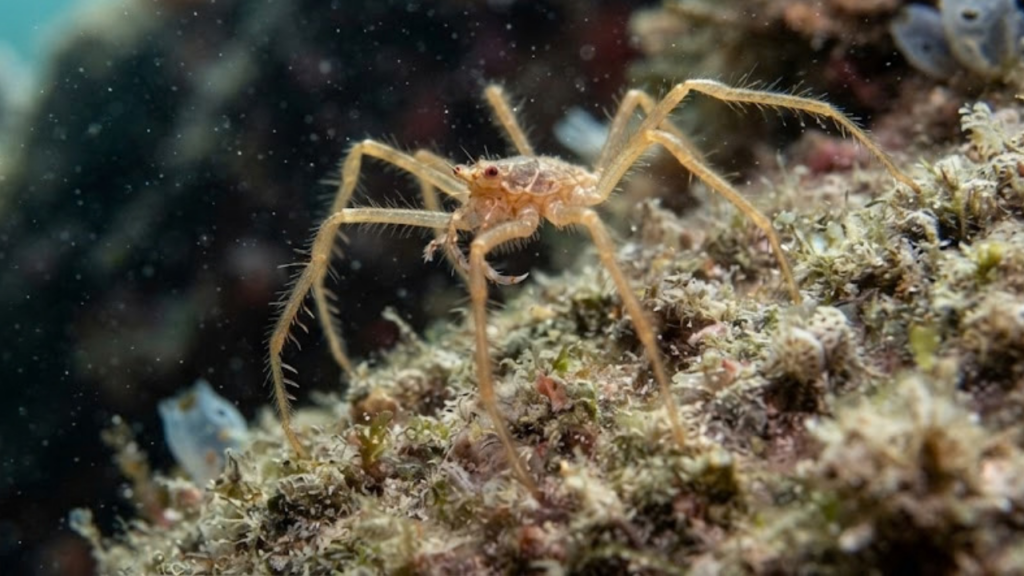
Two new sea spider species have been described from Canada’s Salish Sea, the first to be added there in almost a century. Researchers at the University of British Columbia announced the pair on Wednesday, September 23, in a study published in Organisms Diversity & Evolution. One has red eyes and hairy legs. The other is routinely found under a coat of debris and its own parasites.
Why the Salish Sea’s sea spiders went unrecorded for so long
Sea spiders are marine arthropods, not true spiders. They are distant relatives of spiders, scorpions and horseshoe crabs, and they have lived in the ocean for roughly 500 million years. Some species have as many as 12 legs, all of them carry a sucking proboscis, and body size runs from under a centimetre to more than 70 centimetres in Antarctic waters. Biologists still know little about the group, and many of the small shallow-water species survive as parasites, using the proboscis to feed on larger animals.
That thin record is exactly what the lead author, Cormac Toler-Scott, ran into. He was working toward a master’s degree in zoology at UBC and wanted to learn how sea spiders respond to climate change and human disturbance, but found nothing to build on. Without a list of which species live in the region and how they live, he says, there is no baseline against which to measure harm.
Two new sea spider species, very different in habit
The first animal, Callipallene pilosuspedes, takes its species name from Latin words for “hairy feet,” a reference to the curved spines along its lower legs. Its eyes are red. It grips food with a short, claw-tipped proboscis before biting, and its triangular mouth has three lips fringed with sensory tendrils. The most telling feature is a pair of limbs called ovigers. In sea spiders it is the males that raise the young: a male gathers the eggs with his ovigers, coats them in glue from his legs and carries them on his body. In C. pilosuspedes these limbs are agile enough that researchers saw them used as grooming tools, sweeping debris from the legs with comb-like spines. Oceanographic Magazine reports that only one specimen of this species has been found so far.
Tanystylum kiixin shows the opposite. Its ovigers are smaller and less dexterous, so it cannot clean itself properly, and collected animals were often caked in sediment and carrying microscopic parasites, which makes each animal something like a small habitat for others. Toler-Scott describes the result as “an ecosystem within an ecosystem within an ecosystem.” The name comes from an ancient Indigenous village site near where the first specimens were taken. Pronounced “kee-hin,” the word refers to the sound of waves breaking at the base of that site.
How the team confirmed the find
The animals were collected between September 2023 and August 2024 on dives to depths of up to 18 metres, roughly 60 feet, at Quadra Island, Vancouver, Bamfield and Victoria. The study is the first comprehensive assessment of the region’s sea spiders to combine detailed imaging with DNA analysis. It also produced genetic data for several species that had never been sequenced, plus an identification guide for the region, and both new sea spider species are now registered in a global taxonomic database.
What the new sea spider species mean for conservation
Toler-Scott’s argument is simple: marine invertebrates cannot be protected from climate change or other pressures until scientists can identify them. The genetic data and identification guide that came with the two new sea spider species give future surveys a starting point that did not exist before. For readers wondering what changes now, the two names are official entries that other scientists can cite, test against new specimens and refine.
Questions about where animal groups come from and how they are related keep reshaping what scientists think they know about the natural world, as with HCN’s report on the Bat1K study of where bats originated. The find in British Columbia is smaller in scale, but the new sea spider species came about the same way: careful sampling and DNA turned an overlooked group into a documented one. Toler-Scott had one field season, and he says more undescribed diversity is out there. Whether other new sea spider species are still hiding in the Salish Sea, and how many will be recorded before conditions change for them, is not yet known.
[…] Diamondback terrapins are small turtles that live in coastal estuaries. The northern subspecies is found along the Atlantic coast from Cape Cod south to Cape Hatteras, North Carolina. In Massachusetts, their populations are largely concentrated around Cape Cod and a few other coastal spots, according to Popular Science. A 2021 report on a similar hatchling described the species as threatened in the state. HCN has also reported on a new sea spider species found in the Salish Sea. […]