
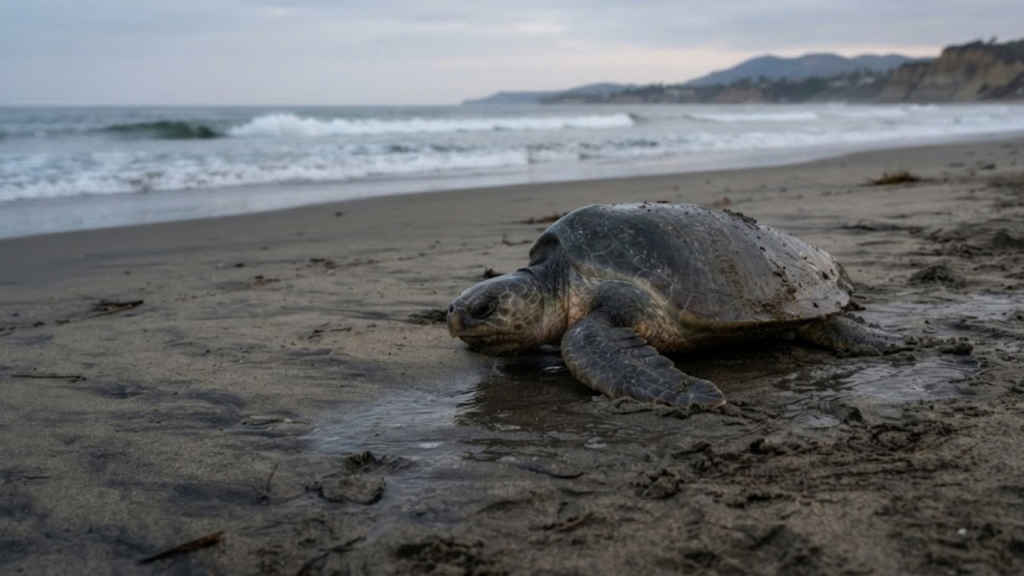
On 16 September, an olive ridley sea turtle crawled out of the Pacific near Seal Beach in Orange County, dug a hole in the sand and laid her eggs, something no sea turtle has ever been recorded doing on the US West Coast. The Huntington Beach Fire Department filmed it, and the footage was later shared by NOAA Fisheries. Three days afterwards a turtle came ashore again near the Huntington Beach Pier, a few miles to the south, and laid a second nest. Both spots are now fenced off and signposted, and each is thought to hold between 50 and 100 eggs.
NOAA Fisheries describes it as the first-ever recorded natural nesting of any sea turtle species on this coast. The bigger questions come after that: why an olive ridley sea turtle turned up in Southern California at all, whether these eggs have any real chance, and what a couple of nests can tell us about where the species is heading.
What NOAA has confirmed so far
The early assumption was that one female had made both nests. NOAA Fisheries and the California Department of Fish and Wildlife have since established, according to later reports, that two different turtles were involved, which makes the event a little less of a fluke than a single confused animal would have been. Justin Viezbicke of NOAA Fisheries also pointed to something odd about the behaviour. Olive ridleys ordinarily nest at night, he said, yet at least one of these came up during the day, around sunset. He added that there could be other nests that no one has found, which is a fair worry on a busy coastline, where an olive ridley sea turtle nest laid in the dark could easily go unnoticed.
The olive ridley sea turtle is the smallest sea turtle in the Pacific, growing to roughly three feet and about 100 pounds, and it is protected under the US Endangered Species Act. Its usual nesting beaches lie in Mexico, Nicaragua, Costa Rica and Panama, and the nearest regular nesting to California is at the southern tip of Baja California, hundreds of miles away. Southern California does see the odd olive ridley now and then when warm currents drift one north, but until this month none had ever been documented nesting on American shores.
Why an olive ridley sea turtle came this far north
Nobody knows yet why an olive ridley sea turtle would choose these beaches, and NOAA says so plainly. Viezbicke called it the “million dollar question,” The Guardian reported, and scientists are weighing several explanations at once: unusually warm coastal water, the wider effects of El Niño, or a recent Pacific hurricane that may have blown the turtles off course. The water part is easy to believe. Data from the Scripps Pier in San Diego show 42 days of record-high water temperatures so far in 2026, and Todd Steiner, an ecologist who founded the Turtle Island Restoration Network, told the San Francisco Chronicle he thinks this year’s strong El Niño is the likely reason the turtles came.
There is a wrinkle worth understanding, though. Sea turtles are known for returning to nest in the same region where they hatched, a habit biologists call natal homing. That makes two females nesting in California an oddity rather than a natural extension of a tropical population, and it suggests these turtles did not head for Orange County on purpose. That is my reading of the biology rather than something officials have said. Lance Adams, a veterinarian at the Aquarium of the Pacific in Long Beach, has floated a bigger possibility, that this could be an early sign of nesting creeping north as warming oceans reshape the species’ range, though he stressed it is much too soon to say.
What has to go right for these eggs to hatch
Incubation in this species typically lasts 45 to 60 days. Counting from 16 and 19 September, hatchlings, if there are any, would emerge between the end of October and about the middle of November. That is my own arithmetic and not an official forecast, and ABC7 Los Angeles was careful to say it will be weeks before anything could hatch, “if they hatch at all.” Temperature is the great unknown. Tropical beaches stay warm through the whole incubation period, while these nests will spend part of it in Southern California sand that is cooling into November, and nobody has data on how that will play out because it has never happened before.
Temperature also decides whether the babies are male or female, with warmer sand producing more females, so the weather over the next two months will shape the makeup of any clutch as well as its chances. Conservation groups such as the Olive Ridley Project put the odds at about one in a thousand for a sea turtle hatchling to reach adulthood, and an olive ridley sea turtle nest on a busy public beach adds obstacles that a remote tropical shore does not. That is why NOAA and its state and local partners are asking people to stay well back and leave the fencing and signs alone.
Why two olive ridley sea turtle nests are not a new nesting ground
It helps to keep this in proportion. Olive ridleys are famous for the arribada, a mass nesting in which thousands, and sometimes tens of thousands, of females come ashore together on a handful of beaches in Mexico, Nicaragua, Costa Rica and Panama. Against that, two solitary nests in Orange County are tiny, and one unusually warm autumn is not a trend. The species can ill afford to lose eggs. The Inertia cites an estimated 30% to 36% decline in its population over the past century, and NBC Los Angeles lists bycatch in fishing gear and harvest as leading threats.
Still, the season may not be finished. According to The Guardian, nesting is not over and an individual olive ridley typically lays several nests, and NOAA has said openly that other nests could exist. The National Wildlife Federation puts it at one to three nests per female in a season, so a few more discoveries would not be a surprise. For another wildlife story from the past week, see HCN’s coverage of the Fat Bear Week 2026 bracket at Katmai.
What matters most now is the calendar. If tiny turtles scramble down a California beach into the Pacific in November, it will mean the nests worked. Whether an olive ridley sea turtle ever tries this again, in California or anywhere else this far north, is something only future seasons can answer.