
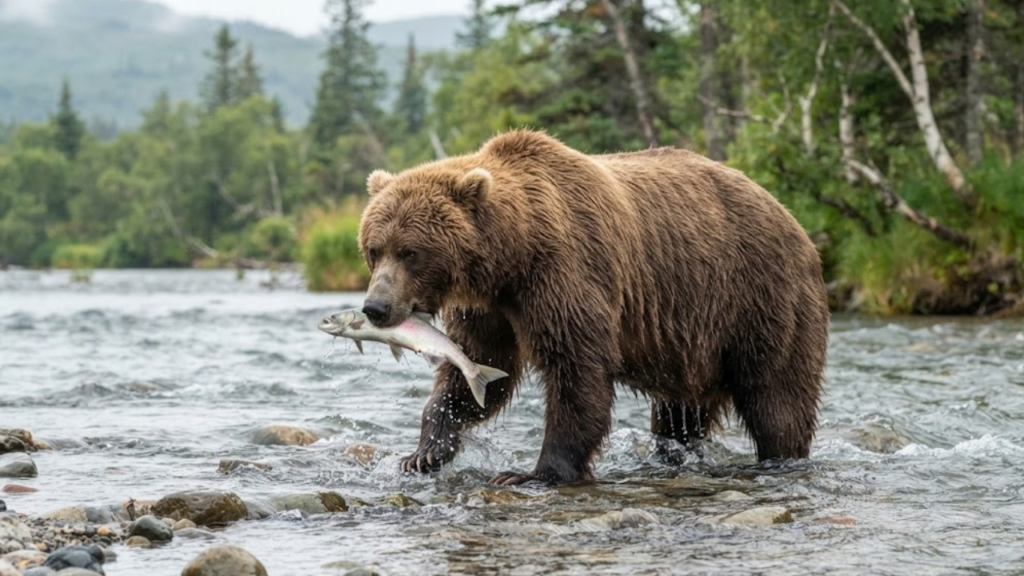
Sixteen brown bears are competing in this year’s Fat Bear Week 2026 bracket, four more than any previous edition, after Katmai National Park and Preserve reported one of its busiest cub seasons in years.
Voting opened Tuesday at Brooks River in southwest Alaska, where the bears spend their summers gorging on salmon before a winter with nothing to eat at all. The single-elimination bracket, run jointly by the National Park Service, Explore.org and the Katmai Conservancy, pairs bears head-to-head through fatbearweek.org, with the public choosing who advances each round. The final vote closes on September 29.
Fat Bear Week 2026: A Bigger Field Than Ever
Twelve bears made the cut in past years. This time the field includes five family units, two subadults, four single adult females and six adult males, according to the park service. Naturalist Mike Fitz, a former Katmai ranger now with Explore.org, counted 37 cubs along the river this year, a record for the park.
“There are more cubs at Brooks Camp this year than have been seen in a long time,” Park Superintendent Mark Sturm said in the announcement. “A new generation of fat bears is taking shape, and they’re off to a strong start.”
The expanded bracket reflects that shift directly. Where past tournaments leaned heavily on solitary adults, this year’s field folds in whole family units, letting cubs ride into the competition alongside their mothers rather than competing separately, as they had in past years under a junior bracket that has been retired for the 2026 season.
Defending Champion Returns
Defending the crown is Bear 32, known as Chunk, who beat rival Bear 856 in last year’s final after two previous runner-up finishes. Park officials say he has recovered from a broken jaw sustained in 2025 and returns as the field’s most recognizable face, having spent the summer rebuilding the bulk that made him a favorite in the first place.
Among the newcomers is Bear 89, nicknamed “Backpack” after an injury as a cub left him riding on his mother’s back for a stretch. Bear 151 Walker, described by rangers as one of the river’s more dominant animals, also joins the bracket for the first time in several seasons, known among regular viewers of Katmai’s live bear cams for holding prime fishing spots at Brooks Falls against younger, hungrier rivals.
Katmai ranger Sarah Bruce, who helped unveil the matchups, said the contest isn’t only about size. Mothers raising cubs face different pressures than solitary males building fat reserves for hibernation, she noted, and voters weighing which bear looks fattest should factor that in before casting a ballot.
From a One-Day Event to a Global Vote
Fat Bear Week began in 2014 as a single day meant to draw attention to the park’s brown bear population, which numbers around 2,200 across Katmai’s 6,562-square-mile range on the Alaska Peninsula. It grew into a full week the following year and now draws a global audience: more than 1.7 million votes came in from over 100 countries during last year’s tournament, according to figures the National Park Service has published on the park’s bear monitoring program.
The event has become one of the more visible public entry points into North American bear conservation, sitting alongside a wider push by wildlife agencies to track how healthy salmon runs and protected habitat translate into stronger animal populations — the same logic driving international efforts like the one outlined in HCN’s report on which countries are lagging on the 30×30 biodiversity target.
The contest also carries a fundraising arm. Donations made through October 3 to the Katmai Conservancy’s Otis Fund, named for the four-time champion who died in 2024, will be matched by Explore.org, with proceeds going toward bear research and habitat protection at Brooks River.
Whichever bear voters crown by next Tuesday, Katmai’s rangers say the real story is the river itself — a season that, by their count, produced more new bears than the park has seen in years, with no way yet to know how many will make it back for salmon season in 2027.
[…] Working out that bats originated in Europe took samples from far beyond it. Researchers from the Wildlife Conservation Society supplied samples from the hammer-headed bat in Congo, the largest bat in mainland Africa, and Burton Lim of the Royal Ontario Museum provided about a third of all samples, collected mostly in tropical South America and Southeast Asia. For another look at how wildlife science reaches a wide audience, see HCN’s coverage of the Fat Bear Week 2026 bracket at Katmai. […]
[…] Still, the season may not be finished. According to The Guardian, nesting is not over and an individual olive ridley typically lays several nests, and NOAA has said openly that other nests could exist. The National Wildlife Federation puts it at one to three nests per female in a season, so a few more discoveries would not be a surprise. For another wildlife story from the past week, see HCN’s coverage of the Fat Bear Week 2026 bracket at Katmai. […]