
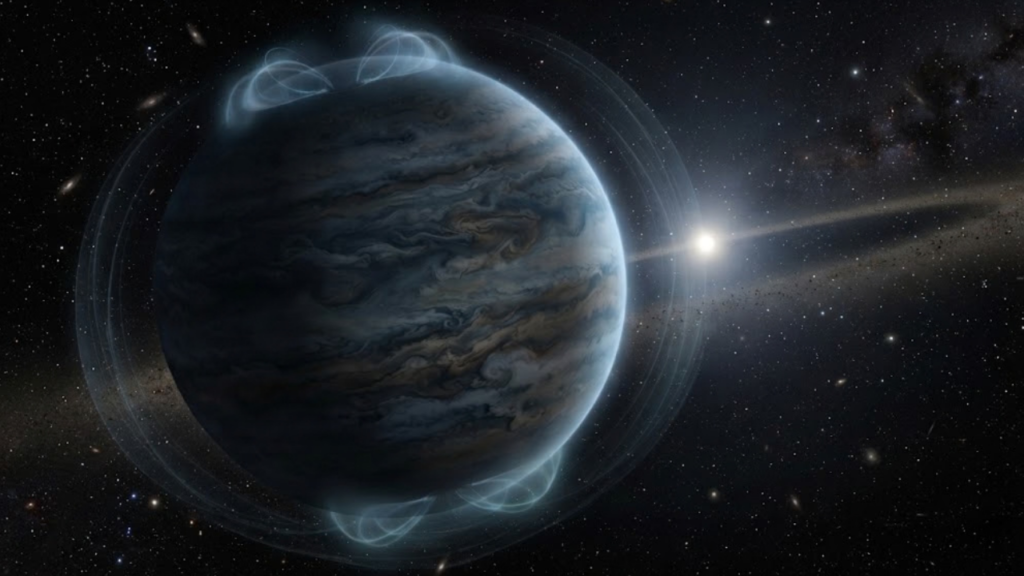
Astronomers have confirmed the first Beta Pictoris b radio detection ever traced directly to a planet outside our solar system, not a signal from anyone, but the fingerprint of an aurora and a magnetic field far stronger than our own. The planet is Beta Pictoris b, a young gas giant roughly 63 light-years from Earth, orbiting a star hotter and more massive than the sun. Researchers from the Center for Astrophysics at Harvard and Smithsonian and the University of Oregon observed the system four separate times across 2025 and 2026 using South Africa’s MeerKAT radio telescope array, catching short radio bursts that flared and faded within minutes, layered over a steadier background hum.
How the Beta Pictoris b Radio Detection Was Confirmed
Radio emission from planet-hosting star systems isn’t new. Pinning that emission to the planet itself, rather than the star it orbits, has been the hard part. The team solved that by using distant quasars as fixed reference points, letting them map the radio source precisely enough to rule out the star and place it squarely at Beta Pictoris b.
Much of the signal was circularly polarized, the radio waves twisted through space in a corkscrew pattern rather than a straight line. That’s the signature of a process called electron cyclotron maser instability, the same mechanism behind the auroras that light up Earth’s poles and generate Jupiter’s own radio bursts. Known radio-emission processes tied to the host star itself, the researchers say, don’t explain what they recorded.
Because aurora strength tracks directly with a planet’s magnetic field, the detection let the team estimate that field for the first time on a world beyond our solar system. The field appears thousands of times stronger than Earth’s, consistent with what theory predicts for a young, massive gas giant still radiating heat from its formation.
Why This Matters Beyond One Distant Planet
A planet’s magnetic field does more than produce pretty lights. It shields an atmosphere from being stripped away by the stellar wind pouring off its star, the same protection Earth’s field provides against the sun. For astronomers trying to work out which distant worlds could plausibly hold onto air and water long enough to matter, being able to measure that field directly, rather than estimate it indirectly, is the real advance here.
Joe Callingham, an astronomer at the University of Amsterdam who had no role in the research, called the result an exciting one for the field if the finding survives scrutiny. “This result, if it holds up in peer review, is an incredibly exciting advancement,” he said. “It would be a fantastic result.” That caveat matters. The full observational details and analysis were posted September 15 to the preprint server arXiv, and the paper has not yet been peer-reviewed. The researchers themselves frame it as a strong candidate detection rather than a settled fact, which is standard practice before a finding this significant gets formally published in a journal.
The MeerKAT array itself, 64 dishes spread across the Northern Cape near the town of Carnarvon, is a precursor instrument to the Square Kilometre Array, the next-generation radio observatory now under construction, and will eventually be folded into that larger project. Beta Pictoris itself is classified as an A6V star, meaning it burns hotter and shines brighter than the sun, and its planetary system is still young enough by astronomical standards that Beta Pictoris b is thought to be radiating leftover heat from its own formation.
Instruments built for exactly this kind of faint, precisely localized signal are still years from full operation, which means Beta Pictoris b may not stay the only planet with a directly measured magnetic field for long. Astronomers now have a method, and a first confirmed example, to go looking for the same signature elsewhere.
[…] in the field does. It’s a pattern showing up elsewhere in science coverage this year too — a recent radio detection traced directly to a distant exoplanet for the first time was also a case of researchers finally reading a signal that had been sitting there, waiting to be […]