
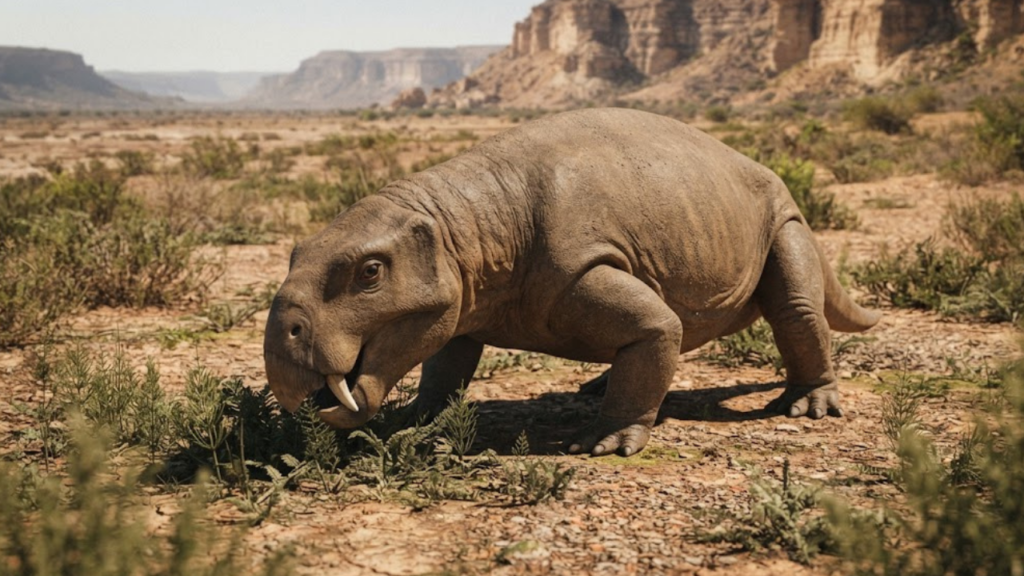
For sixty years, a box in a London museum held the answer to a question nobody was asking yet. Now that it’s finally been opened, scientists say it may reset how old some of the world’s earliest dinosaur fossils really are. The bones belong to a newly named animal, scientists are calling it the Dinodontosaurus isiyavamanda fossil, dug up in Tanzania and only now identified by a team at the University of Bristol. It wasn’t a dinosaur. It was something stranger and, in its own way, more useful, a tusked, beaked plant-eater called a dicynodont, part of the mammal family tree, living around 240 million years ago in rocks that also happen to hold Tanzania’s most famous fossil mystery: possible evidence of the earliest dinosaurs anywhere on Earth.
Here’s where the story gets interesting. A British team dug the skull and part of the skeleton out of the ground back in 1963 and shipped it off to the Natural History Museum. And there it stayed, unstudied, unnamed, gathering dust while paleontology moved on around it. A second, smaller skull turned up in 2012. It took CT scans and 3D imaging, decades later, for researchers to realize what they actually had.
Dinodontosaurus was supposed to be a South American animal. Only South America. That was the rule, until this fossil broke it. And that’s really the heart of why the Dinodontosaurus isiyavamanda fossil matters so much: it changes the math on Tanzania’s rock layers. Geologists had dated the Manda Beds, the formation these bones came from — partly by comparing them to South African rocks thought to be roughly the same age. But Dinodontosaurus has a solid, well-established date in Brazil and Argentina. If it also lived in Tanzania, the rocks there line up with the South American ones instead, and that pushes the timeline younger. Potentially by a lot. Researchers now think Tanzania’s so-called oldest dinosaur candidates could be up to 10 million years younger than everyone assumed.
“This fossil specimen from Tanzania has been in our care for over 60 years, and it’s wonderful that its identity has now been brought to light,” said Dr. Mike Day, who curates non-mammalian tetrapods at the Natural History Museum. He added that finding Dinodontosaurus on two continents “offers a glimpse of our planet 240 million years ago.” The full write-up, CT data, phylogenetics, all of it, ran in the Journal of Vertebrate Paleontology.
One more detail worth knowing: the species name, isiyavamanda, comes from the Wamanda people, whose land this is and whose help recovering the original skeleton back in 1963 made the whole discovery possible in the first place. The researchers made a point of naming that.
There’s still work left. Most of what the team has actually studied so far is the skull and jaw, the rest of the skeleton is sitting there waiting for someone to compare it properly against the South American cousins. They also want to figure out how so many large plant-eating species managed to coexist in the same Triassic ecosystem without one simply pushing the others out, which is its own puzzle entirely. It’s also worth saying plainly why any of this matters outside a paleontology department. The “oldest dinosaur” title isn’t just trivia. Every time a candidate fossil gets re-dated, it shifts the whole map of when dinosaurs actually split off from their reptile relatives and started spreading across the planet. Shave 10 million years off one site, and suddenly a dozen textbook timelines need a second look.
None of this settles when or where dinosaurs first showed up. If anything it just moves the goalposts a little. But it does prove something else, almost by accident: sometimes the breakthrough isn’t in the ground. It’s in a drawer that’s been closed since 1963, waiting for someone to look twice, not unlike a recent radio signal traced directly to a distant exoplanet for the first time, another case this year of scientists finally making sense of something that had been sitting there all along.