
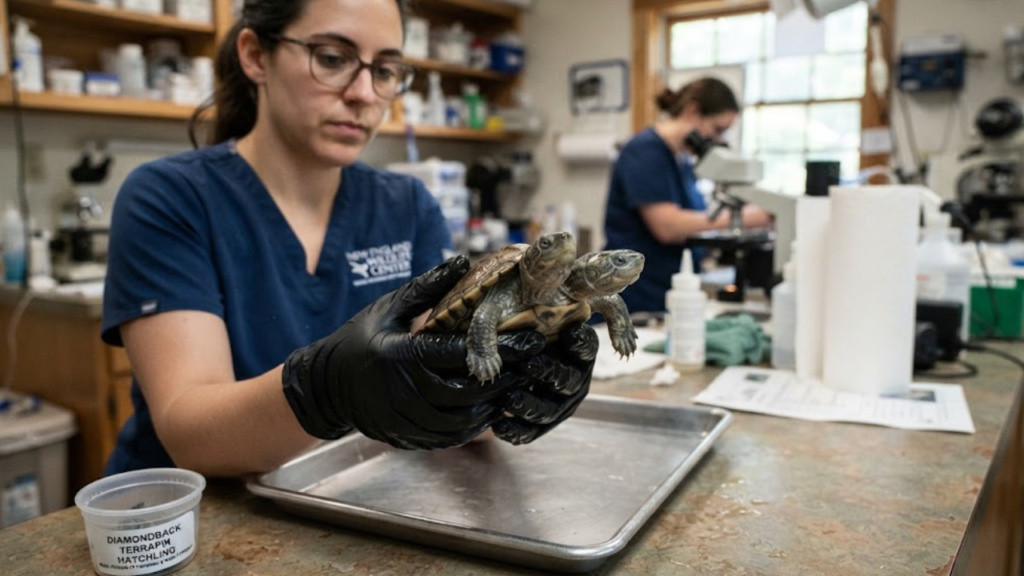
A two-headed diamondback terrapin that hatched in mid-September is now being cared for at a wildlife center on Cape Cod, Massachusetts. The baby turtle weighs just 5.2 grams, about the size of a nickel, and its two heads share one body. Vets do not yet know how it will develop, but staff are watching its feeding, growth and behavior closely, and the case is only the third of its kind the center has handled in five to six years.
How the hatchling reached the Cape Wildlife Center
The hatchling arrived at the Cape Wildlife Center in Barnstable on Thursday, Sept. 17, 2026. Staff from Mass Audubon’s Wellfleet Bay Wildlife Sanctuary brought it in after it was found at a protected nesting site in Wellfleet. Fox Weather reported that the find came during nest monitoring, shortly after the turtle hatched. The center, which is part of New England Wildlife Centers, shared photos of the tiny arrival in a Facebook announcement.
Diamondback terrapins are small turtles that live in coastal estuaries. The northern subspecies is found along the Atlantic coast from Cape Cod south to Cape Hatteras, North Carolina. In Massachusetts, their populations are largely concentrated around Cape Cod and a few other coastal spots, according to Popular Science. A 2021 report on a similar hatchling described the species as threatened in the state. HCN has also reported on a new sea spider species found in the Salish Sea.
Why a two-headed diamondback terrapin is so rare
Bicephaly is the medical term for an animal born with two heads. The Cape Cod Times reported that published estimates often put the odds at roughly one in 100,000 hatchlings, and described the chance as “very, very uncommon.” Two-headed animals generally face greater challenges, the paper said, although some have lived for decades.
The center has seen this before, though not often. Zak Mertz, CEO of New England Wildlife Centers, told Popular Science this is the organization’s third set of two-headed terrapins in six years, while the Cape Cod Times put the span at five years. Mertz has also said there is little research on the condition, so each case adds to what vets and the public can learn.
An earlier case offers a comparison. In 2021, a two-headed diamondback terrapin hatchling with six legs was cared for at the same Barnstable center, and each head controlled three legs while swimming. Coverage at the time said that turtle came from a West Barnstable nest in a hazardous spot, surfaced for air with each head at different times, had two digestive systems, and ate blood worms and food pellets.
What vets are still trying to learn
Vets are waiting for the hatchling to grow before doing advanced imaging that should show more of its internal anatomy, Popular Science reported. Mertz told Fox Weather that scans of the two earlier turtles suggested fairly separate anatomy, while this one appears to share much more. None of the coverage HCN reviewed says how many legs it has or how the shared anatomy might affect its health.
The center is hopeful. Fox Weather reported that staff believe the turtle’s quality of life is good, and they hope it can live a long, healthy life like other two-headed turtles they have heard about. They also want to use the case to show the public how such animals can live.
Several basic questions are still open. Coverage so far does not say whether the two-headed diamondback terrapin will eventually be released, when the imaging might happen, or how its condition may change as it grows. The reports HCN reviewed also do not say where in Wellfleet the nest was located. Until those answers arrive, the hatchling remains a rare chance for vets to study an unusual animal up close. HCN will update this story as new facts emerge.