
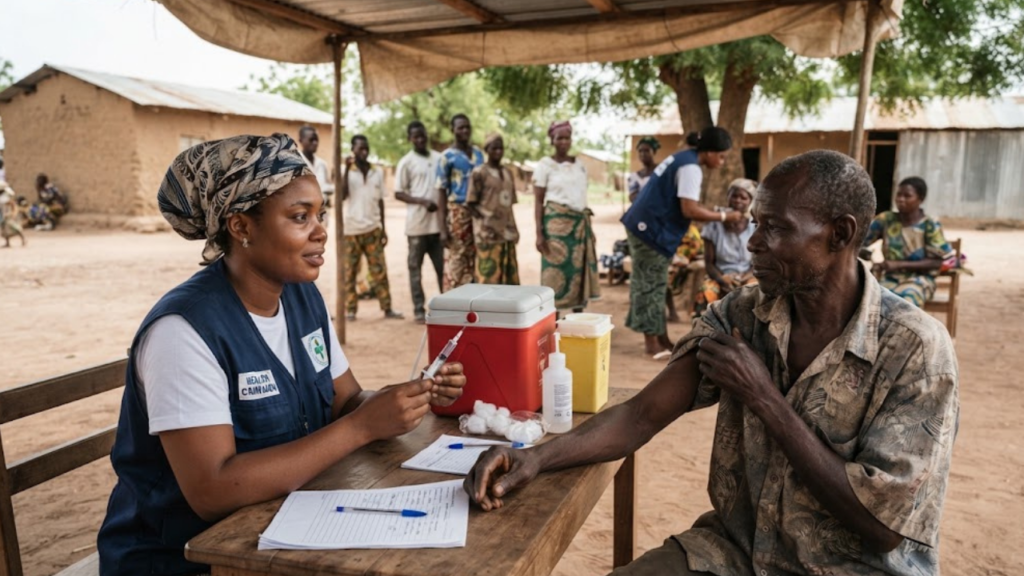
Reported meningitis deaths in Africa’s meningitis belt fell about 30% in 2025, while most human plague cases came from Madagascar and the Democratic Republic of the Congo (DRC), according to WHO’s latest data on meningitis and plague. The figures appeared on 29 September 2026 in the agency’s Weekly Epidemiological Record, alongside its annual cholera report.
The meningitis and plague reviews sit beside the cholera report and share one difficulty with it: the counts depend on which countries report. WHO says so itself, cautioning that the drop in meningitis cases cannot be read as an equal fall in disease burden.
Meningitis in Africa’s belt: deaths down, cases hard to compare
In 2025, 24 of the 26 countries in WHO’s enhanced surveillance network sent data, reporting 21,526 suspected cases and 971 deaths, a fatality rate of 4.5%. A year earlier the total was 26,457 suspected cases and 1,397 deaths. On those crude totals, cases fell 18.6% and deaths 30.5%.
The case decline needs care. Ethiopia and Uganda, which together reported 3,766 cases in 2024, sent no data for 2025, and WHO says that gap explains 76% of the apparent drop. Among countries that reported in both years, cases fell 5.9%, while deaths fell 30.8%.
WHO adds that incomplete 2024 reporting from the DRC and Nigeria understated that year’s totals for both cases and deaths, so the true reduction may be larger than the figures suggest. Deaths were less sensitive than cases to the change in the reporting pool, though the agency still advises caution when comparing years.
Three countries carried most of the burden. The DRC reported 5,602 suspected cases and 419 deaths, Nigeria 3,916 and 143, and Niger 2,604 and 110, together 56.3% of all cases. The DRC alone accounted for 43.2% of deaths.
Fatality rates varied from zero in three countries to 20.8% in Sierra Leone. WHO warns that these rates rest on suspected rather than confirmed cases, that some involve very small numbers, and that the two highest came from countries outside the belt that submitted no data on the bacteria involved.
Laboratory results, which identify the cause of an infection, covered fewer patients. Countries collected 8,569 spinal fluid specimens, 42.6% fewer than in 2024. Of the 1,280 in which a bacterium was identified, Streptococcus pneumoniae accounted for 39.9%, followed by meningococcus, the bacterium behind epidemic meningitis, in serogroups C (28.4%) and W (17.3%). None was serogroup A.
Vaccines changed the belt’s picture, but epidemics continue
A conjugate vaccine against serogroup A, introduced from 2010, cut confirmed cases of that type by more than 99% in vaccinated populations. WHO reports no confirmed serogroup A case since 2017 in countries that adopted it. Epidemics caused by other serogroups continue.
A newer vaccine covering five serogroups is now being introduced for outbreak response and preventive campaigns. Niger ran the first country-wide campaign using it in 2025, and WHO frames the effort as part of its goal to defeat meningitis by 2030.
The stakes are high because meningitis can kill within 24 hours without prompt treatment, according to WHO, and about one in five survivors is left with lasting effects such as hearing loss, seizures or cognitive problems. WHO also flags a reporting gap: Nigeria recorded confirmed serogroup C and W activity without sending matching laboratory results to the regional dataset.
Human plague: few countries, high fatality
Plague is a bacterial disease that usually circulates among animals and spreads through fleas, and it can sometimes infect people. Between 2019 and 2025, ten countries reported suspected human cases to WHO, totalling 3,860. Six reported confirmed cases: the DRC, Kenya, Madagascar and Uganda in Africa, and China and Mongolia in Asia.
Across those six countries, 3,847 suspected cases produced 423 reported deaths, a fatality rate of 11.0%. The yearly rate ranged from 6.3% in 2024 to 19.9% in 2019. Madagascar alone reported 1,482 suspected cases and 307 deaths, a rate of 20.7%, and has recorded confirmed cases every year, from 51 in 2025 to 174 in 2023.
WHO notes that plague may also occur in countries that do not report it, and that annual counts swing with the timing, place and size of outbreaks. Its advice centres on monitoring rodents and other animals and responding quickly to outbreaks, so that human cases are caught early.
The cholera figures that sit beside them
Beside the meningitis and plague sections, the same edition reports 451,499 cholera cases and 7,870 deaths from 47 countries in 2025, with deaths up about 30% even as reported cases fell. The case decline reflects a large fall in Yemen and a smaller pool of reporting countries, 47 against 60 in 2024. HCN examines those figures in its full cholera report.
What the meningitis and plague data cannot show yet
The meningitis and plague figures cover 2025 only, so they cannot show what this year brings. The dry season in the belt, which generally runs from November to June, is when meningitis epidemics usually occur, and whether the fall in deaths holds is a question only next year’s data can answer.
Ethiopia, which had 17 districts cross the epidemic threshold in 2024, sent no data for 2025, so its situation is not visible in these tables. Plague counts are similarly incomplete, since WHO says cases may occur in countries that do not report them.