
Cholera deaths reported to the World Health Organization (WHO) rose about 30% in 2025 to 7,870, the highest annual toll since 1999, even though reported cases went down. WHO published the figures on 29 September 2026 in its Weekly Epidemiological Record, drawing on 47 countries that together reported 451,499 cases.
Reading the trends in cholera cases and cholera deaths together requires care. Reported cases fell 19.5% from 560,823 in 2024, but 60 countries reported cases that year and only 47 did in 2025. WHO says the totals reflect what surveillance systems captured, not the true burden. Its estimate for endemic countries, listed on its cholera fact sheet, is 1.3 million to 4.0 million cases and 21,000 to 143,000 deaths a year.
Why cholera deaths rose in 2025 while reported cases fell
Much of the drop in cases comes from one country. Yemen reported 166,811 fewer cases than in 2024, and WHO’s report says that fall largely explains the global decline. Excluding Yemen, cases among countries reporting in both years rose by 28,715, with the largest increases in South Sudan, the Democratic Republic of the Congo (DRC), Sudan and Burundi.
The sharpest rises in cholera deaths came where reported cases also climbed. The DRC recorded 1,645 more deaths than in 2024, South Sudan 898 more, Angola 895 more and Sudan 705 more, and all four reported more cases. Angola had reported no cases in 2024.
In WHO’s African Region, cases rose 34% and deaths 58% on 2024. The region accounted for 54% of reported cases but 68% of reported deaths, a gap WHO says should be read cautiously because countries differ in how completely they record deaths, including those that happen in the community.
Seven countries account for nearly nine in ten reported cases and deaths
Yemen, South Sudan, Sudan, the DRC, Angola, Nigeria and Bangladesh each reported more than 10,000 cases. Together they made up 89% of reported cases and 91% of reported cholera deaths. Bangladesh, with 22,709 cases, submitted no death figures, so its toll is absent from the totals.
| Country | Reported cases, 2025 | Reported deaths, 2025 |
|---|---|---|
| Yemen | 93,463 | 246 |
| South Sudan | 79,480 | 1,258 |
| Sudan | 73,597 | 2,161 |
| DRC | 71,168 | 2,071 |
| Angola | 36,341 | 895 |
| Nigeria | 24,354 | 548 |
| Bangladesh | 22,709 | Not reported |
Source: WHO Weekly Epidemiological Record, volume 101, issue 38.
Five of the seven (the DRC, Nigeria, South Sudan, Sudan and Yemen) were classed by the World Bank as conflict-affected during 2025, and all seven recorded displacement from conflict or disaster. South Sudan had the highest attack rate, at 662 reported cases per 100,000 people, followed by Yemen at 224 and Sudan at 142.
Cholera deaths outside health facilities point to delayed care
WHO says more than one in five reported deaths occurred outside health facilities, which it reads as a sign that too many patients are not reaching care in time. The annual report puts the figure at 1,302 community deaths among 5,734 deaths in the 23 countries that recorded where people died.
The largest community death counts came from Angola (387), South Sudan (346) and Sudan (303). In the Republic of the Congo, 56 of 67 deaths happened outside facilities; in Côte d’Ivoire, all 24 did. Another 1,438 of the 5,734 cholera deaths had no place of death recorded, including 778 in Sudan and 418 in Nigeria.
WHO’s facility-based fatality rate, which counts deaths in clinics against all reported cases, was 0.9% worldwide, under the 1% level treated as a marker of adequate care. It could be calculated for only 37 of the 47 countries, however, and 12 of those exceeded 1%. The DRC, which had the second-highest death toll, provided no facility data.
What cholera is and why quick treatment matters
Cholera is an acute diarrhoeal disease caused by Vibrio cholerae bacteria. According to WHO, it spreads through food and water contaminated with faeces, especially where safe water and sanitation are missing. It is preventable and treatable, but it can kill if severe dehydration is not treated quickly.
For that reason, WHO’s report says oral rehydration solution and early case management should be built into primary health care and community health worker programmes, so patients are treated before illness becomes severe. Knowing where people die, at home or in a clinic, helps health officials see where that capacity is weakest.
Vaccine supply recovers and preventive campaigns return
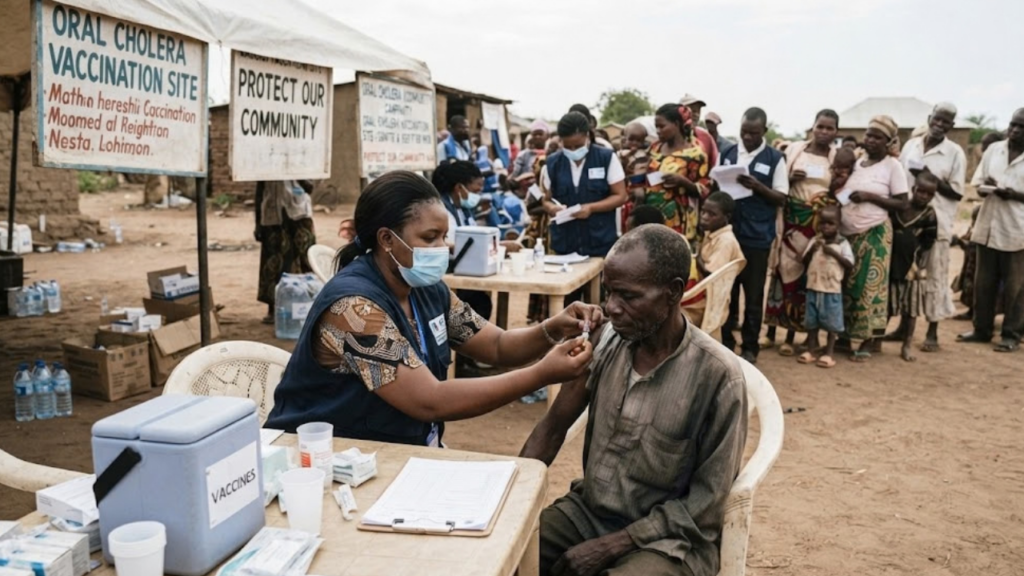
Oral cholera vaccine supply has improved sharply. Global production more than doubled from about 30 million doses in 2022 to roughly 80 million in 2025, and preventive vaccination, suspended for more than three years, resumed this year. In February, WHO, Gavi and UNICEF allocated 20 million doses for preventive campaigns: 3.6 million delivered to Mozambique, 6.1 million to the DRC and 10.3 million planned for Bangladesh.
Emergency use also grew. Reactive vaccination, meaning campaigns launched in response to outbreaks, reached its highest level on record in 2025, and the median wait between confirming an outbreak and starting a campaign fell to 45 days, from 64 in 2024 and 120 in 2022. Requests to the International Coordinating Group on Vaccine Provision totalled 116 million doses; 71 million were approved.
WHO’s report stresses that vaccines complement, rather than replace, safe water, sanitation, early detection and quality treatment. A single dose, standard in outbreak response since 2022, gives high protection for two to six months and reduced protection for about one to two years.
What the cholera deaths data still cannot show
Dr Chikwe Ihekweazu, who runs WHO’s Health Emergencies Programme, said “no one should be dying from cholera today” given the tools that exist. He pointed to safe water and sanitation in the hardest-hit countries as the place where targeted investment could matter most. The report covers 2025 only and does not show whether deaths have kept rising this year.
Data gaps remain wide. Some 81 countries submitted zero reports for 2025, up from 58 a year earlier, and another 77 sent no data at all. WHO itself cautions that death reporting varies in completeness between countries and years, so the size of the rise in some places may partly reflect how deaths were counted.
The figures also set the backdrop for the Global Task Force on Cholera Control’s 2030 roadmap, which aims to eliminate cholera transmission in up to 20 countries and cut cholera deaths by 90%. Reported cholera deaths moved the wrong way in 2025.