
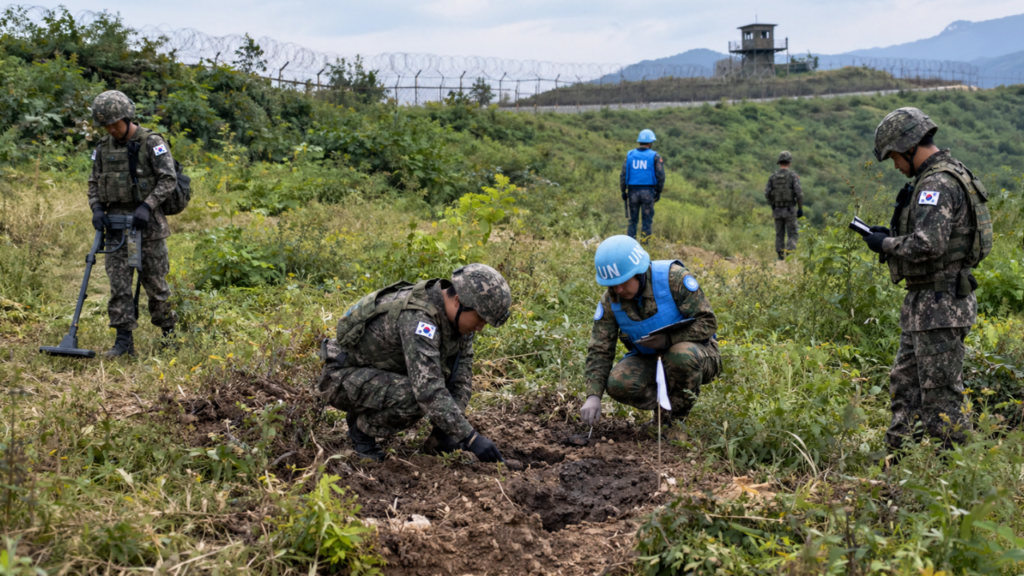
The DMZ landmine investigation into the 21 September explosion now rests on a few physical clues: where the blast happened, how large it was, what it left behind and what soldiers saw. South Korea’s military says those clues point to North Korean mines, and Defence Minister Kang Shin-chul told lawmakers on Tuesday that their placement broke the armistice. Kim Yo-jong, the sister of North Korean leader Kim Jong Un, rejected the conclusion on Wednesday, so the two governments now dispute evidence that neither has fully made public. The case is strongest on location and weakest on intent, and HCN’s earlier report on the blast covers where the accusation began.
What the DMZ landmine investigation has established
The Joint Chiefs of Staff (JCS) said the blast happened about 10 metres south of the Military Demarcation Line (MDL), the line that marks the effective border. It added that the site was roughly 10 metres from ground where terrain had changed and where North Korean forces are believed to have recently planted mines. Vice Chairman Kwon Dae-won said the crater, the flame pattern and the severity of the injuries led the military to rate North Korean mines as the likely cause, according to Al Jazeera’s report on the preliminary findings.
The JCS also compared blast size, saying South Korean mines have a lethal radius of about 20 metres or more, while the mines that exploded last week had a relatively small one. Forensic analysis found brown residue but no metal fragments or shrapnel, which the military said made South Korean mines an unlikely cause. On Tuesday, the JCS said its probe with the United Nations Command had also found a further North Korean resin anti-personnel mine near the site.
Where the accounts do not line up
Testimony from the scene is less tidy. A JCS operations official said on 28 September that soldiers described a device resembling the wooden-box mines used by the North Korean military, apparently made of plastic, while another person suggested a different type. One soldier also reported an additional mine that had not detonated, Seoul Economic Daily reported.
The reports reviewed do not explain how the wooden-box description fits the resin mine found later. Accounts also differ on the toll: Reuters said two personnel were injured, while Al Jazeera, ABC and AFP reported three. Seoul itself describes its findings as preliminary, and the DMZ landmine investigation is continuing.
Drifted or deliberately laid: the question behind the armistice claim
Mines have washed south across the border in floods before, so the cause depends partly on whether these did. On Monday, JCS operations director Yang Jin-hyeok said the final investigation would determine whether the mines were deliberately planted or had drifted. A day later, Kwon said the mines did not appear to have drifted and that the United Nations Command assessed them as lying clearly south of the MDL. Kang said the mine found near the site did not look washed away.
Seoul’s armistice argument depends on the mines having been placed, not carried, south of the line. The United Nations Command, which shares oversight of the DMZ under the 1953 armistice, determined that a violation had occurred. Reuters reported that the remaining question for Seoul is intent, meaning whether the North laid the mines knowing South Korean troops could enter the area and be hurt.
How Pyongyang answers the evidence
In a statement carried by state media on Wednesday, Kim Yo-jong called the finding a “clear farce” and said North Korean soldiers have never crossed the border. She said the South Korean military had invented groundless results as a pretext for political and military provocation. The reports HCN reviewed describe a general denial rather than a point-by-point answer to the forensic findings.
Seoul’s account this time is that the mines were laid as part of North Korea’s fortification work near the MDL. In 2015, by contrast, Seoul concluded that North Korean troops had crossed the line to plant wooden-box mines, an accusation Pyongyang also denied. Kim also warned of an “immediate and merciless” retaliatory attack if South Korean troops fire on North Korean soldiers.
Why the DMZ landmine investigation matters beyond the site
About 2 million mines are estimated to lie in and around the DMZ, and they periodically injure military personnel, Al Jazeera reported. Since 2024, when Kim Jong Un declared South Korea his country’s main enemy, North Korea has laid mines and built anti-tank barriers to seal the frontier, AFP reported. The blast came as troops returned from a route-clearing operation in the western sector.
The finding also lands as South Korean President Lee Jae Myung seeks to draw Pyongyang back to dialogue, after North Korea declared the South an enemy state and dropped its goal of peaceful reunification, Reuters reported. Kang said Seoul would seek to engage the North directly over the incident, while the JCS has demanded an apology and an end to the fortification work. After the 2015 incident, Seoul resumed loudspeaker broadcasts, and the resulting standoff ended with a high-level inter-Korean agreement.
What would settle the case
Seoul Economic Daily reported that whether debris or unexploded mines can be recovered is expected to be the key variable in establishing the cause. Until then, the drift finding rests on the military’s assessment, and the intent question remains open. Neither side has published its physical evidence in full, as far as the reports reviewed show.
Seoul has promised a response without spelling it out, and Pyongyang has promised retaliation if its troops are fired upon. The next markers are the joint investigation’s final report and any announcement of South Korean measures. HCN will update its coverage of the DMZ landmine investigation as new findings emerge.