
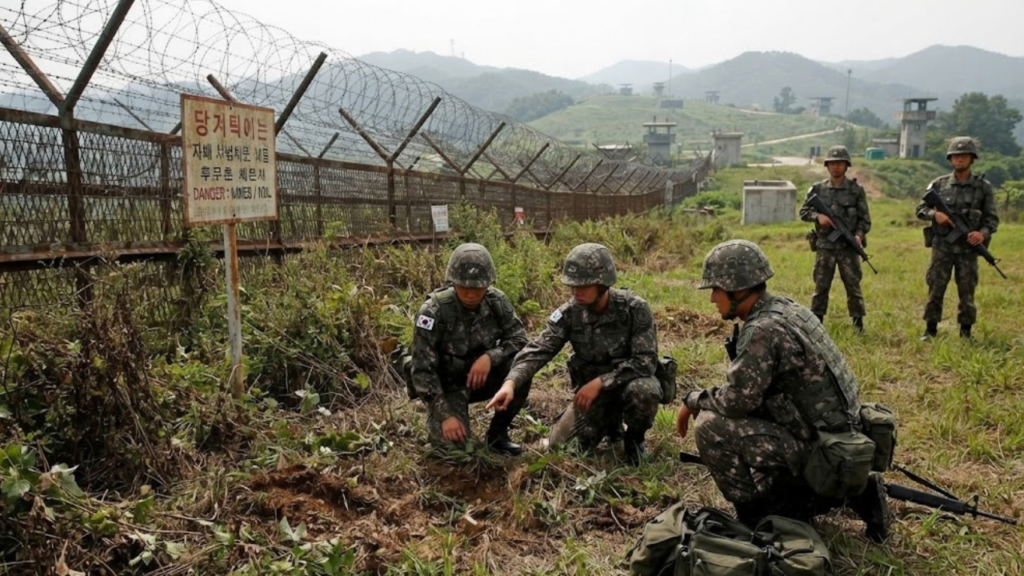
The North Korea DMZ blast that wounded South Korean troops last week was caused by North Korean landmines, Seoul’s defense ministry said Tuesday, calling it a violation of the 1953 armistice that ended the Korean War. Defense Minister Kang Shin-chul told a parliamentary hearing that Pyongyang bears responsibility and that Seoul “will take corresponding measures.” He said the military has response options and would carry them out in stages, without giving further detail.
The blast happened on Sept. 21 inside the DMZ, the heavily fortified and mined buffer zone that has divided the two Koreas since the armistice was signed. Reuters, citing Kang, reported that two South Korean personnel were injured. Separate reporting from AFP and Euronews put the number at three troops, with one losing a foot; that figure could not be independently reconciled with Reuters’ count as of this report. Kwon Dae-won, vice chairman of South Korea’s Joint Chiefs of Staff, said Monday that two mines detonated during the incident and that a third, unexploded mine was found as soldiers withdrew from the area.
What Investigators Found About the North Korea DMZ Blast
South Korea’s Joint Chiefs of Staff told lawmakers Tuesday that a site investigation had turned up an unexploded North Korean plastic anti-personnel mine. Kang said the mines appeared to have been planted near the Military Demarcation Line, the line bisecting the DMZ, as part of North Korean border fortification work. He said the open question is whether North Korea placed the mines knowing South Korean troops could enter the area and be harmed.
North Korea has not publicly responded to the accusation. Reuters reported that North Korea’s mission to the United Nations and its embassies in Beijing and Singapore did not immediately reply to requests for comment. The absence of a response means Seoul’s account of the DMZ blast is not yet contested or confirmed by Pyongyang.
Why the Mines Are There
Since 2024, after North Korean leader Kim Jong-un declared South Korea his country’s principal enemy, Pyongyang’s military has laid mines and built anti-tank barriers along the border as part of an effort to seal it off permanently. More than a million mines are believed to be buried across the DMZ in total, planted by both sides since the war. The area remains one of the most heavily fortified frontiers in the world despite its name.
How the North Korea DMZ Blast Echoes 2015
The incident recalls a 2015 landmine blast in which two South Korean soldiers were badly wounded, one losing both legs, in an explosion South Korea also blamed on the North. Seoul’s response then was to resume anti-North Korea loudspeaker broadcasts across the DMZ, which triggered a military standoff that only ended after a high-level inter-Korean agreement. Kang did not say Tuesday whether Seoul was considering a similar step now, and it was not clear what “corresponding measures” would specifically involve.
The Diplomatic Backdrop
The blast lands at a delicate moment for inter-Korean relations. South Korean President Lee Jae Myung has spent recent months trying to draw North Korea back toward dialogue, including during his current overseas trip covering the UN General Assembly and a state visit to Mexico. North Korea has moved the opposite direction, declaring South Korea an enemy state and abandoning its long-standing policy goal of peaceful reunification.
That gap between Seoul’s outreach and Pyongyang’s rhetoric leaves the government facing a decision with no easy middle ground: a muted response risks looking weak after an armed forces member lost a limb, while a forceful one risks shutting down the dialogue Lee has been trying to reopen. Neither government has indicated when the promised response to the North Korea DMZ blast will take shape, or whether it will affect any of the diplomatic channels currently open. For now, the incident stands as an unresolved flashpoint on a border that has produced this same pattern before.