
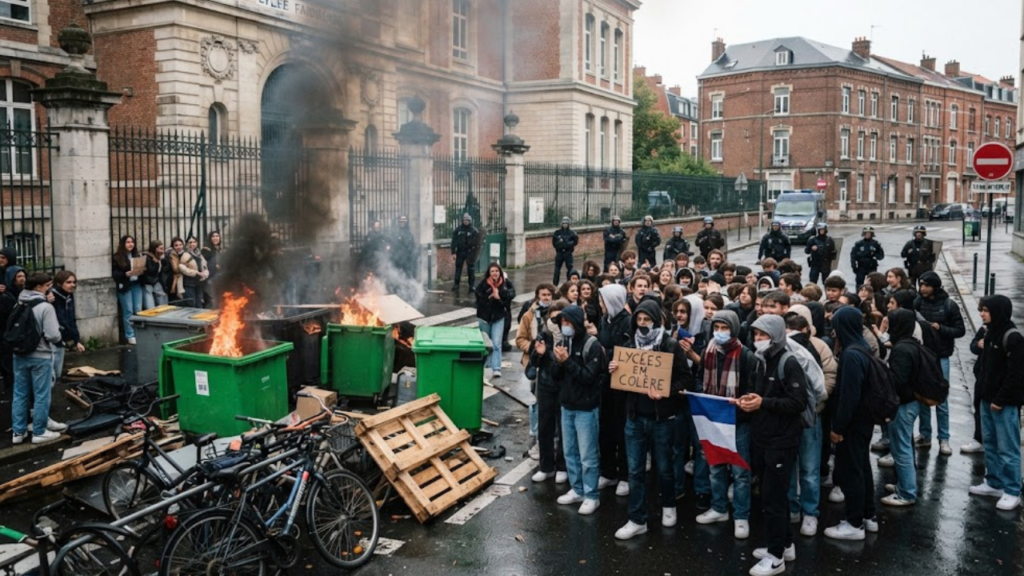
French student protests spread to more cities on Tuesday, with high school pupils setting bins alight and throwing projectiles at police as blockades that began last week continued. The pupils are demanding smaller classes, more teachers and lighter timetables. The dispute has become a political fight after Prime Minister Sébastien Lecornu warned that any escalation would be irresponsible and accused the hard-left France Unbowed (LFI) party of encouraging the movement. It landed on the same day as a nationwide public-sector strike against Lecornu’s budget, and the situation was still developing when this report was written.
How the French student protests began and where they have spread
The movement started in the lycées, the schools covering the final years of secondary education, in the Île-de-France region around Paris. For about a week, roughly a dozen schools in the region have been blocked by pupils, according to Spanish-language reporting on the Interior Ministry’s account. On Tuesday, education authorities reported blockades at around 10 schools in the region, while similar action was reported further afield.
Interior Minister Laurent Nuñez said 180 schools were affected on Monday and 164 people were arrested, according to France 24’s report on the blockades. He described the situation as urban violence and said excesses could not be tolerated. The ministry’s tally of injuries included 12 members of the security forces, eight teachers (three of them school heads) and about a dozen pupils.
Outside the capital region, an AFP photographer in Lille reported masked pupils burning bins outside the Lycée César Baggio, with bus shelters and billboards vandalised and police answering thrown bottles and paving stones with tear gas. In Rennes, around 100 pupils threw projectiles at the Lycée Brequigny, the largest school in Brittany. Pupils in Nantes stacked dozens of bins across the entrance to the Lycée Gabriel Guist’hau, and actions were also reported in Marseille, Bordeaux, Lyon, Grenoble and Sedan.
What the pupils say they want
The complaints driving the French student protests are practical and, in many cases, personal. Pupils cite overcrowded classes, teacher shortages, heavy workloads and classrooms that overheated during recent heatwaves. In Lille, pupils also pointed to an expensive canteen and, at a boarding school, bedbugs and broken showers.
At the Lycée Lamartine in Paris, around 80 pupils gathered with slogans including “more hours of lessons than sleep.” A 17-year-old there, who asked not to be named, told AFP she was angry about the lack of resources and overloaded timetables. She added that the pupils were also backing their teachers, whom she said carry a heavy workload for their pay. In Seine-Saint-Denis, a low-income suburb of Paris, a 16-year-old named Victoire described conditions at her school as unsanitary and said children of the suburbs felt neglected.
Government and hard left trade blame over the student protests
Lecornu, a close ally of President Emmanuel Macron, said on Monday that any escalation of the school protests would be irresponsible. He also accused LFI of encouraging them. HCN has not seen evidence in the reporting reviewed to establish whether that claim is accurate, and no LFI response to the accusation itself was available.
LFI mayor Bally Bagayoko did join hundreds of pupils at the Lycée Paul-Éluard in Seine-Saint-Denis, leading them in the Marseillaise. He called the protest fully legitimate and argued that poorer areas receive fewer resources than wealthier ones. Education Minister Édouard Geffray, speaking on France Inter, said democratic institutions cannot be bypassed through violence and attributed some of the incidents to people from outside the schools.
A public-sector strike lands on the same day
Unions had already called a day of national strikes and demonstrations against the 2027 budget drafted by Lecornu’s government, with the budget announcement due within days. Around 170 demonstrations were planned, including in Paris, Marseille, Nice and Toulouse, and teachers and fire services were on strike nationwide. Public transport was not badly affected, but France’s civil aviation authority asked airlines to cut flight schedules at Paris-Charles de Gaulle and Marseille-Provence airports.
Sophie Binet, head of the CGT union, told BFM TV that the government must revise a draft budget she called dangerous for the country and warned it risked driving France into recession. The Union Syndicale des Lycéens, the main pupil organisation, had called for blockades to spread to high schools nationwide on Tuesday to coincide with the strike. That timing is what turns two separate grievances into one political test for the government.
What remains unclear
No official figures for Tuesday’s blockades, arrests or injuries had been published when this report was written. It is also not established how many of the pupils involved are acting on their own initiative and how many are being directed by organised groups, as the government suggests. France is due to hold a presidential election next year, but the reports reviewed frame the French student protests around school conditions and the budget, not the vote. HCN will update this story as verified information emerges.
More to read
Sweden’s government deadlock and the role of Magdalena Andersson