
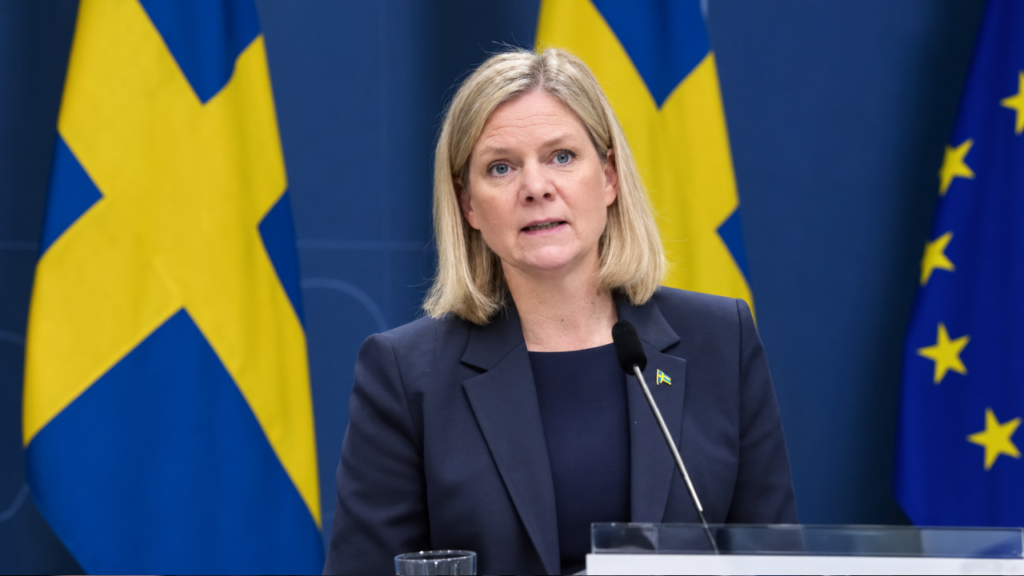
Sweden government deadlock is now the honest description of Swedish politics: the centre-left bloc won the 13 September election with 176 of the Riksdag’s 349 seats, yet nobody in it says she can form a government. Social Democratic leader Magdalena Andersson told a Monday press conference, Reuters reported, that “there is currently no possibility for me to form a government.” She is handing back the exploratory mandate Speaker Andreas Norlén gave her on 18 September, so the next move in the Sweden government deadlock now belongs to him.
What broke her attempt was a vote on a different job entirely. On Sunday the Left Party said it would back Norlén, a Moderate, for another term as speaker rather than the Social Democrats’ own nominee, Johanna Haraldsson. Norlén won on Monday by 200 votes to 146 in a secret ballot, according to Xinhua, with the four right-of-centre parties behind him. Andersson said the Left Party’s choice undercut her efforts to build a government. The Left Party says that was not a deal with the Moderates. In its telling, Norlén’s experience running government talks made him the sensible pick.
How the Sweden government deadlock works
The 176-seat majority is really four parties: the Social Democrats, the Left Party, the Greens and the Centre Party. It only counts if all four move together, and the Left Party and the Centre Party have been pulling apart since election night. The Left Party wants cabinet seats in return for its backing. The liberal Centre Party says it will not support a government that includes Left Party ministers. Each demand cancels out the other.
Andersson knows what a workable version of this looks like. In late 2021 she became prime minister at the head of a Social Democratic minority government that relied on flexible support from the Centre, Left and Green parties, and it governed until the 2022 election. That model needs the Centre and Left parties to tolerate each other from outside the cabinet. This time the two are arguing over whether the Left Party gets ministers at all.
Sweden’s rules add a twist. Under what is called negative parliamentarism, a prime ministerial nominee does not have to win a majority. The nominee is confirmed unless at least 175 of the 349 members vote no, so abstaining helps the nominee. It works like a veto threshold, not a vote of confidence, which means the useful question is never simply which bloc is bigger. It is whether 175 members will actively vote against the person the speaker puts forward.
Why the speaker vote mattered so much
Andersson described the outcome as a “new constellation in parliament” linking the Left Party and the Moderates. She argued that parliamentary tradition gives the speaker’s chair to the largest party in a governing grouping. On that logic, the group that formed around Norlén’s re-election should now try to agree on a government itself. That is her argument, and the Left Party has rejected the framing.
Sweden government deadlock: where Speaker Norlén goes next
Reuters reports that the speaker will now decide who gets the task, potentially outgoing Prime Minister Ulf Kristersson, who resigned after the election. Reuters also noted that the vote was widely seen as a referendum on his promise to form a coalition with the far-right Sweden Democrats. On paper, the arithmetic is tight. The centre-left parties hold 176 seats, so a Kristersson nominee would survive only if at least two of them abstained or voted yes. Nobody has announced that they would.
A handover of a very different kind is under way in Serbia, where President Aleksandar Vučić’s resignation is meant to bring early elections forward. HCN covered it in our report on Vučić’s resignation and Serbia’s election. The contrast is useful: Serbia’s transition follows one man’s decision to leave, while Sweden’s is stuck on who can live with whom.
A Sweden government deadlock can also run for months. After the 2018 election, Kristersson lost a confirmation vote 154 to 195, and Social Democrat Stefan Löfven lost one 116 to 200. Löfven was finally confirmed on 18 January 2019, after a deal with the Centre Party and the Liberals in which the Left Party agreed to abstain. The constitution also provides for an extra election if parliament rejects four prime ministerial nominees in a row, a backstop that has never been used.
What remains unknown
The speaker had not said whom he would task next when this report was written. It was also unclear whether Kristersson would try, and how the Left Party or the Centre Party would vote on any nominee. Andersson framed her decision as applying to the present situation, which leaves room for a later attempt. Three things will show which way this goes: the name Norlén puts forward, any movement on the Left Party’s demand for ministers, and whether any centre-left leader signals abstention. HCN will update this report on the Sweden government deadlock as facts emerge.
[…] open. Bardella has said a group will form, but formal constitution is the step that settles it. HCN will update this report on the National Rally Senate group as those details are […]
[…] Sweden’s government deadlock and the role of Magdalena Andersson […]