
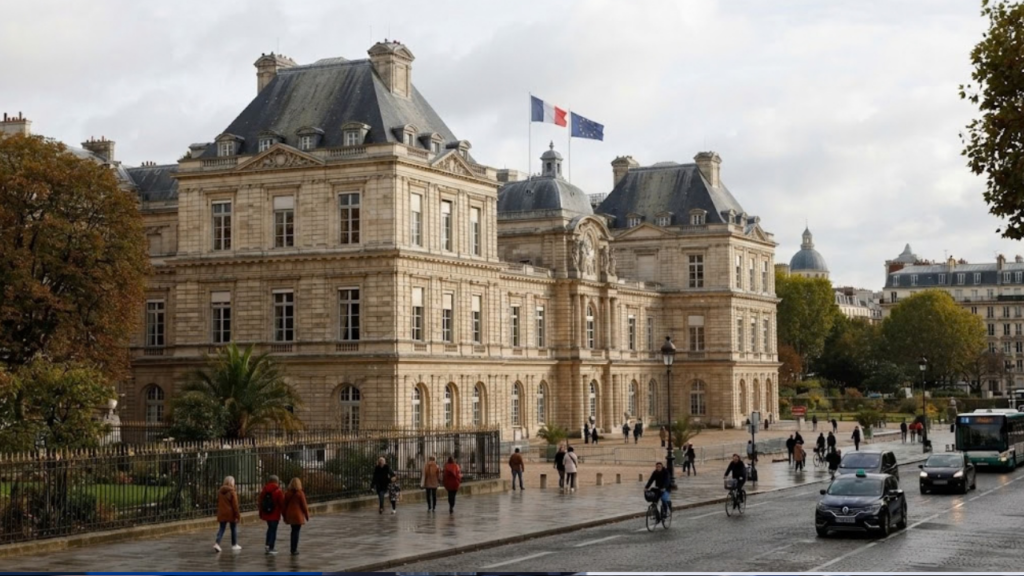
A National Rally Senate group will exist for the first time in the party’s history. Near-final results from Sunday’s elections show the far-right party and its allies from Éric Ciotti’s UDR holding at least 14 of the Senate’s 348 seats, four more than the minimum needed to form a group.
Marine Le Pen called it a “historic victory.” Before the vote the party had only three senators, elected in 2023. An AFP tally credits it with nine more on Sunday, and two further seats went to the UDR, the party Ciotti founded after leaving the Republicans in 2024. RN president Jordan Bardella said the new senators will sit as one group with their UDR allies.
These numbers are preliminary. Brussels Signal counts a possible 15th member if a Republican senator who announced a switch is included, and the group’s exact roster will be clear only once it is formally constituted.
What a National Rally Senate group actually gets
Under the Senate’s rules, a group needs at least ten members and a political declaration setting out its aims. Until now the RN’s three senators sat outside any group, sharing an administrative meeting with other unaffiliated senators rather than running an organisation of their own.
Membership brings several concrete tools. The group’s president joins the Conference of Presidents, the body chaired by the Senate’s president that sets the chamber’s agenda and timetable. Committee seats, the Senate’s bureau posts and many outside appointments are shared out in proportion to each group’s size. In organised debates every group gets the same minimum speaking time, with the rest divided by headcount, and the Conference also splits government question time between groups. A group may also run its own administrative secretariat, according to an analysis in La Nouvelle Revue Politique.
The status guarantees less than it may sound. It does not secure a committee chair, a quaestor’s post or exclusive control of an agenda day, the same analysis notes. And with 14 seats out of 348, the group holds about 4 percent of the chamber, so a proportional share of committee places will be small. The National Rally Senate group gains a place in the machinery of the Senate, not a blocking vote.
Why the Republicans still run the chamber
The Senate is not chosen by voters directly. An electoral college of local officials picks its members, and 178 of the 348 seats were contested this time, Brussels Signal reported. That makes local strength the currency: EU Today notes that the RN’s results in March’s municipal elections widened its base among local elected officials. The party first entered the chamber in 2014, when it was still the National Front, with two seats, and held three after 2023.
None of this shifts control. AFP reported that the right, the centre and the Socialists looked set to remain the three largest forces in the chamber, and Larcher, of the Republicans, 77, who has led the Senate for more than a decade, is expected to win re-election as its president next week.
The result adds a formal foothold for a party that is already the largest in the National Assembly, the lower house, since the 2024 legislative elections, with a presidential election due next year, its first round set for April.
The first practical test comes with the allocation of committee places. Under the rules, members of the permanent committees are named after each partial renewal, and group presidents draw up the list together on a proportional basis. Any group president, or thirty senators, can object in writing if the proportional rule is not applied. How many places the National Rally Senate group receives, and on which committees, will show how much weight it carries in committee.
What remains unclear
Official confirmation is still pending. The Senate had not published a final composition in the material HCN reviewed, so the exact size of the group, whether the UDR senators join as full members or as affiliates, who will lead it, and whether the possible 15th senator arrives all remain open. Bardella has said a group will form, but formal constitution is the step that settles it. HCN will update this report on the National Rally Senate group as those details are confirmed.
[…] Lecornu needs support for that budget in a divided parliament, while parties position themselves for the presidential election to choose Emmanuel Macron’s successor next spring. Latour said left-wing parties could try to link different protest movements, and that university unrest was possible given years of underfunding. That is his analysis, not an established outcome. For wider context on parliamentary politics in France, see HCN’s report on the National Rally’s first Senate group. […]
[…] like this often decides how political power is shared, as HCN’s report on how a Senate group works in France shows in a very different […]