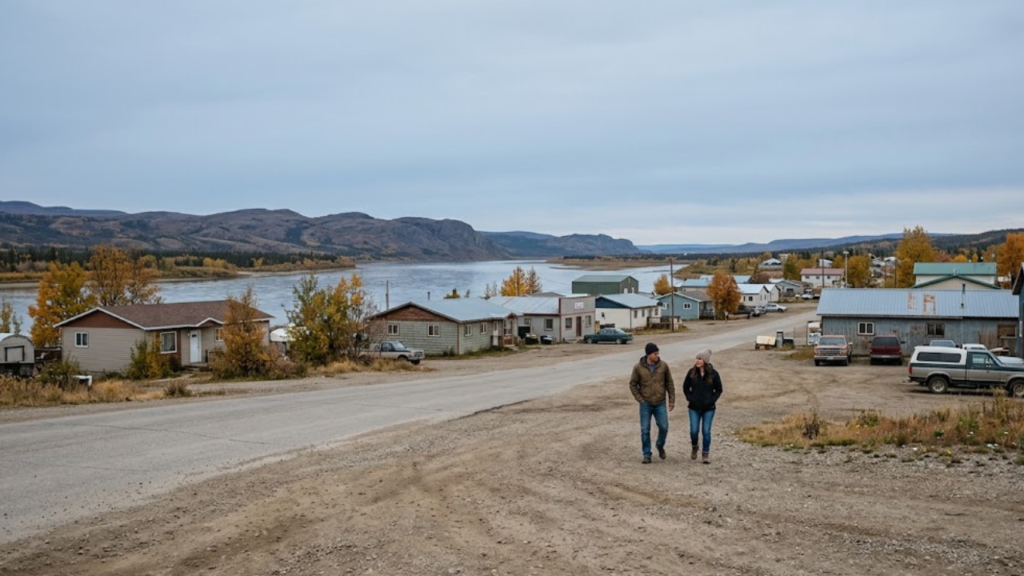
The Norman Wells self-government treaty became Canadian law on Thursday, when Bill C-27 received Royal Assent. The legislation gives legal force to the Final Self-Government Agreement for the Tłegǫ́hłı̨ Got’įnę. It also formally recognises the Tłegǫ́hłı̨ Got’įnę Government as the government of the Sahtu Dene and Métis of Norman Wells, in Canada’s Northwest Territories. The agreement is not yet in operation. It takes effect on a date to be set by order in council, and that date has not been announced.
What the Norman Wells self-government treaty gives the Tłegǫ́hłı̨ Got’įnę
Crown-Indigenous Relations Minister Rebecca Alty announced that the bill had received Royal Assent. The law affirms the community’s inherent right of self-government. According to the federal description, that covers the authority to make laws, protect language and culture, run programs and services such as education and healthcare, and elect its own leadership. The name Tłegǫ́hłı̨ Got’įnę translates roughly as the government of the people of the place where the oil is.
Norman Wells is one of five Indigenous communities in the Sahtu Region of the Northwest Territories. Alty said the day marks a renewal of Canada’s relationship with the Tłegǫ́hłı̨ Got’įnę. Sherry Hodgson, who is both president of the Tłegǫ́hłı̨ Got’įnę Government and its lead negotiator, said the agreement gives young people the foundation to preserve and advance the nation’s rights in future.
Twenty years in the making
The treaty follows a long process. The 1993 Sahtu Dene and Métis land claim agreement committed Canada to negotiate self-government with each Sahtu community. Negotiations with the Tłegǫ́hłı̨ Got’įnę began in 2005. Community members ratified the agreement on March 31, 2025, and a four-day gathering of music and games followed in Norman Wells that July, according to local radio reporting. Canada, the Government of the Northwest Territories and the Tłegǫ́hłı̨ Got’įnę Government signed the final agreement on September 18, 2025, after 20 years of talks. The Tłegǫ́hłı̨ Got’įnę Government was previously known as the Norman Wells Land Corporation.
The territory approved the agreement as well. A territorial act supporting it received assent in March 2026, and local reporting says the Northwest Territories legislature approved it unanimously. By mid-June the federal bill had passed the House of Commons and moved to the Senate. At that stage Alty said the legislation honours commitments and would help the nation build and prosper on its own terms. Royal Assent was the last step needed to make the agreement federal law.
Procedure like this often decides how political power is shared, as HCN’s report on how a Senate group works in France shows in a very different setting.
What remains unsettled
The announcement leaves several practical questions open. No start date has been set. The material reviewed does not give the full implementation timetable, the funding arrangements, how the transition will work, or how the new government will work alongside the territorial government. The agreement text and the bill record are the places to look for those details.
One provision has drawn local attention. Cabin Radio reported that the agreement allows the Tłegǫ́hłı̨ Got’įnę Government to replace the town government of Norman Wells, taking on its municipal responsibilities, if its members ever make up 70 percent or more of the town’s population. HCN has not independently reviewed that clause.
The statements so far come from the federal and territorial governments and from the nation’s own leadership. They describe what the law is meant to do. How it affects services, language programs and local decision-making will only become clear once the agreement takes effect. The next confirmed step is the order in council that sets the start date, and until it is published the Norman Wells self-government treaty is law on paper but not yet in operation.