
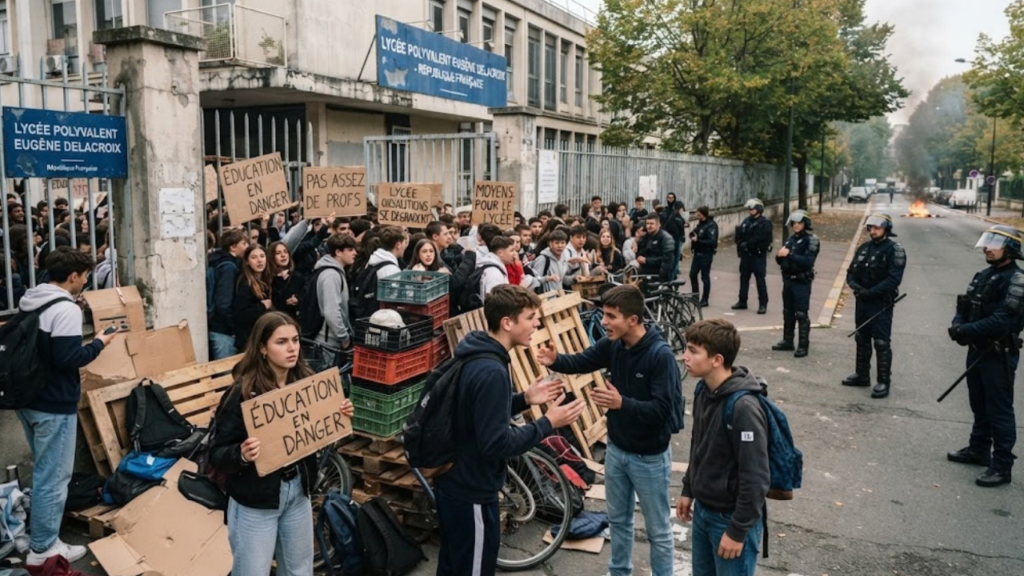
French student protests over crowded classrooms, teacher shortages and run-down school buildings escalated on Thursday, with fires set outside schools, more than 160 high schools shut and the interior ministry reporting 1,949 arrests in a single day. Prime Minister Sébastien Lecornu called a crisis meeting of ministers.
The French student protests began last week at lycées around Paris and have since spread across the country. By mid-morning on Thursday, police counted about 340 demonstrations outside high schools. University students joined in, with a student union saying around 30 campuses were blocked, including in Paris and Marseille. Police in Belgium also reported protests and damage at a handful of schools in Liège.
What is driving the French student protests inside lycées
Lycées cover the final three years of secondary school, for students aged 15 to 18. The complaints are consistent from city to city: classes of 32 to 35 pupils, absent teachers who are not replaced, buildings with leaks and poor insulation, and timetables some students describe as running from 8am to 6pm. “There are 35 of us per classroom,” Raphael, a 17-year-old, told AFP in Strasbourg.
A 17-year-old student named Fadila told CNN that her canteen is too expensive and the toilets run out of paper. Vincent Latour, a politics professor at Université Toulouse Jean Jaurès, said in an Al Jazeera explainer that discontent has built since June heatwaves exposed poorly insulated school buildings without air conditioning. On Tuesday, the education ministry said protests had touched about 400 of France’s 3,700 lycées.
French student protests: what the official figures show
The numbers come from different ministries on different days, so they are official tallies rather than independent counts. Interior Minister Laurent Nuñez said 440 people were detained on Tuesday and 625 on Wednesday, most of them young. For Thursday, the interior ministry reported 1,949 arrests and 305 injured officers, according to France 24.
Education Minister Édouard Geffray said 170 students and 65 education staff had been injured since the protests began. CNN, citing government figures, reported a lower total of 159 injured students and staff, including a student who lost part of the use of his hand while setting off a firework. The two figures had not been reconciled in the reporting reviewed.
Several school principals were hurt, harassed or assaulted during blockades on Thursday, according to regional education authorities, prefectures and unions. In Marseille, a principal and his deputy were splashed with petrol at Victor Hugo high school. Local authorities said a student was trying to throw petrol into a bin, though prosecutors first described the teachers as assaulted and doused.
At Marseille’s Saint-Exupéry high school, police said hundreds of young people surrounded a fire engine, forced firefighters out and set the vehicle alight. In Nantes, a fire at the entrance of Lycée Nelson Mandela was brought under control with no injuries, and the building was evacuated, a deputy mayor said. In Strasbourg, trams were halted after students burned barriers on the tracks. Nuñez condemned “unbridled violence.”
Students say police have been heavy-handed, pointing to tear gas and batons, and the Union Syndicale Lycéenne, a high school students’ union, has called the response institutionalised repression. Nuñez said police opened internal investigations into brutality allegations involving three students. He also said agitators were moving from school to school to incite violence, a claim HCN could not independently verify.
How the government and opposition have responded
Lecornu asked ministers to cancel travel so that regional prefects, the state’s local representatives, could handle the blockades, his office said. Geffray said he would meet staff unions and parent and student associations on Friday, and urged schools to teach remotely where protesters are blocking the premises. HCN found no new spending or staffing commitment announced by Thursday evening.
The government has accused the far-left France Unbowed party of encouraging the protests. Its presidential candidate, Jean-Luc Mélenchon, said the party called for nonviolent methods and described the government’s response as repressive. Earlier in the week he called the police response racist in tone, which Lecornu rejected as an insult. Neither characterisation has been independently established.
Why a budget fight sits behind the school protests
The French student protests overlap with a public-sector strike against the government’s 2027 budget, which includes 54 billion euros in funding cuts and savings. It also proposes freezing civil servants’ base salaries to save about 2 billion euros; unions say that would be the fourth annual freeze. The education ministry said just over 11 percent of teachers and school staff joined Tuesday’s strike.
Lecornu needs support for that budget in a divided parliament, while parties position themselves for the presidential election to choose Emmanuel Macron’s successor next spring. Latour said left-wing parties could try to link different protest movements, and that university unrest was possible given years of underfunding. That is his analysis, not an established outcome. For wider context on parliamentary politics in France, see HCN’s report on the National Rally’s first Senate group.
What remains unresolved
Arrest and injury totals are still moving, and the official counts have not been reconciled. It is not yet known whether Friday’s talks with unions and student groups will produce any commitment on class sizes, staffing or building repairs, or whether the blockades will continue into next week.
The grievances behind the French student protests can be checked against data on class sizes, teacher vacancies and building repairs, and the government had not published a plan to address them in the reporting reviewed. HCN will update this story as facts emerge.