
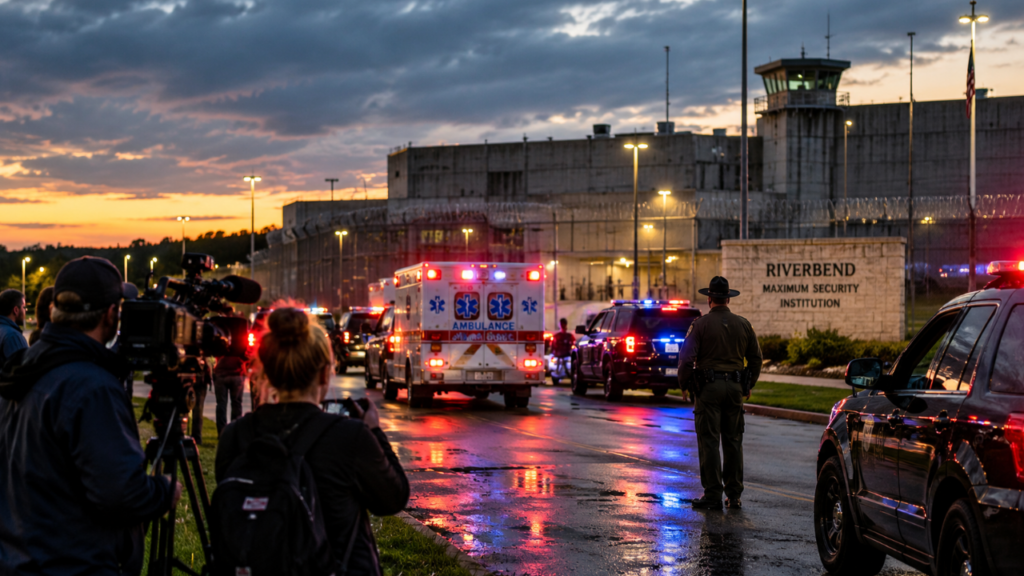
Tennessee’s attempt to carry out the Christa Pike execution on 30 September ended without her death, after officials gave two doses of pentobarbital. Governor Bill Lee has since ordered an outside review and cancelled the state’s one remaining execution for this year. Pike, 50, was alive when taken by ambulance to a hospital, her lawyers said, and a leading death penalty expert called the outcome unprecedented.
How the Christa Pike execution attempt unfolded
Pike was scheduled to die at 10 a.m. at Riverbend Maximum Security Institution in Nashville. About an hour before that, the 6th US Circuit Court of Appeals voted 2-1 for a stay, saying it needed time to consider whether her allegations of childhood sexual abuse were fully weighed at sentencing.
Hours later the US Supreme Court lifted the stay. Its conservative majority gave no explanation, and the three liberal justices signed a dissent saying Pike’s claims deserved a closer look. The state’s attorney general’s office had urged the court to act, arguing that a last-minute halt traumatised the family of Pike’s victim and rewarded what it called “abusive delay tactics” by her lawyers.
Media witnesses watching from a separate room said the curtains to the execution chamber were raised at 7:27 p.m., showing Pike strapped to a gurney. She described herself as at peace in her last words, then remained awake and at one point raised her head to ask officials whether her arm was supposed to feel that way. It was not clear what she meant.
Witnesses reported that the second dose was administered by 8:26 p.m. Pike could be heard snoring behind the closed curtain until the microphone was cut at 8:53 p.m., when the media witnesses were escorted out. Her lawyers filed an emergency motion late Wednesday with the Tennessee Supreme Court, saying she was in “unnecessary agony” and that continuing would violate her right to be free of cruel and unusual punishment.
The governor’s review and the state’s defence of its protocol
Late Wednesday, Lee said he had ordered “a comprehensive, third-party review to determine exactly what occurred” and that the remaining scheduled execution would not go ahead this year. That execution, of Gary Wayne Sutton, had been set for December. Lee added that Tennesseans expect executions to be lawful, constitutional and effective. Reports reviewed by HCN did not name who will lead the review or when it will report.
The Tennessee Department of Correction said it followed every step of a protocol approved by the attorney general’s office, and that Pike was moved to an off-site medical facility. That protocol calls for a second set of syringes if the inmate is not deceased after the first. It does not say what should happen if the person is still alive after the second set.
A second failed execution in Tennessee this year
Robin M. Maher, executive director of the Death Penalty Information Center, said the Christa Pike execution has no parallel. She said seven other people have survived after execution teams failed to reach a vein, but no one else has stayed alive after being given the drugs themselves.
It was also the second time this year that Tennessee could not complete a scheduled execution. In May, officials called off the lethal injection of Tony Carruthers, convicted of kidnapping and killing three people in 1994, after executioners spent more than an hour trying and failing to place an IV line. Pike’s lawyer Stephen Ferrell had warned in May that her small veins and a blood condition could complicate the procedure.
Tennessee has paused executions for a review before. In 2022, Lee halted all executions for the year after officials stopped Oscar Smith’s lethal injection about an hour before it was due and acknowledged the drugs had not been properly tested. A former federal prosecutor, Ed Stanton, was named to lead that review. In 2024, the state moved from a three-drug protocol to the single drug pentobarbital.
The 1995 killing and the fight over Pike’s sentence
Pike and her boyfriend, Tadaryl Shipp, were convicted over the 1995 killing of Colleen Slemmer, a classmate at a job-training centre in Knoxville. Prosecutors said Pike believed Slemmer was after her boyfriend, lured her to a wooded area on 12 January 1995 and attacked her with a box cutter and a large piece of asphalt. Shipp has admitted carving a pentagram into the body.
Shipp was 17 and received a life sentence with the possibility of parole; Pike, 18, was the only one sentenced to death. The case drew wide attention partly because of the pentagram and the era’s fears of Satanic worship. Pike did not deny the killing. Her supporters say her age, mental illness and allegations of severe sexual abuse deserve weight, and after the crime she was diagnosed with bipolar disorder and post-traumatic stress disorder.
Slemmer’s mother, May Martinez, had travelled to Nashville hoping to witness the execution and told the Associated Press days earlier that she had waited decades for it. She could not immediately be reached for comment after the attempt failed. Stephen Ferrell, a federal defender representing Pike, argues her sentence is an outlier because other 18-year-olds in Tennessee have had death sentences vacated.
What is still unresolved
After the Christa Pike execution attempt, her lawyers said they had not been told her condition, and no official medical update appeared in the reports HCN reviewed. It is also unclear what the third-party review will examine, who will conduct it, and whether Tennessee intends to try again to carry out her sentence. None of those questions was answered in any statement available when this was written.
Had the Christa Pike execution gone ahead, she would have been the first woman executed in Tennessee in more than 200 years and the 30th person put to death in the US this year. Since the Supreme Court reinstated capital punishment in 1976, 18 women have been executed, about 1 per cent of the total, according to the Death Penalty Information Center. HCN will update this story as facts emerge.
Related HCN coverage: suspects released on bail in the RAF Fairford inquiry.