
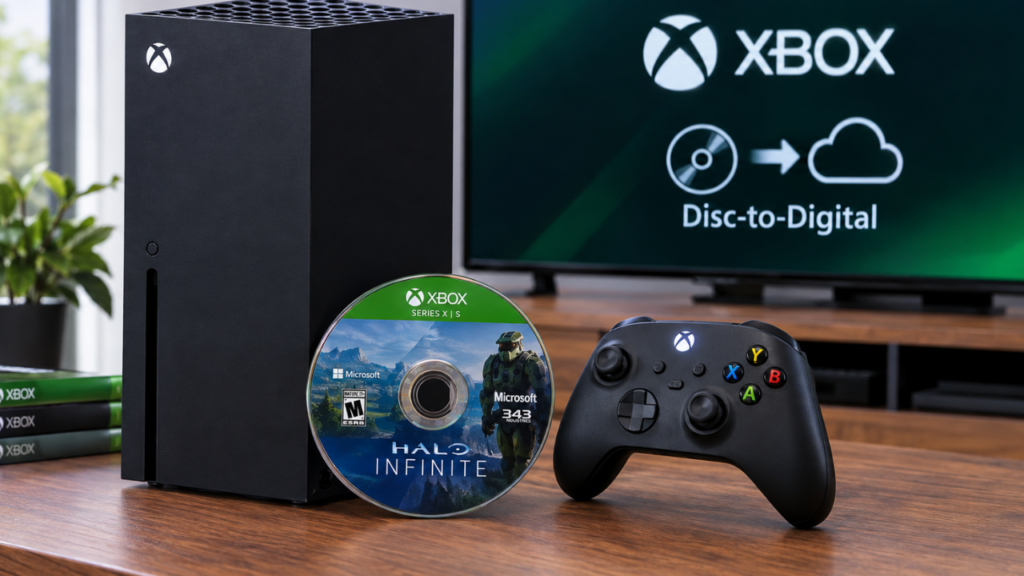
Microsoft opened its Xbox Disc-to-Digital program to all players on September 29, letting owners of supported Xbox One and Xbox Series X discs claim a digital license that works without the disc sitting in the drive. The license comes with a condition that sets it apart from a normal purchase: it stays tied to the disc, and it can be lost if the disc changes hands.
That condition, more than the convenience, is what makes the rollout matter for game ownership. Xbox Disc-to-Digital had spent about a month with Xbox Insiders, the group that tests early builds, before Microsoft announced the wider release in a post on social media.
Players are receiving it through a system update, and some may need to restart their console before it appears. Xbox said support for another batch of games arrived alongside the rollout but had not yet named them, according to Video Games Chronicle.
How Xbox Disc-to-Digital works in practice
To claim a license, a player inserts a supported disc into an Xbox One or Xbox Series X with a disc drive while signed in to their Microsoft account. Launching the game claims the entitlement, or the player can highlight the disc’s tile, press the Menu button and choose “Claim Digital License.”
Once claimed, the game can be installed and played without the disc, which keeps working as before. Games that support Xbox Play Anywhere, Microsoft’s scheme for carrying one purchase across Xbox and Windows, also work on compatible PCs and handhelds, and supported titles stream through Xbox Cloud Gaming.
Microsoft’s support page says not every Xbox One or Series X disc qualifies, and the company says the list may change because of technical, licensing, publishing and manufacturing factors. For an ineligible disc, Xbox Disc-to-Digital returns a “Disc license unavailable” error, and original Xbox and Xbox 360 games are excluded. For multi-disc games, disc one is used to claim the license.
A community-run tracker, XCT.live, counts 1,578 fully compatible games, while another outlet cited about 1,568. Those counts come from player testing rather than from Microsoft, so they are best read as a running estimate. Ubisoft and Sega have both joined the program since testing began.
Why the Xbox Disc-to-Digital license follows the disc
Microsoft’s usage rules describe the Xbox Disc-to-Digital license as conditional on continued possession of the qualifying disc, and say it cannot be transferred separately from that disc. In hands-on testing, when another account claims a sold or lent disc, the first account’s digital license is revoked.
The original owner can regain access by getting the disc back and playing it, or by buying the game digitally. Xbox also provides a console settings area for checking which licenses have been revoked, according to reports on the Insider test.
Resale remains possible, because claiming a license does not block a later sale. The cost is the license itself: a buyer’s claim ends the seller’s digital access. The disc therefore serves as both proof of ownership and the key to the digital copy.
How often Xbox checks that a player still holds the disc, and what happens to an installed game once its license is revoked, are not explained in the coverage HCN reviewed. Both matter, because they decide how durable the license really is.
What the program means for preservation and player rights
The clearest preservation benefit so far involves games no longer sold in the Xbox store. Hands-on testing found that delisted titles including Deadpool, Transformers: Devastation and Minecraft: Story Mode became playable digitally again with their discs, while Transformers: Rise of the Dark Spark did not grant a license.
One writer’s tests are not an audit, and results clearly vary by title. The rollout also lands amid a wider argument about what buying a game means. Recent episodes have put that question in front of players, including an Xbox outage that stopped physical games from working and account-level blocks on game libraries.
Kotaku noted that digital copies have outsold physical ones by a wide margin on both major consoles in recent years, while many longtime fans still hold large disc collections from before the digital shift. For players, the practical point is that a disc-to-digital license is a conditional permission that follows the disc, not a permanent second copy.
For publishers, joining Xbox Disc-to-Digital is a choice, which is why the supported list depends on publishers signing on, as Ubisoft and Sega have. None of the coverage HCN reviewed included a commitment from Microsoft on how long it will keep the program running.
What is still unresolved
Several questions remain open: how possession checks will work over time, how installed games are treated after a revocation, whether more publishers will join, and whether Xbox Disc-to-Digital will carry over to future Xbox hardware. Microsoft had not answered these in the material HCN reviewed.
Readers can check the current terms on Microsoft’s Disc-to-Digital support page, and HCN will update this story as Microsoft or publishers clarify them. For more from HCN’s entertainment desk, see our report on the split between Alan Ritchson and his wife Catherine.