
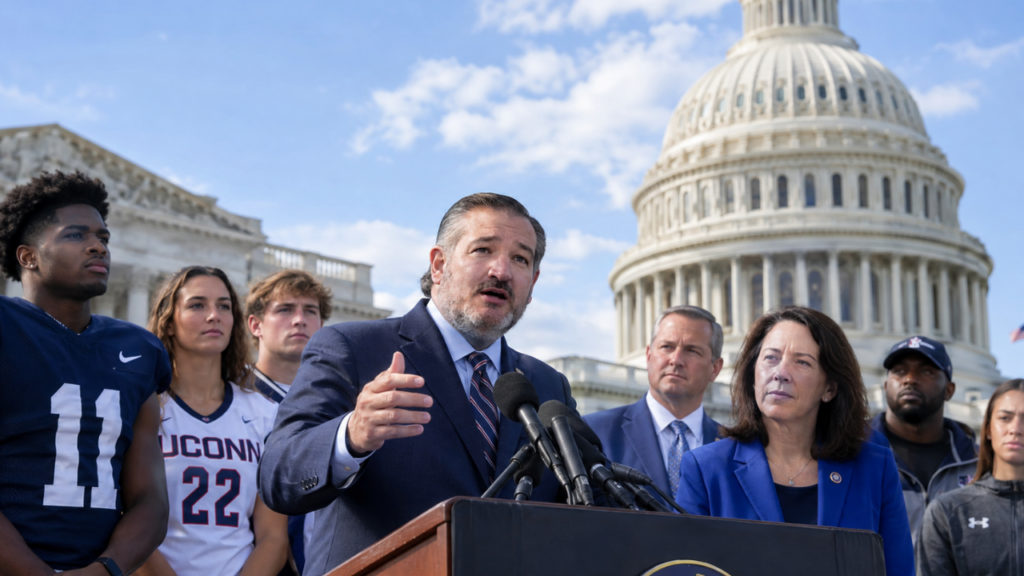
The U.S. Senate voted 77-22 on Monday to pass the Protect College Sports Act, a bill that would replace the patchwork of state laws governing college athletics with a single federal framework. The bipartisan measure covers how student athletes get paid for their name, image and likeness, how they transfer between schools, and how conferences realign. It now moves to the House, where its timeline is far less certain.
Senators Ted Cruz, a Texas Republican, and Maria Cantwell, a Washington Democrat, led the bill through nearly six hours of floor debate and seven amendments before the final vote. Cruz called it “a monumental day for college athletics.” President Donald Trump also welcomed the vote, posting on Truth Social that the bill would “save college sports” and the schools that run them.
What the bill would actually do
The Protect College Sports Act would create a federal right for college athletes to earn money from their name, image and likeness, commonly known as NIL, and would override the mix of state NIL laws that schools have had to navigate individually. It would also give the NCAA and athletic conferences limited protection from antitrust lawsuits when they enforce standardized rules on recruiting, transfers and eligibility.
The bill sets up three separate pools of money schools can use to pay athletes: a $21.6 million revenue-sharing cap carried over from an earlier legal settlement, a new $22.5 million retention fund, and $5 million set aside specifically for women’s sports programs. It also caps compensation for agents handling athlete NIL deals at 5%, a response to complaints about predatory representation.
Conference realignment is addressed too. Schools that want to leave one major conference for another would have to compete as an independent for three years first, down from the current five, but still a significant financial penalty for any school considering a jump. The bill would also let conferences pool and sell some of their media rights together rather than negotiating alone.
Why lawmakers say it’s needed
Supporters have described college sports as a system thrown into disorder since NIL payments and looser transfer rules took hold in recent years. Speaking before the vote, Senate Majority Leader John Thune said the current landscape “is a mess” and “needs to be addressed.” Backers, including more than 370 schools and 32 conferences according to the White House, argue that a single national standard would replace years of legal uncertainty.
Not every senator agreed the bill solves the right problem. Connecticut Democrat Chris Murphy argued from the floor that the legislation does nothing to limit how much money flows through college sports, and instead restricts how much of it athletes themselves can earn. Labor groups, athlete advocacy organizations and the NAACP also opposed the bill, saying it protects institutions’ revenue while giving athletes little say in how the rules are written.
What happens next
The bill’s path through the House is uncertain. Lawmakers there are not due back in Washington until after the November midterm elections, and Cruz has said he has spoken with House Speaker Mike Johnson about scheduling a vote once they return. If the House makes any changes to the text, the legislation would have to go back to the Senate, adding further delay to a bill whose sponsors have repeatedly said time is its biggest obstacle.
The real deadline is January 3, when the current Congress ends. Any bill that has not become law by then would have to start over from scratch in the new session. For now, hundreds of thousands of college athletes and the universities that field them are left waiting to see whether the Senate’s decisive vote is enough to carry the measure across the finish line before the clock runs out.