
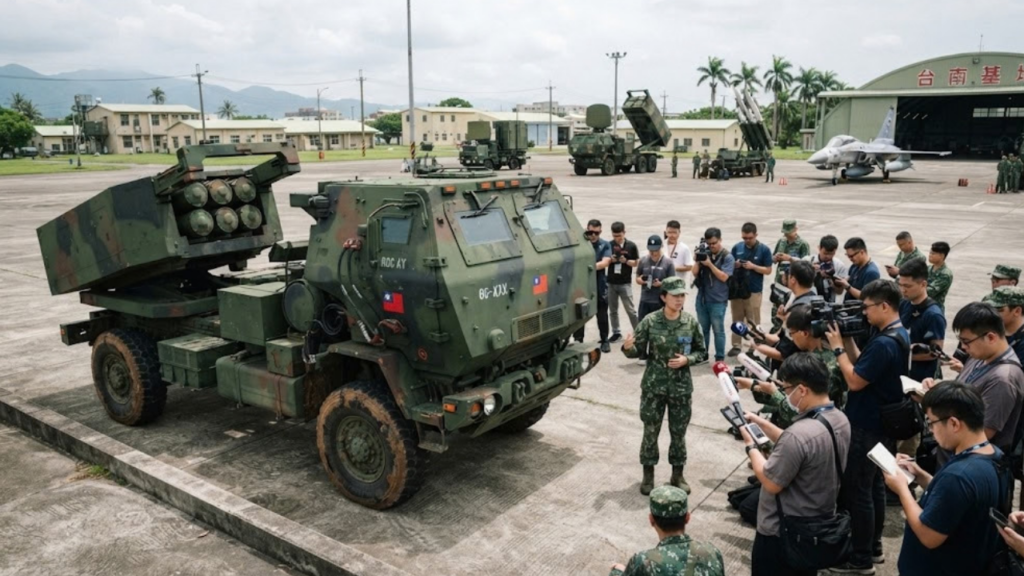
Taiwan arms sales will continue moving forward on schedule, Taiwan’s defense ministry said Wednesday, a statement timed just days before President Trump and Chinese leader Xi Jinping meet in Washington for their first in-person summit since Xi’s visit to Beijing earlier this year.
Deputy spokesperson Chiao Fu-chun made the comments to reporters in Tainan, in southern Taiwan, during a media event at Tainan Air Base that put some of the island’s recent acquisitions on display, including a HIMARS rocket system, Apache and Black Hawk helicopters, and a Stinger missile simulator. Chiao described maintaining security and stability in the Indo-Pacific as a shared interest among democratic nations, and said Taipei would continue coordinating with the US government and Congress to see existing arms packages through.
Why Taiwan Arms Sales Are Back in the Spotlight This Week
The timing is not incidental. Xi is expected to raise Taiwan arms sales directly with Trump during the Washington meeting, according to people familiar with the discussions, potentially pointing to the third of the 1982 US-China joint communiques, in which Washington agreed to gradually reduce arms sales to Taiwan. China has never formally recognized Taiwan’s self-governance, treats the island as its own territory, and has repeatedly called on the US to halt weapons transfers there.
The arms pipeline itself is not new, but its second half is currently stalled. Trump approved an $11 billion package for Taiwan in December, the largest single sale to the island on record. A follow-up package worth roughly $14 billion was announced afterward, but Trump said in May, after a visit to Beijing, that it was being held “in abeyance.” Neither Washington nor Taipei has said publicly when, or whether, that second package will move forward, and Wednesday’s comments from Chiao did not address it directly.
Washington’s position rests on a law that predates the current dispute. Since formal diplomatic relations with Taiwan ended in 1979, the US has continued supplying the island with defensive weapons under domestic legislation obligating it to help Taiwan maintain the capability to defend itself. That arrangement has coexisted, often uneasily, with the joint communiques China now points to.
Around the island itself, the dispute is not abstract. Chinese military aircraft and ships operate near Taiwan on a near-daily basis, part of a pattern that has continued regardless of the diplomatic temperature between Washington and Beijing. Taiwan’s government maintains that Beijing has no sovereignty claim over the island and that its political future is a decision for Taiwan’s own population, not for Beijing or, implicitly, for Washington either.
Taiwan arms sales are only one item on a crowded agenda for this stretch of Trump’s diplomacy. The president spent the same week managing an entirely separate confrontation with Iran at the UN General Assembly, where he alternated between threats and direct talks in New York before turning to face Xi in Washington. The pattern is consistent: high-stakes leverage held in reserve, deployed selectively, with allies and rivals alike left to read the signals rather than receive firm commitments.
What happens with the stalled $14 billion package may depend less on Taipei’s stated intentions than on what Trump and Xi actually discuss behind closed doors this week, according to Reuters. Both a trade truce and a broader set of disputes — over tariffs, rare earth minerals and artificial intelligence — are also on the agenda for the Washington summit, giving Taiwan arms sales one item among several that could shape, or be shaped by, the outcome.
For now, Taipei’s message is unambiguous: it intends to keep pressing forward on its own timeline, regardless of what is decided elsewhere. Whether Washington’s actual conduct matches that message once Trump and Xi sit down together is the question this week’s summit will begin to answer.