
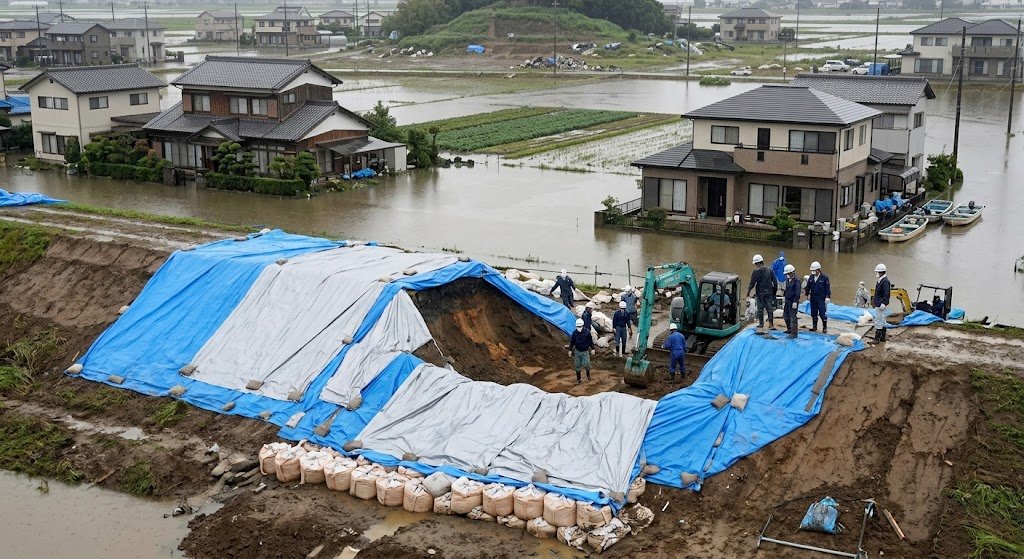
Nearly a month after Typhoon Dujuan passed close to Tokyo on September 21 and 22, Japan is still counting its losses. At least 15 people have died in Chiba and Kanagawa prefectures, according to Kyodo News, most of them in landslides set off by record rainfall. Emergency repairs have only just been finished on levees at Lake Inbanuma in Chiba that burst during the storm. The Typhoon Dujuan aftermath shows how much of the deadly damage came from rain, flooding and unstable ground, not from the wind alone.
Typhoon Dujuan aftermath: deaths, missing and damage
The death toll has risen steadily since the storm. Japan’s Fire and Disaster Management Agency (FDMA) reported 12 deaths and three people missing nationwide as of September 24, with seven deaths in Chiba, four in Kanagawa and one in Miyazaki. Those figures were described as preliminary. By September 28 the count had reached 14, and on Saturday, October 3, Kyodo reported 15 deaths in Chiba and Kanagawa after a body was found at a landslide site in Chiba’s Nagara. HCN could not find a later official national total, and counts differ depending on whether the death in Miyazaki is included.
Many of the victims were caught in landslides at their homes in places such as Kamogawa in Chiba and Miura and Yokosuka in Kanagawa. Others died in floodwater, including one man found in a submerged car. Rescue teams, including Self-Defense Forces personnel, searched for the missing for days.
The rain itself was exceptional. Reports based on FDMA data say 832 millimetres, or about 33 inches, fell in 48 hours on Oshima in Tokyo, an all-time record for that station. Ground already soaked by earlier storms could not absorb more water, and the Japan Times noted that some residents were dealing with flood damage for the second time in a few weeks, after heavy rain in August.
Nearly two million were urged to leave
Authorities urged nearly 2 million residents to evacuate as the storm approached. These were advisories, not orders, and people were not required to leave. That helps explain the gap between the headline figure and the number who actually moved to shelters: on September 28, evacuation centres in Chiba were housing about 160 people, according to reported prefectural figures. The advisory system relies on people deciding for themselves, and in past Japanese disasters some residents who stayed home were later trapped by water or mud.
For the people affected, the practical effects came in layers. At the peak, about 59,000 people lost power. A week after the storm, around 3,900 homes in Chiba were still without electricity and roughly 450 had no running water. Hundreds of flights were cancelled, and some rail lines were suspended. By September 28, about 1,600 homes were flooded and more than 200 damaged, mostly in Chiba.
The levee breach and what it left behind
The most lasting damage came from the failure of embankments around Lake Inbanuma, a major lake in northern Chiba. The water level in the western part of the lake reached a record 5.04 metres, and about 100 metres of embankment near Narita collapsed on September 22, with further breaches along a nearby river. Houses, shops and farmland were flooded, and the Japan Times reported that the levee was breached in four places.
Kyodo reported on October 5 that emergency repairs to two breached sections were complete. The Ministry of Land, Infrastructure, Transport and Tourism repaired a 72-metre section by piling up soil and sand and covering it with tarp sheets, with up to 500 workers on site around the clock. The ministry says new levees will be built later, which means the current repairs are temporary. The flooding also hurt local farming: rice fields were inundated, and about 100,000 carp were washed away from a fish farm.
What remains unknown
Several questions are still open. HCN could not find a current count of people displaced from their homes or living in shelters, a final national death toll, or an official estimate of total damage costs. It is also unclear how well the temporary levee repairs would hold in another heavy rainstorm. Chiba officials warned in the days after the typhoon that saturated ground could produce more landslides even with light rain.
The next markers to watch are the FDMA’s final casualty figures, the timeline for permanent levee construction around Lake Inbanuma, and any support announced for flooded households and farmers. The full Kyodo report on the repairs is available at Japan Today. HCN will update this report as official figures change. For more of our coverage, visit the Human Crisis News homepage.