By dusk on Wednesday, September 2, the narrow lanes of al-Mughayyir were already familiar with soldiers and settlers moving through them. By nightfall, two of the village’s sons – a teenager about to start 11th grade and a young man who had just graduated top of his class – were dead. Their killing, during a West Bank village raid that began as a dispute over stolen sheep, has become the latest flashpoint in a summer of escalating settler and military pressure on Palestinian communities northeast of Ramallah.
Timeline of the West Bank Village Raid
According to the Palestinian health ministry and local officials, the two victims were Omar al-Nassan, 19, and Khalil Abu Alia, 16. Accounts differ slightly on spelling and exact ages, with some outlets citing the surname al-Naasan, or Shehadeh for the younger victim. Both were residents of al-Mughayyir, a village of shepherding families roughly 25 kilometers north of Ramallah.
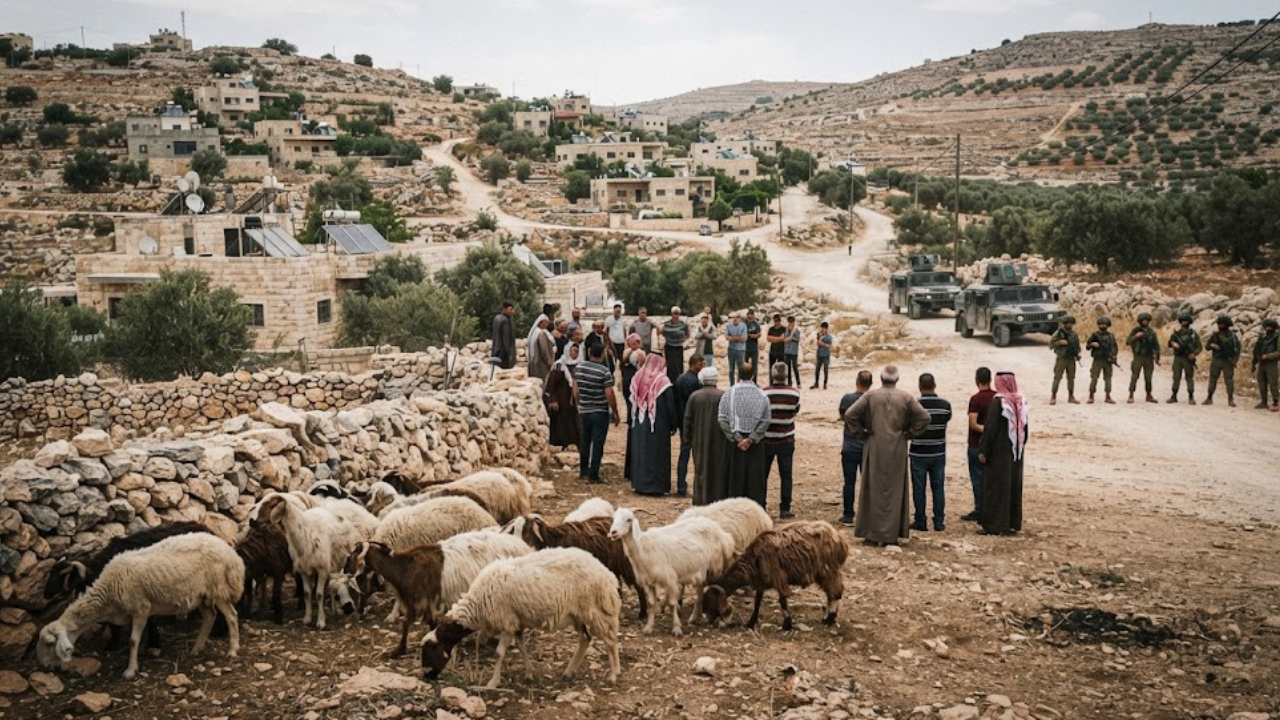
The sequence of events, pieced together from village residents, Israeli activists and the Israeli military’s own account, began just after sunset. A group of settlers entered al-Mughayyir under police and army escort to retrieve livestock they said belonged to Israeli civilians, according to residents and activists cited by international outlets, including Al Jazeera.
Villagers confronted the group as it approached homes where sheep were being taken. Residents told journalists that snipers had already taken up positions on rooftops before the confrontation turned violent. Soldiers opened fire, and two young men were critically wounded. Both later died of their injuries, according to the village council.
Encircled: How Residents Describe Life Under Pressure
For people living in al-Mughayyir, Wednesday’s killings were not an isolated event. They were the sharpest point yet in weeks of tightening restriction that many residents describe as a slow-motion siege rather than a single raid.
Since late August, soldiers and settlers had begun closing the village’s one remaining access road for hours at a time, setting up a temporary checkpoint near the local school each morning and evening. Residents say at least eight families left the village in the week before the shooting because they could no longer reliably reach their jobs, renting rooms elsewhere instead. The village school, which employs 26 teachers, has only nine who actually live in al-Mughayyir – and staff worried aloud that the rest might not be able to reach their classrooms at all.
Kathem Al-Haj-Ahmed, a 57-year-old resident, put the pattern in blunt terms, saying the army and settlers appear to be “exchanging roles” as pressure on the village mounts, and that the underlying goal, in his view, is to make people leave. His account echoes a broader description shared by residents and rights monitors: a slow tightening of curfews, road closures and agricultural restrictions that intensified markedly over the past month, culminating in what several described as a full encirclement of the village on the night of the killings.
This is not al-Mughayyir’s first brush with fatal violence during this West Bank village raid pattern. In April 2024, hundreds of settlers escorted by soldiers stormed the village, burning homes and vehicles; a 25-year-old resident was shot dead weeks before his planned wedding. A teenager from the village was killed in July of this year while helping neighbors respond to another settler attempt to storm a family home. Viewed against that history, Wednesday’s shooting reads less as an isolated clash than as the latest entry in a running toll the village has been keeping for more than two years.
Israel’s Account: A Livestock Retrieval That Turned Violent
The Israeli military has offered a different framing of the same night. Responding to press inquiries, the army said its troops had secured the entry of Judea and Samaria District Police officers and an Israeli civilian into the village solely to retrieve livestock that had been identified, by distinguishing marks, as belonging to Israeli civilians.
While that retrieval was under way, the military said, a “violent riot developed” in which people threw concrete blocks and stones at the soldiers. Troops responded with live fire directed, in the army’s words, at “key instigators” of the disturbance in order to remove what it described as a threat. The military has said the shooting is under investigation, without offering a timeline for that review or details on how many rounds were fired or by whom.
The two accounts converge on the basic chronology: settlers entering under military and police escort to reclaim sheep, a confrontation with residents, and gunfire that killed two young men. They diverge sharply on causation and intent. Palestinian residents and rights monitors describe an operation built around the presence of snipers positioned in advance. The Israeli military describes a policing action that escalated only after it came under attack from stone-throwing.
A Wider Pattern Behind This West Bank Village Raid
Al-Mughayyir’s killings arrived in the same 24-hour period as a separate demolition roughly 60 kilometers south, where Israeli forces razed the homes of a dozen Palestinian families in Khirbet a-Taban, in the South Hebron Hills. That demolition followed the area’s designation as a restricted military training zone, even as nearby settler outposts have expanded largely unchecked. All 70 residents of that community, including 28 children, were left without shelter. HumanCrisisNews previously covered a similar pattern of force in the occupied territory in its report on a training-centre raid in Qalandiya.
Neither incident is unique this year. According to the United Nations Office for the Coordination of Humanitarian Affairs, at least 79 Palestinians, including 19 children, have been killed by settlers or Israeli forces in the West Bank since the start of 2026. More recent UN-sourced figures cited by other outlets put the toll closer to 81, with roughly a quarter of those deaths tied specifically to settler violence rather than military operations.
Human rights group B’Tselem has separately documented dozens of Palestinian communities – estimates range from the mid-60s upward – forcibly displaced from the West Bank since the war in Gaza began in October 2023. Researchers describe this scale of displacement as unmatched since 1967.
That combination of scale and repetition is part of why a village most international readers have never heard of matters. A three-week settler siege of a single home in the nearby village of Qusra last month drew a rare public rebuke from the U.S. ambassador to Israel, Mike Huckabee, a longtime supporter of the settlement movement. It was a sign of how far the pattern has stretched even sympathetic observers’ tolerance.
Retired Israeli generals have gone further, publicly accusing settlers of pursuing ethnic cleansing with the government’s implicit backing. The UN Special Rapporteur on the Occupied Palestinian Territories, Francesca Albanese, has described the recurring structure of these attacks – organized, armed groups moving with little restraint from accompanying soldiers – as consistent with the definition of a pogrom.
Reading the Pattern: Why This Was Predictable
Laid end to end, the events surrounding al-Mughayyir over the past 18 months follow a recognizable escalation curve rather than a series of unconnected incidents. August 2025 brought a four-day siege that barred residents and journalists from entering the village. April 2024 brought the burning of homes and a fatal shooting weeks before a wedding. Late August 2026 brought rolling checkpoints timed to school hours.
Each phase narrowed the space in which residents could move, work, or simply stay, well before the September 2 shooting occurred – which suggests the killing was less a sudden rupture than the end point of a pressure campaign that had been building, largely undocumented by international media, for more than a year. That gap between how gradually the pressure built and how suddenly the deaths registered internationally is itself part of why al-Mughayyir has stayed under-covered until now: incremental checkpoint closures rarely make headlines, even when they are laying the groundwork for what eventually does.
What Comes Next
Israel’s investigation into the al-Mughayyir shooting remains open, with no public findings or disciplinary action announced as of this writing. Palestinian officials and residents say they have little expectation that the inquiry will result in prosecutions, citing the outcomes of past military investigations into similar incidents.
Internationally, pressure is building on other fronts. The United Kingdom’s foreign secretary has signaled a review of Britain’s policy toward Israel that could include restrictions on goods from West Bank settlements. The European Union is separately weighing its own ban on settler-produced exports. Whether either move translates into concrete policy remains unclear.
In al-Mughayyir itself, residents buried Omar al-Nassan and Khalil Abu Alia on Thursday. The checkpoint near the school reportedly remained in place in the days that followed this West Bank village raid, and families who had left in the preceding week had not yet returned.
This is a developing story. Some details – including the precise sequence of the confrontation and the identities of those involved on the settler side -remain unconfirmed and may be updated as further reporting emerges.