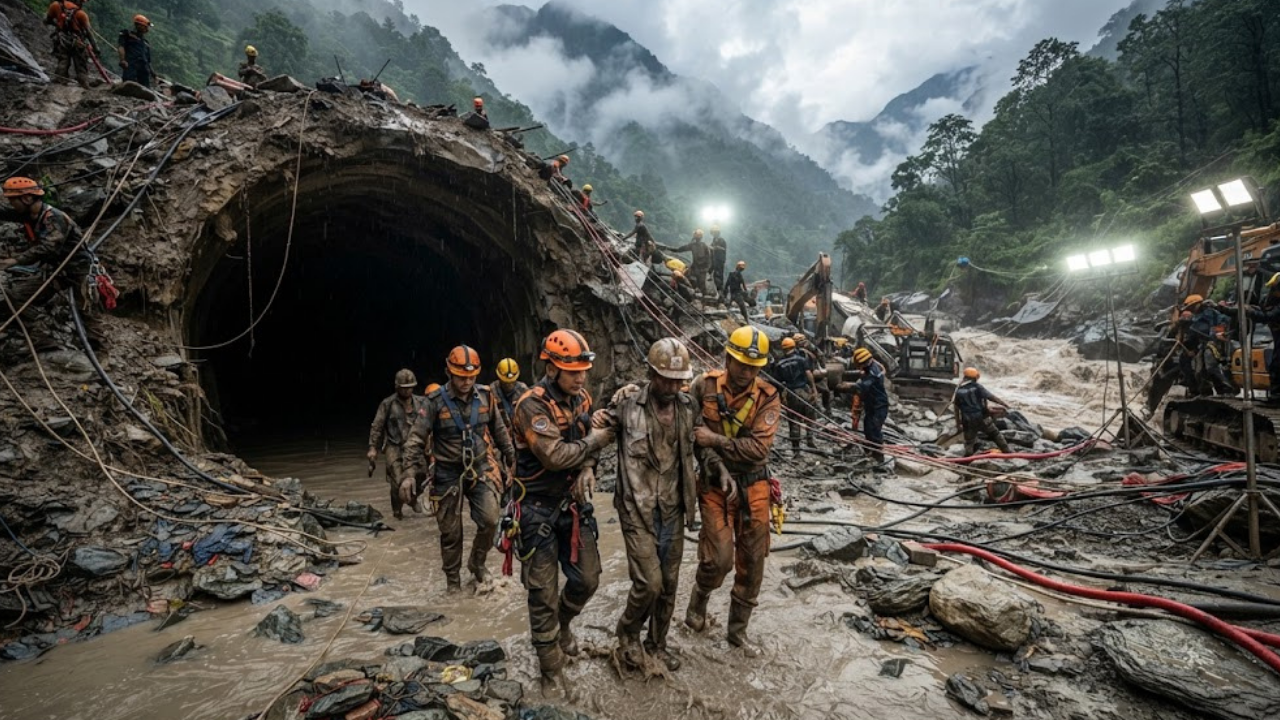
Sanjay Sah’s first words after nine days trapped in the dark had nothing to do with the flood, the mud, or how close he had come to not making it out at all. Carried out on a rescuer’s back, muddy and blinking in the daylight, the 30-year-old mechanical foreman asked a single question: “What day is it?”
Nine days earlier, he and dozens of colleagues had been working inside a hydropower tunnel in Nepal’s Rasuwa district when a wall of water, rock and glacial debris tore through the valley and buried the entrance behind them. This Nepal hydropower tunnel rescue – carried out on September 4 – became one of the few moments of relief in a disaster that had, by then, mostly stopped looking for survivors and started recovering bodies.
The Flood That Swallowed a Mountain
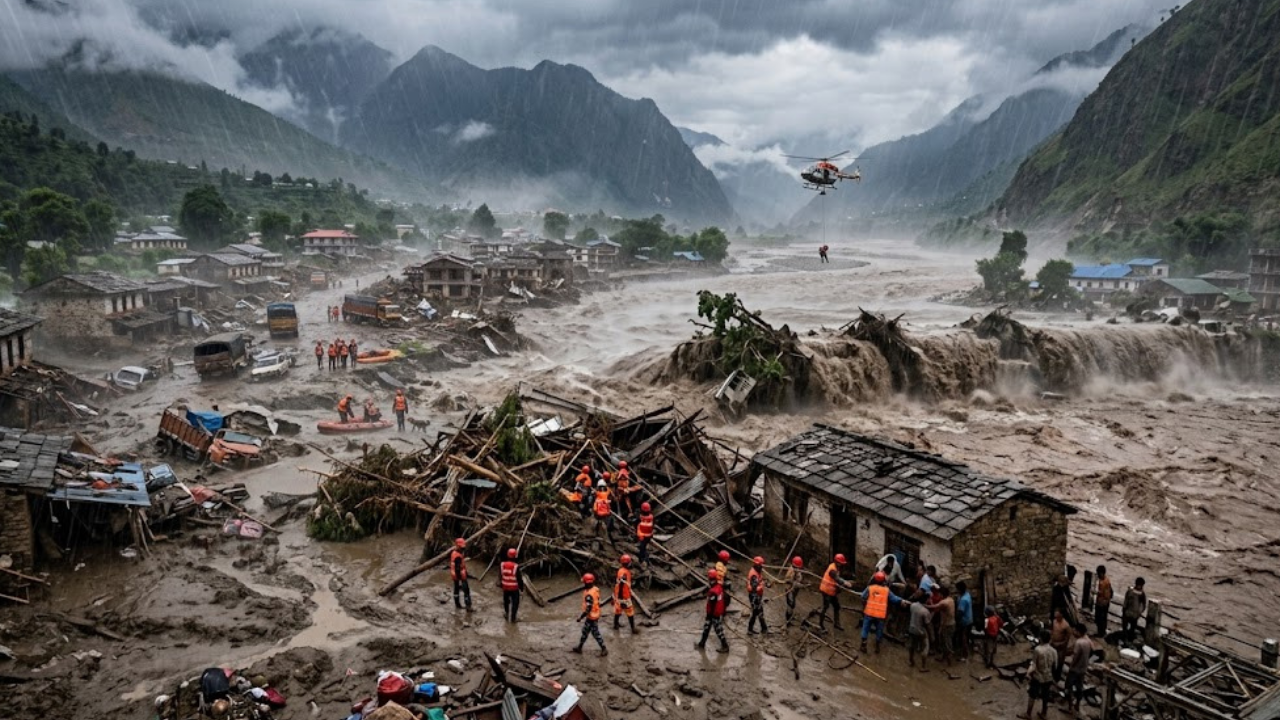
The disaster began on August 26, when a flash flood believed to have been triggered by a partial glacier collapse roared down Himalayan valleys along the Nepal-China border, sweeping away villages and burying entire communities under mud and rock.
By the following week, Nepal’s disaster management agency had confirmed more than 1,287 deaths, and more than 5,000 people remained unaccounted for. A joint tally of Nepali and Chinese figures, reported by CNN, later put combined fatalities on both sides of the border above 1,300. HumanCrisisNews covered the initial scale of destruction in our earlier report on the Nepal-Tibet flash flood.
Among the hardest-hit sites was the Trishuli 3A Hydropower Project, a construction site along the Trishuli River where dozens of workers had been underground when the floodwaters hit. The plant’s tunnel system was not a simple straight shaft but a network of chambers and passages that wound up and down through the mountainside, according to an energy adviser who spoke with CBS News.
Roughly 115 workers were believed to have been trapped inside that single tunnel, according to the Independent Power Producers Association of Nepal. That was part of a wider crisis in which close to 900 workers across 12 hydropower projects nationwide went missing, with an estimated 500 thought to be trapped underground.
Racing Blind: How Rescuers Found a Way In
For more than a week, rescuers had almost nothing to guide them. The flood had left the Trishuli 3A site unrecognizable, and there was no visible sign of where an entrance might still exist.
Geologist Arnold Dix, who advised Nepali rescue teams on the ground, said crews were forced to work from satellite imagery, the plant’s original architectural drawings, and topographic data. That combination helped narrow down which section of tunnel was least likely to have collapsed entirely – a target area Dix described as the “Goldilocks zone.”
Once rescuers broke through, they found the passage filled with water and sludge that had to be pumped and drained before crews could move further in. As water levels dropped, teams switched to white-water rafts to travel deeper into the flooded chambers, clearing debris meter by meter in round-the-clock shifts.
By Friday morning, nine days after the flood, the operation had reportedly begun shifting from a search for survivors toward the recovery of bodies. Then rescuers heard something unmistakable from deep inside the tunnel: a voice answering back. Police officials in the flood-hit district of Nuwakot said crews had already reported hearing sounds earlier that morning, which helped narrow the men’s location before the breakthrough came.
‘What Day Is It?’: Two Men, Nine Days, and What They Endured
The two workers pulled alive from the tunnel were identified by Nepal’s minister of home affairs, Sudan Gurung, as Sanjay Sah, 30, a mechanical foreman, and Kabir Maharjan, 45, a mechanical supervisor.
Sah later described spending his days underground “chanting mantras to give myself hope” while listening to other trapped workers calling out nearby. Exactly how the two men survived nine days without outside food, water or medical care has not been fully detailed publicly, and remains part of the ongoing account rescuers and doctors are still piecing together.
Both men were flown by helicopter to a hospital in Kathmandu for treatment after being freed. For their families, the wait had stretched across more than a week without confirmation of whether either man was alive. Amir, Maharjan’s brother, told AFP after the rescue: “I am so happy, my heart is lighter.” The family was reportedly still traveling to the hospital in Kathmandu at the time to see him in person.
Nepali Army spokesperson Brig. Gen. Raja Ram Basnet said one of the two survivors told rescuers that other workers were still alive somewhere inside the tunnel system – a detail that reshaped the day’s operation from a single rescue into a renewed, wider search. The scale of that search was considerable: roughly 75 army personnel, 18 police officers and a team of technical experts were involved in the Trishuli 3A effort alone.
Beyond One Tunnel: A Search That Isn’t Over
The success of this Nepal hydropower tunnel rescue mattered to crews for a reason beyond the two men’s own recovery. It proved that, more than a week after the flood, pockets of breathable air and shelter could still exist deep inside collapsed tunnels – evidence that gave rescuers reason to keep digging rather than shift entirely to recovery work.
That logic appeared to pay off again in the days that followed. On September 5, rescuers freed a third worker, a Chinese national, from the same general area, and separately located a woman alive in nearby rubble, ten days after the flood first struck.
That same day, the state-owned power utility released a list of 147 employees who had not been reachable since the flood – a reminder that for every family celebrating a rescue, many more were still waiting. Among them was Krishna Poudel, who told Reuters that his younger brother Ishwor, a 26-year-old hydropower worker, had called him at 7:30 a.m. on the morning of the flood to say he was headed into the tunnel for masonry work. Eight days later, Poudel still had no news of him – one of scores of families whose missing-person posters lined boards near the rescue site.
What Happens Next in the Nepal Hydropower Tunnel Rescue Effort
Search and rescue operations remain active across multiple hydropower sites in the Rasuwa and Nuwakot districts, including Trishuli 3A, Trishuli-3B, Upper Trishuli-1, Langtang and Chilime. The Nepali Army reported deploying more than 9,300 personnel across flood-affected areas for medical care, road clearance and continued search operations.
Crews are also working to link flooded tunnel sections to reach workers who may still be trapped. Nepal’s disaster agency has begun estimating the flood’s broader economic toll, though final figures remain preliminary. Officials have not said when search operations at Trishuli 3A are expected to conclude.
This is a developing story. The full account of how Sah and Maharjan survived nine days underground – including how they accessed air, water or shelter – has not yet been independently confirmed and may be updated as further reporting and medical details emerge.