
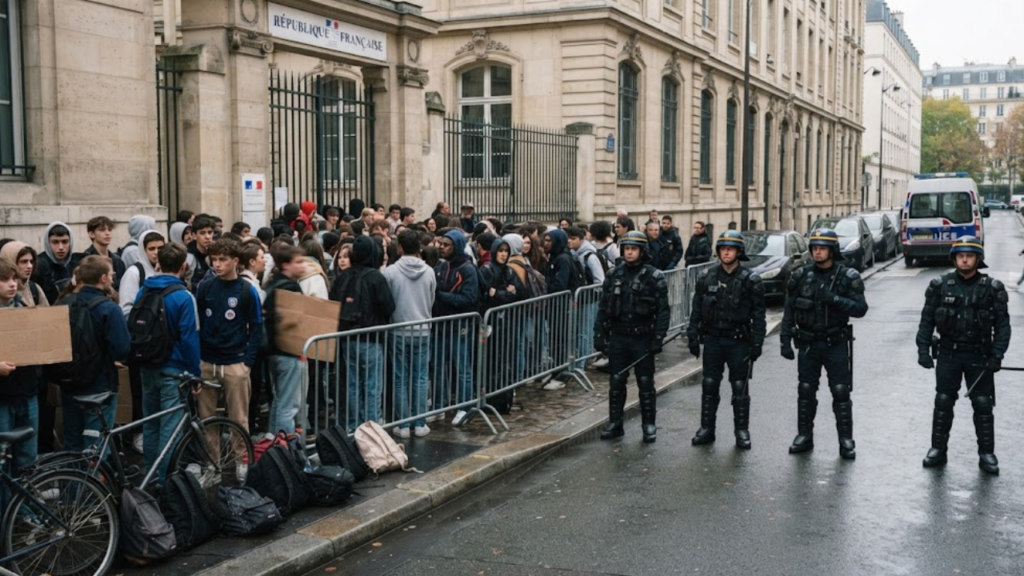
The French student protests over classroom conditions entered a fifth straight day on Friday, Oct. 2, as riot police and high school students clashed again and hundreds of schools stayed shut or disrupted nationwide. France’s education ministry said more than 560 of the country’s 3,700 public high schools were affected that day, down from over 1,000 the day before, according to the interior ministry. Police said they took roughly 2,000 people into custody on Thursday alone. The unrest began in the Paris region in late September and has since spread to Toulouse, Lille, Brest, Marseille and other cities, with no clear end in sight before a teachers’ strike planned for next week.
Why the French student protests started
The students’ core complaints are about resources, not politics in the usual sense. They point to overcrowded classrooms, teachers who go unreplaced when absent, and buildings in poor repair. “There are 35 of us per classroom,” a 17-year-old told the news agency AFP at a protest in Strasbourg, adding that some rooms have water leaks and too few toilets. The education ministry’s own data shows the scale of the staffing problem: nearly 10% of teaching hours in public secondary schools went untaught during the 2024-2025 school year, and about three-quarters of those lost hours were because no substitute could be found.
Education Minister Edouard Geffray has acknowledged the movement is hard to negotiate with precisely because it has no single list of demands. “One of the difficulties of this movement is that there are no national demands,” he said Friday. “It all started with local demands.” The protests have coincided with a wider public-sector strike against a government budget plan that includes 54 billion euros, about $61.3 billion, in spending cuts and savings, which students and teachers say will deepen an already strained school system.
The violence and the police response
Not every protest has turned violent, and student representatives called for the demonstrations to stay peaceful after meeting with Geffray, parents and school staff on Friday. But the images that have dominated French news coverage are of fires set outside schools, stones and bottles thrown at police, and officers firing tear gas to disperse crowds. A fire was set and extinguished at the Leonard de Vinci secondary school in Paris, and clashes were reported outside high schools in Toulouse and the western city of Brest.
Students have accused police of using excessive force, including firing tear gas canisters that they say caused injuries. French authorities have opened four separate investigations into those accusations, though no findings have been announced. News reports describe more than 200 people injured since the unrest began, though no single government total has been published, and the figure has not been independently verified by HCN.
The political backdrop
The unrest lands roughly six months before France’s next presidential election, at a time when opinion polls consistently show President Emmanuel Macron and his government deeply unpopular. Geffray has blamed much of the violence on what he called “ultra-violent fringe groups” hijacking a legitimate student movement. The hard-left France Unbowed party, known as LFI, has denied encouraging the unrest after being accused by government figures of fueling it. Trade unions have called a nationwide teachers’ strike for Tuesday, a week after public-sector workers already walked out once.
What remains unresolved
The exact scale of the disruption is difficult to pin down because different ministries and student groups are counting differently: official figures describe schools “affected” on a given day, while some student accounts describe a cumulative, looser tally. It is not yet clear whether the government plans any concrete concessions on teacher hiring or the disputed budget cuts, or whether Tuesday’s teachers’ strike will widen the protests further. The four police-conduct investigations remain open, and their outcome could shape how the movement is remembered in France long after the schools reopen.