
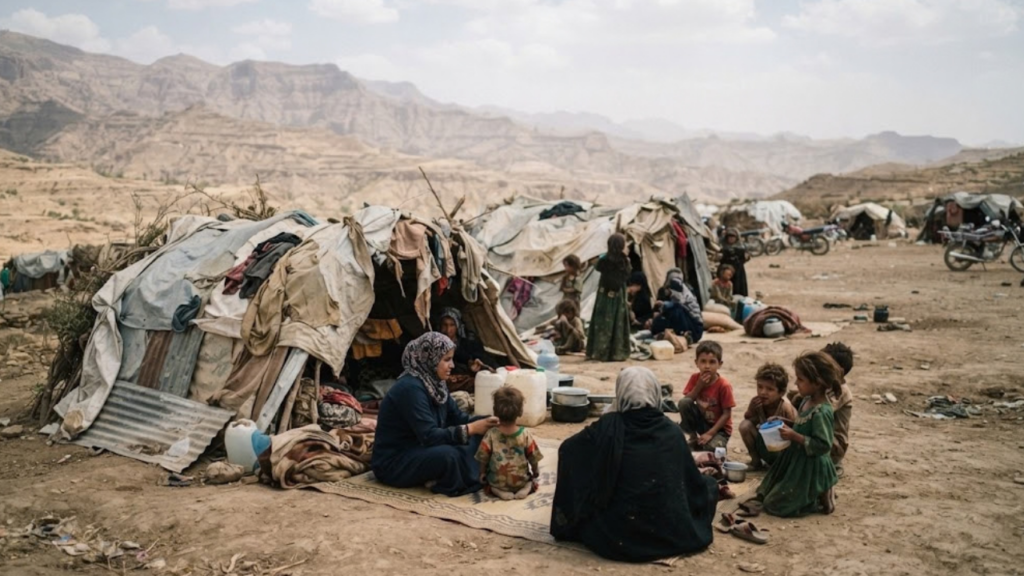
The announcement comes weeks after the Houthis seized the Red Sea coast, as UN agencies report mass displacement and the group claims new strikes on Saudi energy sites.
YEMEN — Yemen’s internationally recognized government announced a major military operation on Sunday, October 4, 2026, aimed at retaking territory held by the Houthis, weeks after a Houthi offensive in Yemen put the Iran-backed group in control of the Bab el-Mandeb Strait. Rashad al-Alimi, head of the Presidential Leadership Council, made the announcement from Saudi Arabia and called on the international community to support the government.
The Houthis have held the initiative on the ground in recent weeks, according to Reuters, and have been pushing forward near the southwestern city of Taiz. The size, objectives and timeline of the new government operation had not been published in the reporting reviewed.
Fighting around Taiz
Reuters reported, citing military sources, that the Houthis gained ground on strategic hilltops near Taiz over the previous 48 hours. They are advancing on what the report described as the last road linking the city with Aden, where the Saudi-backed government is based.
Mohammed Al-Qadhi, a veteran Yemeni journalist from Taiz who now works as a political analyst, told Reuters that seizing the rugged mountains in western Taiz would help the Houthis consolidate control of the flat coastal area around Bab el-Mandeb. The Houthis have besieged Taiz itself for more than a decade.
Government forces have made their own claims. They said they regained a strategic point in the ash-Shamaytayn district of Taiz province on September 23, and later reported advances in southern Taiz, including higher ground. On Thursday, October 1, government forces said six airstrikes hit Houthi positions southeast of Taiz, killing or wounding dozens of fighters, and reported heavy clashes at several fronts in western Taiz. None of these claims has been independently verified. The Houthis said airstrikes hit the capital, Sanaa, overnight on Sunday but gave no details.
How the Houthis reached the coast
Yemen has been at war since the Houthis seized Sanaa in 2014 and the government retreated to Aden. A fragile truce in place since 2022 collapsed in July, according to Al Jazeera.
In mid-September, the Houthis captured the port city of Mocha and the island of Perim, completing their control of Yemen’s Red Sea coastline. Reuters described the advance as a lightning offensive in which government forces collapsed. Al Jazeera reported that Houthi forces are now about 20 kilometers (12 miles) from the African coast.
Why the Houthi offensive in Yemen matters for Red Sea shipping
Bab el-Mandeb is the southern exit of the Red Sea and a key shipping route between Asia and the Mediterranean. Reuters said its importance has grown this year because it serves as an alternative to the Strait of Hormuz, which it described as effectively closed by the Iran conflict. A maritime security expert, Alexandru Cristian Hudisteanu, told Al Jazeera that the strait is narrower than Hormuz.
Saudi Arabia has been using the Red Sea route as an alternative, Al Jazeera reported. The Houthis have accused Riyadh of carrying out attacks in Yemen and have said they will prevent Saudi tankers from passing through the strait.
Claimed attacks on Saudi Arabia
On Saturday, October 3, Houthi military spokesman Yahya Saree said on X that the group had struck an Aramco facility in Riyadh with ballistic missiles and drones, causing fires. Saudi authorities and Aramco had not confirmed the claim. The Houthis made a similar claim in late September about Aramco facilities in Yanbu, a Red Sea port on Saudi Arabia’s west coast. Neither claim has been independently verified, and the extent of any damage is not known.
Human impact
The fighting has driven one of the fastest displacement surges in the country this year. The International Organization for Migration reported on September 11 that at least 46,000 people had fled after the Houthis seized Mocha, and said families were being forced to flee for a second or third time. By September 15, the agency counted 93,864 newly displaced people, and UNHCR said thousands had crossed the strait to Djibouti.
On September 22, UNHCR said more than 130,000 people had fled their homes since the start of the month. It said the vast majority were women and children, and that Taiz was the center of the crisis. More than 5.2 million people were already internally displaced in Yemen before the escalation.
The UN also warned on September 15 that the fighting was choking off aid shipments. UN Emergency Relief Coordinator Tom Fletcher released $9 million from the Central Emergency Relief Fund for displaced families and the communities hosting them. Aid groups told NPR that far more funding is needed. Houthi leader Abdul-Malik al-Houthi said in a video message that Yemenis fleeing western and southern provinces were not the group’s target. More recent reports describe hundreds of thousands of people displaced since the fighting restarted. The latest UN figure in the sources reviewed is from September 22.
What remains unclear
- Scale of the operation: The government has not published troop numbers, objectives or a timeline in the reporting reviewed.
- Battlefield claims: Each side’s claims of territorial gains and enemy casualties are unverified.
- Aramco claim: Saudi authorities and the company have not confirmed it.
- Current displacement: The most recent verified UN figure is from September 22, so the true total is likely higher.
What happens next
More fighting is expected around Taiz and along the Red Sea coast, and the government has asked for international backing. Updates are expected from the Presidential Leadership Council, Saudi authorities and UN humanitarian agencies. Shipping through Bab el-Mandeb remains a key concern as the Houthi offensive in Yemen continues and the Saudi-Houthi confrontation widens. Human Crisis News will update this report as new information is confirmed.