
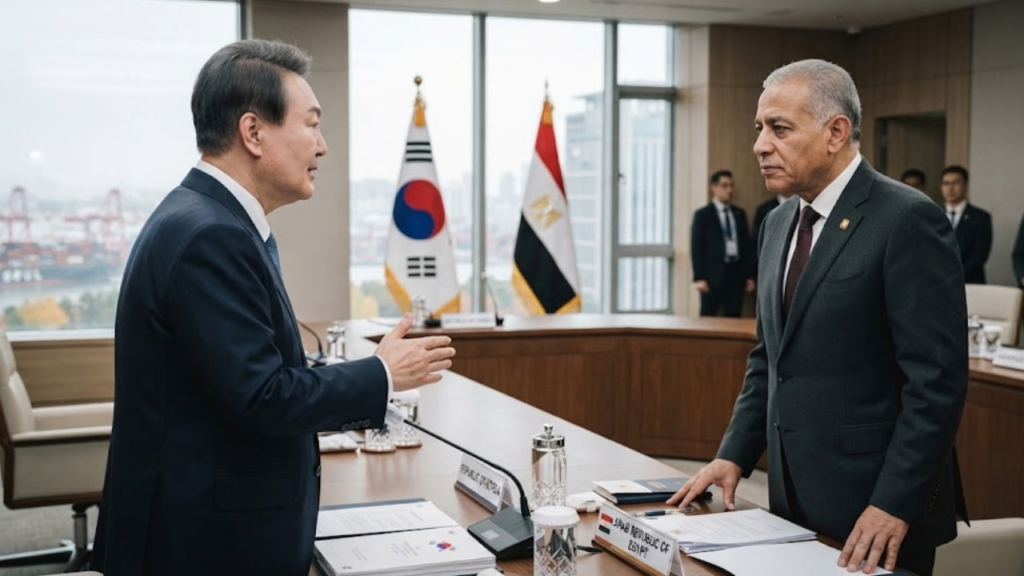
Presidents Lee Jae Myung and Abdel Fattah el-Sisi signed or revised 12 agreements in Seoul, building on a defense relationship centered on K9 howitzers and aiming to widen it into trade, energy and shipbuilding.
SEOUL, South Korea and Egypt have upgraded their bilateral relations to a strategic partnership and formally launched negotiations on a Comprehensive Economic Partnership Agreement (CEPA), Seoul said on Thursday. The decisions followed summit talks in Seoul between South Korean President Lee Jae Myung and Egyptian President Abdel Fattah el-Sisi. The upgrade matters because it pairs a higher diplomatic status with a concrete trade negotiation, something a ceremonial upgrade does not always include.
Speaking at a joint press conference on October 8, Lee said the two sides had issued a joint statement elevating relations to a strategic partnership. El-Sisi said the upgrade opens the way for a promising future for Egyptian-Korean ties and framed it as part of Egypt’s balanced and diversified foreign policy. He also said the partnership would support international peace and security.
What South Korea and Egypt announced
Lee said the CEPA talks follow an agreement last year to pursue the pact, and that the two countries declared the launch of negotiations on the same day. The two sides signed a joint declaration launching the negotiations. Lee said the proposed agreement would strengthen trade and investment and create openings for South Korean companies to expand into markets across the Middle East and Africa.
The countries signed or revised 12 cooperation documents. In industry, these included memorandums of understanding on shipbuilding, clean energy and power infrastructure. Other documents cover defense, information technology, education and cultural exchanges.
Two other outcomes were announced:
- South Korea became the first Asian country to sign a social security agreement with Egypt, which eases the burden of dual pension contributions for workers dispatched between the two countries.
- The two governments designated next year the “Korea-Egypt Year of Mutual Cultural Exchange.”
Defense cooperation
Lee and el-Sisi described the joint production of K-9 self-propelled howitzers as a successful model of defense industry cooperation, and agreed to carry that cooperation forward. Lee called for cooperation to go beyond weapons exports to local manufacturing and technology transfer. The summit readouts do not name any new defense contracts or purchases.
Trade figures
Trade between the two countries is currently shrinking. Egyptian government statistics put bilateral trade at $874 million for January to August 2026, against $920 million in the same period of 2025. A separate report cited Egypt’s Finance Ministry as showing merchandise trade above $1.6 billion in 2024, a full-year figure that is not comparable with the eight-month totals. South Korea mainly exports vehicles, machinery and electrical equipment to Egypt, while Egypt supplies fuel, fertilizers and garments.
Background
The two countries established diplomatic relations on April 13, 1995. El-Sisi’s visit is his first to South Korea since 2016 and follows Lee’s trip to Cairo last November. Egypt links Africa, the Middle East and Europe through the Suez Canal, which is part of its appeal as a trade partner. Reports differ on the earlier status of the relationship. One describes a 2016 upgrade to a “comprehensive cooperative partnership,” while Lee referred to a “Cooperative Partnership” at the November 2025 summit.
What remains unclear
The CEPA talks have no announced timetable, and neither government has released the agenda or scope of the negotiations. The texts of the 12 agreements have not been published in the readouts reviewed, so their financial value and binding force are unknown. Outcomes such as “tangible results” for citizens, which Lee promised, have no stated targets.
What happens next
The first formal negotiating round has not been scheduled in the sources reviewed. The next step is for the two trade ministries to set a negotiating calendar. Both governments have said 2027 will be a year of cultural exchange events.