
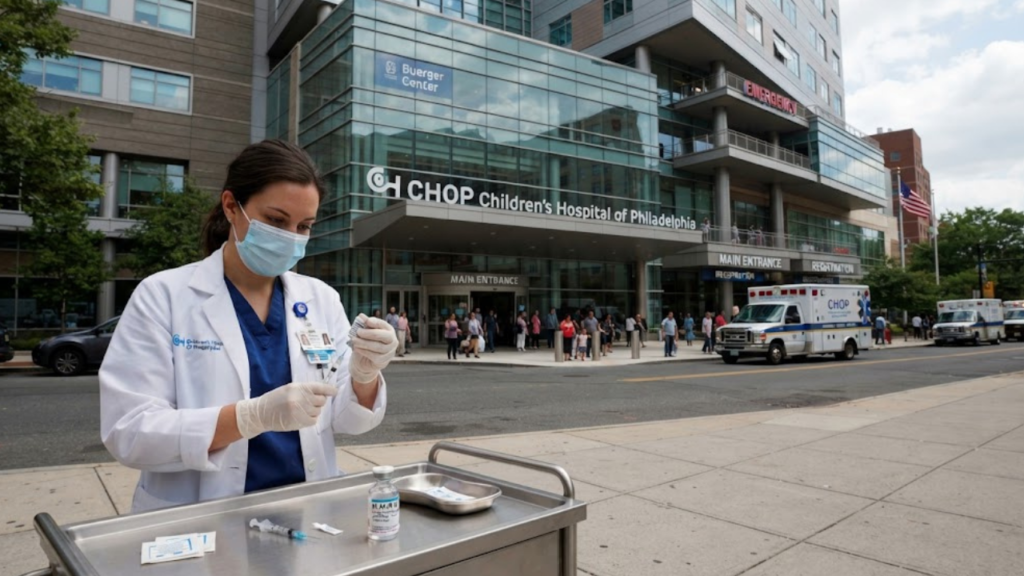
A possible measles NICU exposure at Children’s Hospital of Philadelphia has put the region’s newest and most fragile patients at the center of the country’s worst measles outbreak in more than three decades – and it’s landing in the middle of a season where Pennsylvania, New York and Illinois are all fighting active spread at the same time.
The Philadelphia Department of Public Health said an infected person was inside CHOP’s main campus at 3401 Civic Center Boulevard on Friday, September 11, passing through several high-traffic areas of the hospital over the course of the day: the NICU West unit and its family lounge between 9:30 a.m. and 4:15 p.m., the hospital atrium during that same window, and the main cafeteria from 12:05 p.m. to 2:45 p.m.
Why this measles NICU exposure is being treated differently
Anyone who was in those areas during those hours could have been exposed. But the response inside the NICU has moved faster and further than a typical exposure notice, because the babies inside a neonatal intensive care unit are, by definition, too young to be vaccinated. The measles vaccine isn’t given until at least 12 months of age, which means every infant in that unit had zero built-in protection against the virus.
CHOP, the Pennsylvania Department of Health and city health officials said they’re working to give every infant who was in the NICU that day a preventive antibody product – a treatment that doesn’t stop someone from being exposed, but can prevent the infection from taking hold or keep it from turning severe if it does. It’s an option available only in situations like this: newborns and infants can’t build their own immunity through a vaccine dose in time, so doctors give them a temporary, borrowed one instead.
Philadelphia’s health commissioner, Palak Raval-Nelson, said the exposure isn’t expected to threaten the broader public because most of the city’s population is already vaccinated, but stressed the reasoning behind pushing vaccination broadly: protecting people who have no way to protect themselves yet. People who are not immune and were in the exposed areas have been told to watch for symptoms — fever, runny nose, cough, and red, watery eyes, typically followed by a rash — through October 2, and to mask around unvaccinated people and anyone at high risk in the meantime.
Pennsylvania is already living through its worst outbreak in 35 years
The CHOP exposure didn’t happen in isolation. State figures show Pennsylvania has recorded 693 confirmed measles cases across 38 counties so far in 2026. That includes 133 hospitalizations and four measles-associated deaths – a toll state health officials describe as the Commonwealth’s worst measles outbreak in more than three decades.
Two of those deaths were infants too young to be vaccinated. Two more were unvaccinated adults, one in Jefferson County and one in Mifflin County, confirmed just days before the CHOP announcement. Fewer than 1% of this year’s Pennsylvania cases have occurred in people who were fully vaccinated.
That local surge is part of a larger national picture. The CDC reported 3,471 confirmed measles cases across 47 jurisdictions as of September 17, tied to 39 separate outbreaks — a caseload not seen in the U.S. since before measles was declared eliminated in 2000.
New York and Illinois are seeing their own flare-ups
Pennsylvania isn’t fighting this alone this month. New York’s Department of Health launched a public dashboard on September 15 after confirming 57 measles cases statewide in 2026 — 51 of them outside New York City, concentrated in upstate regions including the Southern Tier and Finger Lakes. Steuben County currently has the most cases in the state at 10, followed by Seneca County with nine and Otsego County with seven. Health officials also detected wild-type measles virus in wastewater samples from Montgomery and Yates counties in August — a signal that at least one infected person passed through those areas, even without a confirmed local case tied to it yet.
In Illinois, the Kane County Health Department confirmed a measles case in a county resident and is now working with the state health department to trace possible exposures. The department is directing residents toward vaccination through their own physicians, local pharmacies, and its own immunization program, which provides MMR shots at no cost to children and adults who are uninsured, underinsured, or on Medicaid.
What actually protects people, and who’s still exposed
The consistent thread across all three states is the same: two doses of the MMR vaccine give about 97% protection against measles, and even a single dose provides roughly 93%. The population still carrying real risk is narrow but specific — infants under 12 months who haven’t reached vaccination age yet, people with medical conditions that prevent vaccination, and the small number of adults vaccinated between 1963 and 1967, when some vaccines in use were a less effective inactivated version.
For anyone who thinks they may have been exposed at CHOP and isn’t sure of their own status, checking vaccination records with a doctor — or, in New York, using the state’s own case dashboard to track local risk — is the concrete first step health officials are pointing people toward, rather than waiting to see if symptoms appear.
What happens next
CHOP has not said how many infants were in the NICU during the exposure window or how many have received the antibody treatment so far. Pennsylvania’s Department of Health continues to update its measles dashboard, and new cases tied to the CHOP exposure — if any appear — would likely surface in the state’s count over the next two to three weeks, roughly the incubation window for measles after contact.
New York’s dashboard refreshes every Tuesday with the previous week’s confirmed cases, and Kane County’s health department says it’s still working to determine how many additional Illinois residents may have been exposed. Outbreaks like this one tend to move fastest through communities with lower vaccination rates, a pattern also seen in the world’s deadliest recent Ebola outbreak in the DRC, where gaps in immunization and health access shaped how far the virus spread. For now, the clearest number families in the Philadelphia area are watching for isn’t a new case count — it’s confirmation of how many of the NICU’s youngest patients get through the coming weeks without ever showing a symptom.