
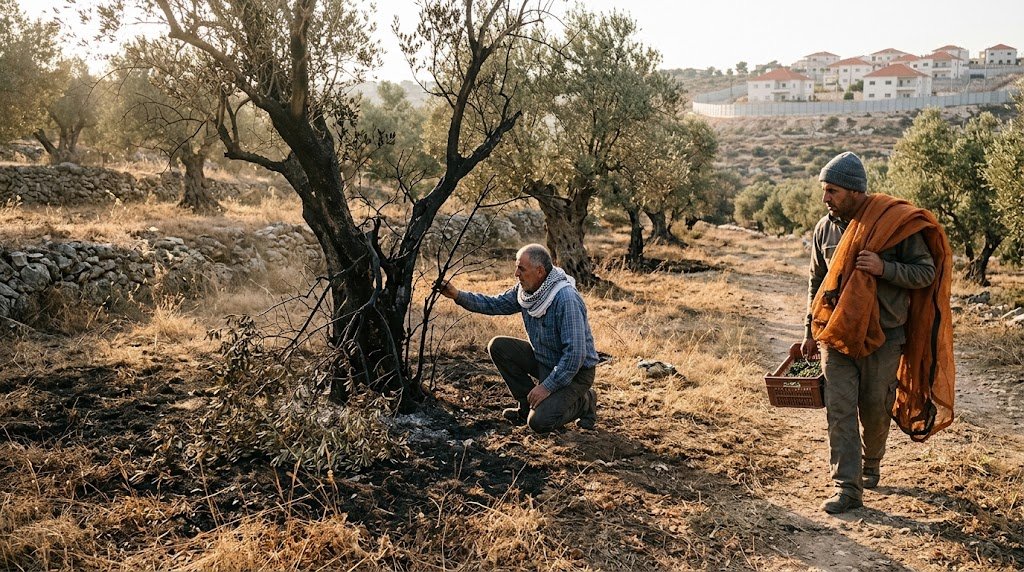
Israeli settlers attack West Bank villages during the olive harvest, with reports from Friday, 16 October 2026, describing cars and trees set on fire and residents and a foreign journalist beaten. The Associated Press reported that local officials and the Palestine Red Crescent Society documented attacks in at least eight villages in the northern West Bank, where most of the territory’s olive groves are found. The violence is the latest in a harvest season that Palestinian farmers’ representatives call the worst they can remember, according to AP’s report. Israel’s military condemned the attacks, while a separate shooting by soldiers in one village is disputed.
Settlers attack West Bank villages: what happened on Friday
In the village of Abu Falah, near Ramallah, residents set out early to harvest, accompanied by peace activists. Settlers then attacked the group, according to AP, and the Washington Post said dozens of masked settlers threw rocks and set groves on fire in what it described as a coordinated assault. Israeli activist Jonathan Pollak, who was present, told AP the attackers came down from a hilltop outpost throwing stones, burning trees and firing gunshots. He said Israeli soldiers stood beside the settlers during the attack, an account that the Washington Post also reports witnesses gave.
Heidi Levine, a veteran Washington Post photographer, was beaten and taken to hospital. She told AP she was kicked for about ten minutes and that her helmet and a vest marked “PRESS” likely protected her from worse injuries. Elsewhere, in Turmus Ayya, northeast of Ramallah, the mayor said settlers burned several cars in nearby groves. Across the territory, the Palestine Red Crescent Society said its medics treated 14 wounded people in six locations, and local officials reported at least four more injuries in two other villages. Israel’s military said the suspects in Turmus Ayya fled before troops arrived.
A shooting in Abu Falah, and two accounts of it
After the settlers left, Israeli soldiers entered Abu Falah and shot a village council member. Residents say the man was unarmed and far from the olive trees. One council colleague told AP he was shot at close range while carrying harvesting tools. The military said soldiers fired because an individual was running toward them with a sharp object.
HCN could not independently verify either version, and AP did not report the man’s condition. The competing accounts matter because they concern whether lethal force was justified, an issue Israeli authorities would normally be expected to investigate.
Responses from Israel and abroad
Israel’s military condemned the violence in Abu Falah and acknowledged that a journalist was injured. Prime Minister Benjamin Netanyahu’s office also condemned it but questioned whether Palestinians and activists were to blame, calling the incidents “disputed.” The statement warned against using them to portray the hundreds of thousands of settlers as lawless. Netanyahu has previously described settler violence as the work of a few dozen fringe youths and said its scale is exaggerated.
Rights groups see it differently. Ziv Stahl, executive director of the Israeli group Yesh Din, said soldiers are not stopping the violence and are sometimes helping settlers. The Foreign Press Association said its repeated calls for action against such attacks on journalists had been ignored. The US State Department said it condemns criminal violence by any party and supports investigations and legal accountability. Britain’s government has said Israel is turning a “blind eye” to the campaign, according to AP.
The pattern is not new, but the numbers are large.
Roughly 110,000 Palestinian families depend on privately owned groves for income and employ tens of thousands of seasonal workers, according to Abbas Milhem of the Palestinian Farmers’ Union. He told AP that settlers have damaged hundreds of thousands of trees in past years, causing losses worth millions of dollars, and that this year is the worst he can remember. The Palestinian Health Ministry said last week that at least four Palestinians had been killed and more than 100 injured since the harvest began earlier in October, and Yesh Din says it has documented hundreds of harvest-related incidents. HCN has not independently verified these figures.
The pattern is not new, but the numbers are large. The UN’s humanitarian office, OCHA, reported more than 1,600 attacks across the territory between January and August this year. A UN agency also found last year’s harvest had the highest level of damage and number of settler attacks since 2020. Accountability remains rare. Yesh Din has found that more than nine in ten investigations into ideologically motivated offences against Palestinians end without an indictment.
The wider setting
The West Bank has been under Israeli military rule since the 1967 war and is home to around 3 million Palestinians and more than 500,000 Israeli settlers, according to AP. Most countries and UN bodies consider the settlements illegal under international law, a view Israel disputes. AP reported that incidents in which settlers attack West Bank villages have risen this year and spiked further in the weeks before Israel’s general election on 27 October.
What to watch next
The harvest is still under way, so more incidents in which settlers attack West Bank villages are possible in the coming weeks. Key questions include whether Israeli authorities arrest or charge anyone over the attack on Ms Levine and the burning of vehicles, and whether the military opens an inquiry into the shooting in Abu Falah. The election on 27 October will also shape how the next government approaches settler violence, which has become a point of friction with Washington and London. Read more in our Conflict coverage.