
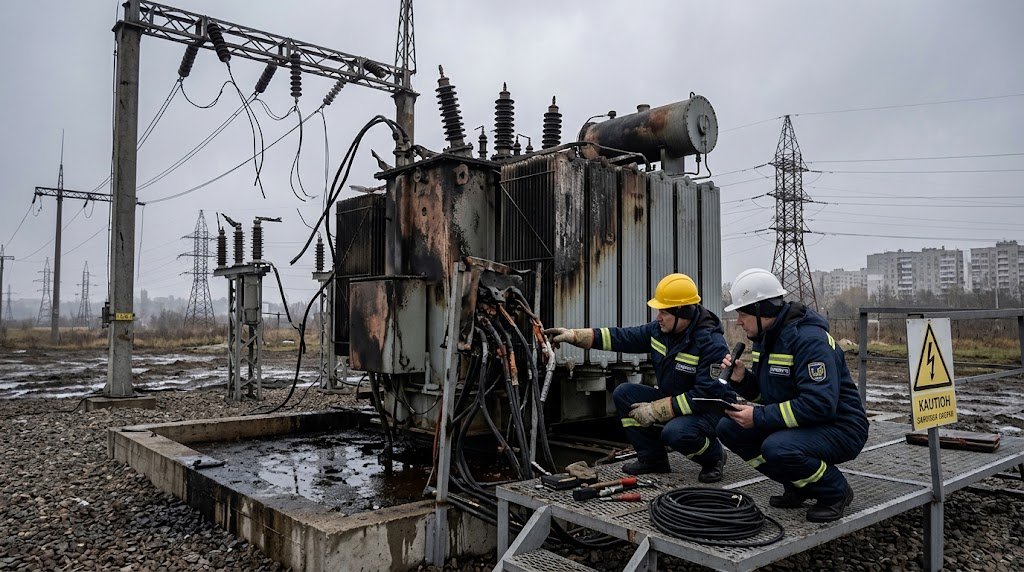
At least 15 people were wounded as the attacks hit homes and the grid. A UN report shows civilian casualties rising sharply as winter nears.
Ukraine power outages hit hundreds of thousands of households on Friday, 16 October 2026, after Russian attacks on nine regions. The strikes also damaged numerous homes and wounded at least 15 people, according to Ukrainian officials cited by the Associated Press. The reports reviewed by HCN did not name all nine regions or give a death toll. The wounded count is a minimum and may change.
What is known about the outages
Officials described the cuts as “emergency” outages. That usually means power is switched off at short notice because the grid cannot supply enough electricity, not on a published schedule. Households cannot plan around them. The reports did not say how long the cuts lasted or how quickly power was being restored.
The strikes came a day after Ukraine said it was abandoning a short-lived pause on attacks against energy-related targets. Kyiv said Moscow had not respected the pause despite US President Donald Trump’s call for a ceasefire. Ukraine has since resumed strikes on Russian targets. Russia’s Defense Ministry said its air defenses intercepted 644 Ukrainian drones overnight. Interfax reported more than 200 delayed flights at four Moscow airports because of overnight restrictions. HCN has not independently verified these figures.
Why Ukraine power outages are a winter risk
Attacks on power infrastructure ahead of the cold months have been a recurring pattern in the war. The AP describes them as an effort to wear down Ukrainians by denying them heating and running water. Ukrainian officials have warned that Russia is stockpiling ballistic missiles for further attacks in the coming months.
For ordinary people, prolonged Ukraine power outages mean more than lost lighting. They can interrupt water pumping, mobile networks, refrigeration, home heating controls and medical equipment that depends on electricity. These effects are likely in any long blackout, but the reports reviewed did not document them for Friday’s attacks.
A rising civilian toll
The UN human rights office in Kyiv published its monthly report the same day. It recorded at least 328 civilians killed and 2,105 wounded in September, which is 85% more than in September 2025. It also said attacks in October had already killed dozens of civilians, including children. The office’s head, Danielle Bell, said the first two weeks of October were among the deadliest periods for civilians in years.
The attacks are hitting more than the power grid. Apartment buildings, public transport, cargo ships, data centers and food stores have also been targeted, according to the AP’s summary.
Air defense and the diplomatic backdrop
Ukraine’s ability to intercept ballistic missiles depends heavily on US-made Patriot systems. President Volodymyr Zelenskyy said on Friday that only small numbers of Patriot interceptors have reached Ukraine in recent months. Some were bought by European countries for Kyiv, and others came from stocks held by other states.
He also said speed restrictions placed on Starshield, a military version of SpaceX’s Starlink, were slowing Ukrainian interceptor drones to 70 kph (43 mph). Russia’s jet-powered drones travel at more than 400 kph (250 mph). Zelenskyy said speeds were being restored but not yet back to previous levels.
Zelenskyy spoke at a European Union summit in Brussels, where leaders pledged continued support and urged Washington to press Moscow. He told them the war would cost Ukraine 155 billion euros (about $174 billion) next year, and that Kyiv would need at least 70 billion euros from Europe. This comes amid public friction between Zelenskyy and Trump. Any effect on US military support has not been confirmed.
What to watch next
- Outage duration. Ukrainian authorities have not yet said how quickly power will be restored, or in which regions. Ukraine power outages of this kind can last hours or longer.
- Winter preparation. It is unclear whether air defense supplies and repair capacity can keep up with attacks on the grid.
- Energy targeting. Both sides have resumed strikes on each other’s energy-related sites after the collapse of the brief pause.
This is a developing story. Figures are based on officials’ statements as of 16 October 2026 and may change as more information is confirmed. HCN will update this article when new verified details are available.