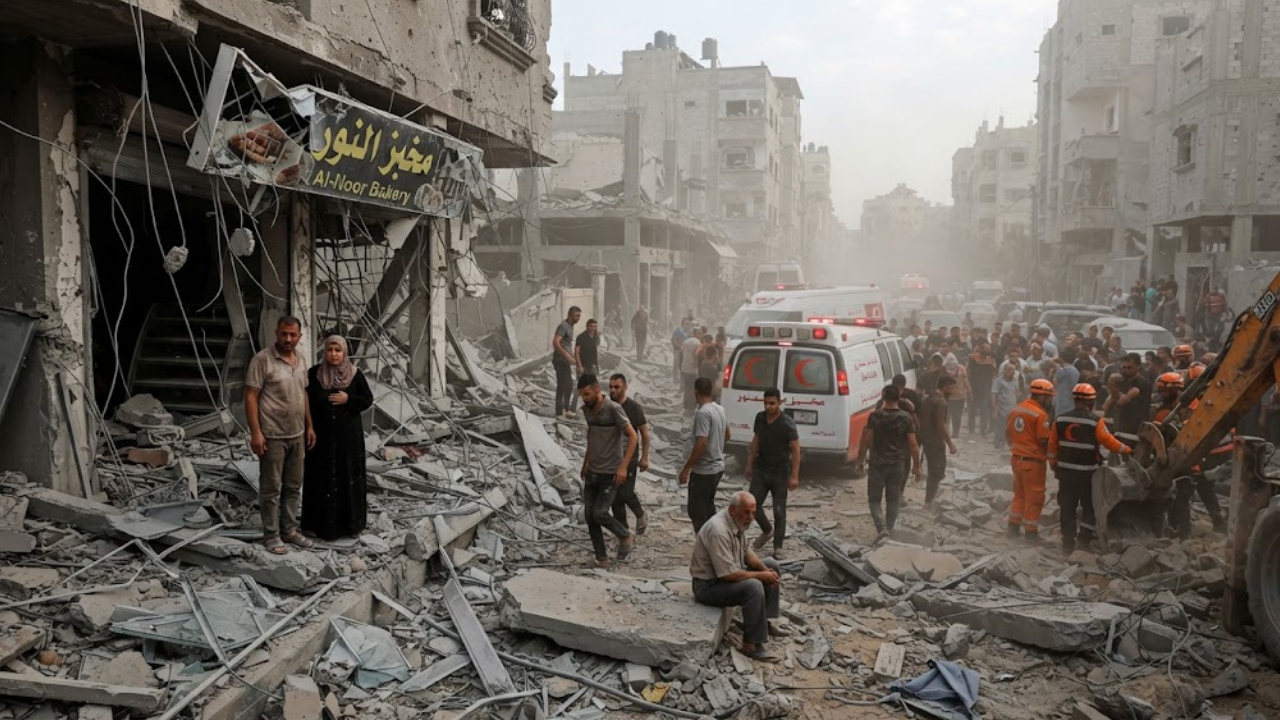
Deir al-Balah, Gaza Strip – A three-year-old boy and a Palestinian man were killed on Sunday when the Deir al-Balah strike hit close to a bakery in the center of the Gaza Strip, according to health officials who spoke with Reuters. The strike, which also wounded several bystanders, adds two more names to a death toll that has climbed steadily in the ten months since a ceasefire was meant to end the killing – a toll HCN has tracked climbing past 1,280 in recent days.
The child, identified by medics at Al-Aqsa Martyrs Hospital as Tayyem Hamdan, and the man, named as Hussam Nusair, were confirmed dead by Gaza’s health authorities on the day of the Deir al-Balah strike. By the afternoon, Hamdan’s mother and other relatives had gathered at the hospital in Deir al-Balah for his funeral; photographs from the scene, taken by Reuters photographer Mahmoud Issa, show an uncle carrying the boy’s body.
What Happened in the Deir al-Balah Strike
The strike landed near a bakery – one of the few still functioning in a city where food access has been a persistent struggle throughout the war. The Israeli military confirmed carrying out the attack, saying it had targeted and killed a Hamas fighter it identified as Nusair, whom it accused of involvement in attacks against Israeli soldiers and civilians. It did not release further evidence to support that claim, and Hamas had not responded to the allegation as of the time of writing.
No explanation has been offered by Israeli authorities for the death of the three-year-old. The circumstances that placed a toddler at the site of the Deir al-Balah strike, aimed at an alleged militant, remain unclarified.
That gap – between a stated military target and an unexplained child death – has become a familiar feature of reporting on Gaza since the ceasefire took hold. It is a detail mainstream wire coverage often compresses into a single line before moving on, even as this Deir al-Balah strike marks one of several recent incidents in which a named “militant” target was killed alongside a young child.
A Ceasefire in Name Only
The Deir al-Balah strike falls within what has become a well-documented pattern. A truce between Israel and Hamas, built around a 20-point plan put forward by the Trump administration, took effect on October 10, 2025, formally halting the large-scale phase of the war. The agreement’s first stage was completed in January 2026, when Israel confirmed that Hamas had returned the remains of the final Israeli hostage held from the October 7, 2023 attacks, according to the Council on Foreign Relations.
What followed has not been peace so much as a lower-intensity continuation of it. Palestinian health officials, cited by Al Jazeera, put the number of Gazans killed by Israeli fire since the ceasefire began at roughly 1,300 as of late August.
That figure has varied by a few percentage points depending on whether it is drawn from the Ministry of Health or Gaza’s Government Media Office, though both track in the same range and both attribute the deaths to continued Israeli strikes, shootings, and shelling carried out under the banner of “security operations.” The UN’s own casualty-recording body has cautioned that its figures for the post-October-2023 war, including the ceasefire period, are added only once incidents are independently verified – a slower process that helps explain why tallies from different trackers rarely match exactly. Thousands more have been wounded since the truce began.
Efforts to move the truce into its second phase – covering Hamas’s disarmament and an Israeli withdrawal – have stalled badly. A roadmap accepted by Hamas in July, brokered through the Board of Peace, was effectively disowned by the board itself days later under Israeli pressure, according to a late-August report from the International Crisis Group.
On August 9, Israeli Prime Minister Benjamin Netanyahu told his cabinet that Israel would not withdraw troops until Hamas underwent what he called “genuine disarmament, not a fictitious one,” according to reporting relayed by the Crisis Group. Hamas, for its part, has signaled privately that it might freeze or store parts of its arsenal but has resisted full disarmament, arguing that Israel has not met its own obligations under the deal.
Caught between those positions, ordinary residents of places like Deir al-Balah have absorbed the cost of a negotiation neither side appears close to finishing. The same city was the site of a separate, deadly attack on civilian infrastructure just days earlier, when HCN reported on the strike that hit Gaza’s main desalination plant, underscoring how repeatedly this stretch of central Gaza has absorbed strikes despite the truce.
Why the Deir al-Balah Strike Rarely Makes Headlines
There is no front line running through the block where Hamdan and Nusair were killed. A bakery queue is not a strategic objective.
That is precisely why a strike like this tends to register, if at all, as a single paragraph buried inside a wire story about ceasefire statistics – a name, an age, a location, then on to the next data point. The scale of the war that preceded the ceasefire, which the Gaza Ministry of Health says has killed more than 73,000 people since October 2023, has a way of making a toll in the low thousands feel almost like restraint. It is not experienced that way by the families involved.
What distinguishes the post-ceasefire period is not the absence of violence but the absence of a war to explain it. Residents who returned to damaged neighborhoods on the understanding that the fighting was over are instead learning to navigate a city where a strike can still arrive without warning near a place as ordinary as a bakery, justified afterward with a claim about an individual the public has no way to verify.
Current Status
As of Sunday evening, there was no indication that the Deir al-Balah strike would be independently investigated. No timeline has been set for a resumption of negotiations on the ceasefire’s stalled second phase.
Egypt, Qatar and Turkiye remain engaged as mediators alongside the United States, but talks on Hamas’s disarmament and a full Israeli withdrawal have not progressed since the Board of Peace’s roadmap collapsed earlier in August. Casualty figures from Sunday’s strike are considered preliminary by local health officials and may be revised as reporting continues.