Kyiv, Ukraine – Air raid sirens have barely stopped in Kyiv this week. The Kyiv drone attacks that began Wednesday stretched into a fourth consecutive day on Saturday, part of a bombardment President Volodymyr Zelensky said involved nearly 2,000 attack drones, more than 1,600 guided bombs and 31 missiles fired at Ukraine over seven days, according to a Telegram post he published on August 30.
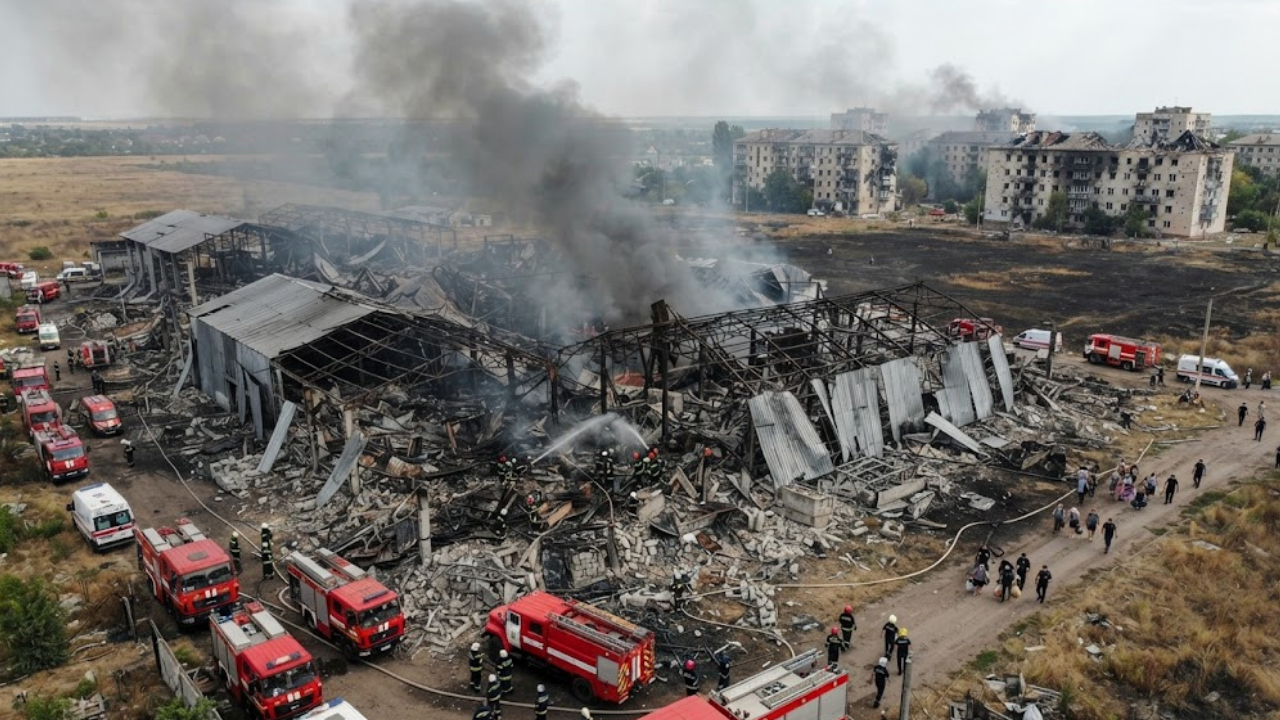
The toll from this round of Kyiv drone attacks is no longer abstract. A Russian drone that slammed into a military ammunition depot in the village of Myla, just west of the capital, has now killed at least 38 people – the deadliest single strike on Ukrainian soil this year, according to Zelensky and confirmed separately by Al Jazeera and the Kyiv Independent. Four people remained missing as of Sunday, and emergency crews were still clearing debris and defusing unexploded ordnance days after the blast.
What Happened in the Kyiv Drone Attacks This Week
The pattern has held for four straight days: waves of Shahed-type drones sent toward Kyiv and its suburbs for hours at a stretch, interspersed with glide bombs and, at times, ballistic missiles. Mayor Vitali Klitschko reported fires and drone debris landing across multiple districts on Thursday alone, including a cafe damaged near the city’s TV tower and smoke visible from several points in the capital. A day earlier, a 2-year-old girl was killed and roughly a dozen people were wounded in strikes on the capital itself, according to the Kyiv Independent, part of the same intensifying wave of Kyiv drone attacks.
Then, at around 8:10 p.m. local time on Friday, a drone struck the ammunition facility in Myla, roughly five kilometers from Kyiv along the Kyiv-Chop highway. What followed was not one explosion but a chain of them – artillery shells, mines and other munitions detonating in sequence, according to Ukraine’s Prosecutor General’s Office. Around 50 buildings, including a care home for elderly and disabled residents, were damaged, and more than 380 people had to be evacuated. Among those killed was Taras Didych, head of the local Dmytrivka community, who had rushed to the scene as a first responder.
For Liudmyla Polianychko, whose home sits near the depot, the aftermath meant walking through broken glass and finding artillery debris scattered across her lawn. “But we’re alive, and thank god for that,” she told the Japan Times on Sunday, describing days spent clearing shell fragments she hadn’t known were stored so close to her family.
A Pattern of Negligence, Officials Admit
What makes the Myla strike different from most Russian attacks this year is that Ukrainian officials are not only blaming Moscow – they are blaming themselves. It was the second time in two months that an ammunition site near Kyiv detonated after a strike, following a similar incident in Vyshneve in July. Prime Minister Serhiy Koretsky did not soften the criticism, writing on Telegram that repeating the same failure was “criminal negligence.”
Zelensky went further, ordering an investigation into why explosives were being kept so close to residential streets in the first place. “There are regulations: ammunition cannot be stored near houses or other residential buildings,” he said, adding that Ukraine’s Security Service and National Police had opened criminal proceedings over the matter. Russia’s defense ministry, for its part, said it had targeted a depot storing components for Ukrainian long-range drones – a claim that does not address why the site sat beside homes.
Food Warehouses and the Quiet Second Front
Beyond the headline casualty figures, the Kyiv drone attacks have been steadily eroding something more mundane: what Kyiv residents can actually buy at the supermarket. Missile strikes on food-distribution warehouses around the capital earlier this month killed at least six workers and knocked out supply routes for major grocery chains, according to reporting relayed by the New York Times. Barley, buckwheat, rice, dairy and even baby formula have grown harder to find on Kyiv shelves as a result – the kind of shortage the capital has not experienced since the earliest months of the full-scale invasion.
The pattern repeated in Boryspil, just outside Kyiv, where food warehouses and Red Cross facilities were damaged in a nine-hour overnight assault in mid-August that also struck a children’s hospital. By late August, the Washington Post was describing a broader Russian shift toward hitting shopping centers and food-distribution sites nationwide, warning that continued strikes could drive prices higher just as winter approaches.
None of this happens in isolation from the drone war unfolding elsewhere in the country. A shopping center in Kharkiv was hit the same week, a bus was struck in Kherson, and strikes reached Odesa – a spread of targets that Ukrainian officials say is designed less to achieve battlefield gains than to grind down ordinary life in cities far from the front line. HCN has tracked a similar pattern of strikes on civilian infrastructure elsewhere in this war, including the missile strike that hit the town center of Pechenihy in Kharkiv region.
Why This Story Deserves More Than a Passing Line
Wire coverage of the war often reduces weeks like this one to a single running statistic: drones launched, drones intercepted, casualties confirmed. What that framing misses is the layering effect – a family in Myla dealing with unexploded ordnance on their lawn while, a few kilometers away, a mother in Kyiv discovers there’s no baby formula left on the shelf, both consequences of the same seven-day bombardment behind these Kyiv drone attacks.
Ukraine has managed to intercept the vast majority of drones aimed at it throughout the war, but Zelensky has said the country now has roughly a tenth of the Patriot interceptors it needs, leaving slower-moving drones to be shot down while faster ballistic missiles increasingly get through – a shortfall that echoes the diplomatic stakes described in HCN’s earlier report on the key ideas in Zelensky’s peace plan.
The government’s response has shifted from purely defensive measures to adaptation: officials are now working out how to keep public transit and businesses running through prolonged air-raid alerts rather than shutting the city down every time sirens sound, Koretsky said this weekend – a tacit admission that the attacks are not expected to let up soon.
Current Status
As of Sunday, the Myla death toll stood at 38, with four people still unaccounted for and bomb-disposal teams continuing to work the site. Kyiv Oblast declared August 30 a day of mourning for the victims. Russia’s defense ministry has meanwhile signaled it is preparing further large-scale strikes on Ukraine’s energy infrastructure this autumn, raising fears of a repeat of last winter’s blackouts. No ceasefire talks are scheduled, and drone and missile activity over Kyiv continued into Sunday night.