Gaza City, September 2, 2026 – An Israeli raid in Gaza City aimed at detaining a senior Hamas commander triggered a barrage of airstrikes on Tuesday that left at least four Palestinians dead, including two children, according to Gaza health officials and multiple international news agencies. The operation, and the bombardment that followed it, unfolded against the backdrop of an increasingly fragile, nearly year-old ceasefire that has yet to deliver on promises of reconstruction or a broader Israeli withdrawal.
Timeline of the Israeli Raid in Gaza City
According to accounts gathered by Reuters and corroborated by Gaza’s Hamas-run government media office, an undercover Israeli unit entered western Gaza City on Tuesday with the specific goal of capturing a high-ranking Hamas figure. The mission was compromised mid-operation. Ismail al-Thawabta, who directs that media office, said the exposed unit was met with resistance, and Israeli aircraft then opened fire to shield the team’s retreat.
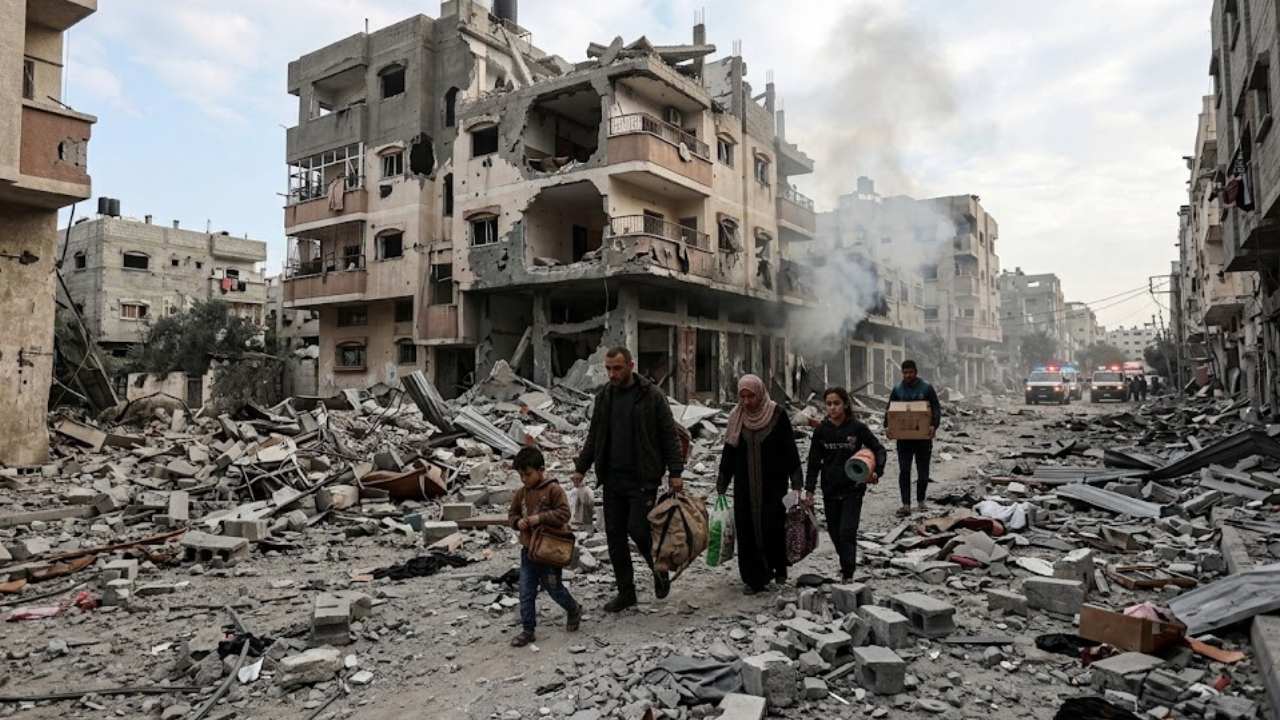
Residents in the Katiba district – a crowded pocket of western Gaza City where thousands of displaced families have taken shelter – told reporters that warplanes fired roughly a dozen missiles in quick succession. Two civilian vehicles were struck directly and left as scorched wreckage.
Medics said the dead included two children and a woman; some outlets put the toll as high as five, and a handful of reports specified three children rather than two. This discrepancy reflects how casualty figures in Gaza are frequently revised as hospitals confirm identities in the hours after a strike – a pattern documented repeatedly by Al Jazeera’s live coverage of the conflict.
Israeli Defence Minister Israel Katz confirmed only that a senior Hamas operative had been detained, without naming him or describing how the arrest was carried out. A separate Israeli security official, speaking on condition of anonymity, identified the man as the head of Hamas’s internal security apparatus. Some Israeli media outlets suggested the raid may not have been an IDF unit at all, but members of an Israeli-backed militia operating out of territory Israel still controls inside the enclave – a detail that, if confirmed, would complicate an already murky chain of command in post-ceasefire Gaza.
Speaking near the community of Netiv HaAsara, close to Gaza’s northern boundary, Katz defended the operation as consistent with standing policy. “This is our policy: we do not wait for threats, but rather pursue Hamas terrorists, thwart them, and destroy their terror infrastructure,” he said.
The Israeli raid in Gaza City is the latest in a string of arrest and strike operations that Israel has carried out inside the enclave since the ceasefire took hold, each one testing how much force the truce actually tolerates.
A Second, Separate Killing the Same Day
Hours after the Gaza City strikes, medics reported that a girl, identified as Israa al-Hissi, was killed and two other people wounded when Israeli forces opened fire east of Deir al-Balah in central Gaza – an incident distinct from the Gaza City raid but reported alongside it by several outlets.
This is not the first time the Deir al-Balah area has seen fatal Israeli fire since the truce began; for more background, see our earlier report on the Deir al-Balah strike. Israeli officials had not, as of this writing, offered a public account of Tuesday’s shooting, and it remains one of the unconfirmed details of the day that deserves separate scrutiny rather than being folded into the Gaza City toll.
Ceasefire Fault Lines: Why Gaza City Still Sees Raids
What makes Tuesday’s raid notable isn’t its scale – by the standards of the war that preceded it, a strike killing four people barely registers – but what it reveals about the state of a ceasefire now approaching its one-year mark. The US-brokered truce, which took hold in October 2025 after President Donald Trump’s peace framework was endorsed by the UN Security Council, halted the mass-casualty bombing campaigns that had defined the previous two years of war. It has not, however, stopped Israeli forces from carrying out near-daily strikes and arrest operations that Israel describes as pre-emptive security measures and that Hamas describes as violations.
The numbers underline the gap between the ceasefire’s promise and its practice. Gaza health officials say more than 1,300 Palestinians have been killed since the truce began, even as large-scale combat has ended; the Israeli military, for its part, reports four soldiers killed in militant attacks over the same period. Nickolay Mladenov, the Bulgarian diplomat leading the Board of Peace’s oversight of the deal, has described the truce as effectively stalled, telling reporters in Jerusalem earlier this year – per PBS NewsHour – that the dispute over Hamas’s disarmament is “not negotiable” from Israel’s side and is blocking everything else: troop withdrawals, the formation of a new Palestinian administration, and reconstruction funding that donor states have pledged but largely not transferred.
According to the UN Security Council’s own briefings on the matter, mediators including Egypt and Qatar continue to describe the Board of Peace as only an interim mechanism, underscoring how far the process remains from a durable settlement. By some estimates, barely half a percent of Gaza’s rubble has been cleared in the months since the guns officially fell silent.
This is the texture of what a “ceasefire” has come to mean in Gaza: not the absence of violence, but its rationing. Raids like Tuesday’s rarely make front-page news abroad precisely because they fall short of the scale that once defined the war – yet for the families in the Katiba district who lost relatives to missiles meant to cover a retreating unit, the distinction between “ceasefire” and “war” offers little comfort. It is this in-between state – too quiet to count as war, too violent to count as peace – that tends to escape sustained international attention, even as it continues to claim children’s lives. We explored this dynamic in more depth in our earlier analysis, Gaza Ceasefire: Point of No Return.
Human Impact of the Israeli Raid in Gaza City
Gaza’s health system, already stretched by two years of war and now compounded by the reconstruction stalemate, has had to absorb Tuesday’s casualties without the emergency capacity it once relied on from international field hospitals, many of which wound down operations after the ceasefire began. Displaced families in western Gaza City, already living in the kind of makeshift shelter that put them in the Katiba district in the first place, now face the added fear that even areas outside active combat zones are not insulated from an Israeli raid in Gaza City targeting Hamas figures.
What Comes Next
There is no indication that Tuesday’s raid or the fatalities it caused will formally derail the broader ceasefire framework, which has weathered similar incidents before. But it adds to a mounting toll that international mediators – the US, Egypt, and Qatar – will need to address if talks on Hamas’s disarmament and Gaza’s reconstruction are to move forward. For now, Gaza City’s residents are left waiting, as they have for months, for a “phase two” that keeps being delayed and a peace that, on days like Tuesday, still looks a great deal like war.